
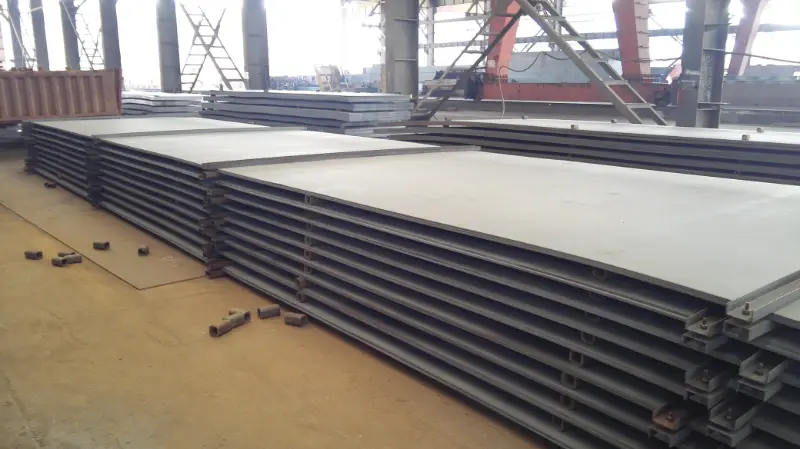
NK Grade E Shipbuilding Steel Plate
NK Grade E Shipbuilding Steel Plate: Properties, Equivalents & Applications
Comprehensive material data for NK Grade E shipbuilding steel plate: chemical composition, mechanical and physical properties, international equivalents, and application guidelines.
Hot rolling, normalizing, TMCP, welding, cutting, forming
- Phone : +8618037372205
- Email : [email protected]
- WhatsApp: Contact via Whtsapp
- WeChat: +8618037372205
NK Grade E Shipbuilding Steel Plate Introduction
NK Grade E is a normal strength hull structural steel defined by the rules of Nippon Kaiji Kyokai (ClassNK). It is widely used in shipbuilding and offshore structures due to its reliable mechanical properties, excellent weldability, and guaranteed low-temperature toughness. The grade designation E indicates a Charpy V-notch impact test temperature of -40 °C, ensuring suitability for cold environments. It is typically supplied in normalized or thermo-mechanically controlled processed (TMCP) condition. This material meets stringent requirements for chemical composition, tensile properties, and ductility, making it a fundamental grade for marine engineering.
NK Grade E Shipbuilding Steel Plate Chemical Composition
The chemical composition of NK Grade E is governed by ClassNK rules to achieve the required strength and toughness. The following table shows the ladle analysis limits. Grain refining elements such as aluminium must be present, and if other refining elements are used, their combined limit (Nb+V+Ti) is restricted. All values are maxima unless a range is given.
| Element | Standard Requirement (%) | Remarks |
|---|---|---|
| Carbon (C) | ≤ 0.18 | Max |
| Silicon (Si) | ≤ 0.50 | Max |
| Manganese (Mn) | 0.70 – 1.50 | Range |
| Phosphorus (P) | ≤ 0.035 | Max |
| Sulfur (S) | ≤ 0.035 | Max |
| Aluminium (Al, acid soluble) | ≥ 0.015 | Min; required for grain refinement |
| Niobium (Nb) | ≤ 0.05 | Optional refining element |
| Vanadium (V) | ≤ 0.10 | Optional refining element |
| Titanium (Ti) | ≤ 0.02 | Optional refining element |
| Nitrogen (N) | ≤ 0.009 | If not fixed by Ti or Al |
| Copper (Cu) | ≤ 0.35 | Residual |
| Chromium (Cr) | ≤ 0.20 | Residual |
| Nickel (Ni) | ≤ 0.40 | Residual |
| Molybdenum (Mo) | ≤ 0.08 | Residual |
NK Grade E Shipbuilding Steel Plate Thermal and Electrical Physical Properties
The physical properties listed below are typical for carbon-manganese structural steels and are applicable to NK Grade E. They are provided for general engineering calculations. Actual values may vary slightly depending on the exact composition and condition. The electrical resistivity and thermal properties are measured at room temperature unless stated otherwise.
| Property | Standard Requirement Value | Unit | Test Condition |
|---|---|---|---|
| Density (ρ) | 7.85 | g/cm³ | At 20 °C |
| Elastic Modulus (E) | 205 – 210 | GPa | At room temperature |
| Shear Modulus (G) | ~ 80 | GPa | At room temperature |
| Poisson's Ratio (ν) | 0.29 – 0.31 | – | At room temperature |
| Thermal Expansion Coefficient (α) | 11.7 × 10⁻⁶ | K⁻¹ | 20 – 100 °C |
| Thermal Expansion Coefficient (α) | 12.5 × 10⁻⁶ | K⁻¹ | 20 – 200 °C |
| Thermal Expansion Coefficient (α) | 13.2 × 10⁻⁶ | K⁻¹ | 20 – 300 °C |
| Thermal Conductivity (λ) | 50 – 55 | W/(m·K) | At 20 °C |
| Specific Heat Capacity (c) | 460 – 480 | J/(kg·K) | At 20 °C |
| Electrical Resistivity (ρₑ) | 0.20 – 0.25 × 10⁻⁶ | Ω·m | At 20 °C |
NK Grade E Shipbuilding Steel Plate Mechanical Properties
The mechanical properties are determined in accordance with NK regulations. Tensile tests are carried out on specimens taken from the product. Impact testing is performed on longitudinal Charpy V-notch specimens at -40 °C. Bending tests are required to demonstrate formability. Values vary with product thickness; separate rows are provided for different thickness ranges.
| Property | Standard Requirement | Unit | Test Condition / Remarks |
|---|---|---|---|
| Yield Strength (ReH), min | 235 | MPa | Thickness ≤ 50 mm |
| Yield Strength (ReH), min | 225 | MPa | Thickness > 50 to 70 mm |
| Yield Strength (ReH), min | 215 | MPa | Thickness > 70 to 100 mm |
| Tensile Strength (Rm) | 400 – 520 | MPa | All thicknesses |
| Elongation (A), min | 24 | % | Gauge length 5.65√So (proportional), thickness ≤ 50 mm |
| Elongation (A), min | 22 | % | Gauge length 200 mm, thickness ≤ 50 mm |
| Elongation (A), min | 23 | % | Gauge length 5.65√So, thickness > 50 to 100 mm |
| Bend Test | 180° without fracture | – | Bend mandrel diameter = 2 × specimen thickness (≤ 25 mm) |
| Bend Test | 180° without fracture | – | Bend mandrel diameter = 3 × specimen thickness (> 25 to 50 mm) |
| Impact Energy (KV2, long.), min | 27 | J | At -40 °C, longitudinal direction |
| Impact Energy (KV2, trans.), min | 20 | J | At -40 °C, transverse direction (if applicable) |
NK Grade E Shipbuilding Steel Plate Fully Equivalent Materials and Replaceable Grades
| Country / Region | Standard / Rules | Grade | Remarks |
|---|---|---|---|
| Norway/Germany | DNV GL Rules | E | Recognised equivalent by class societies |
| United Kingdom | Lloyd's Register (LR) Rules | E | Identical technical requirements |
| France | Bureau Veritas (BV) Rules | E | Interchangeable for shipbuilding |
| United States | ABS Rules | E | Same strength and toughness class |
| China | CCS Rules | E | Equivalent under harmonised Common Structural Rules |
| South Korea | Korean Register (KR) | E | Fully compatible |
| Italy | RINA Rules | E | Direct equivalent |
| International | ASTM A131 | Grade E | Chemical and mechanical properties aligned |
NK Grade E Shipbuilding Steel Plate Application Introduction
NK Grade E steel plate is specifically designed for critical structural components in ships and offshore installations, especially where good low-temperature toughness is required. It is ideal for hull envelopes, strength decks, and members exposed to cold climates or sea water. Typical processing includes cutting (plasma/laser), cold forming, welding (all common processes), and subsequent coating. The material is available in thicknesses from 6 mm up to 100 mm, in normalized or TMCP condition, ensuring homogeneous properties.
Product Applications: Ship hulls and superstructures, Deck plates and bottom plates, Bulkheads and tank walls, Reinforcement elements (stiffeners, web frames), Brackets, seats, and foundation plates
Processed into products: Shell plates (side, bilge, bottom), Main deck and strength deck plating, Longitudinal and transverse stiffeners, Web frames and girders, Structural brackets and connecting plates, Hatch coamings and side frames, Ballast tank boundaries
Application industries: Shipbuilding (commercial, naval, passenger), Offshore oil & gas platforms, Marine renewable energy (wind turbine foundations), Port and harbour construction
NK Grade E Shipbuilding Steel Plate Similar / Alternative Materials with Close Performance
| Country / Region | Standard / Rules | Grade | Remarks |
|---|---|---|---|
| International | DNV/LR/BV/ABS | Grade D | Same strength (235 MPa), impact tested at -20 °C instead of -40 °C; suitable where lower toughness is acceptable |
| Europe | EN 10025-2 | S235J2 | Structural steel with 235 MPa yield, impact at -20 °C, non-marine standard; requires verification for hull applications |
| Japan | JIS G3106 | SM400B | Welded structural steel with 245 MPa yield, impact at 0 °C; limited for shipbuilding unless specially approved |
| International | ASTM A36 | A36 | General structural steel, 250 MPa yield, no mandatory low-temperature impact; not direct substitute for marine grade E |
Notes:
NK Grade E must be produced by an NK-approved manufacturer and is subject to survey and marking according to ClassNK rules. For plates ordered with through-thickness properties, additional requirements as per NK Rule Part K Annex K1 apply. The normalising or TMCP delivery condition should be specified at the time of order. This steel possesses excellent weldability with standard low-hydrogen procedures and preheat requirements are minimal for moderate thicknesses.
- Share



