
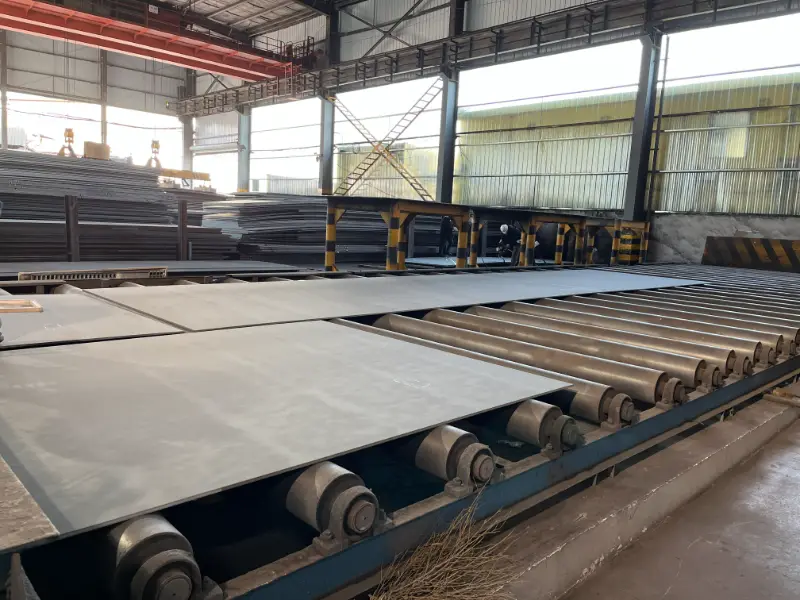
NK Grade A32 Shipbuilding Steel Plate
NK Grade A32 Shipbuilding Steel Plate - High-Strength Hull Structural Steel
Comprehensive data on NK Grade A32 shipbuilding steel plate: chemical composition, mechanical properties, thermal & electrical physical properties, international equivalents, and applications in hull construction and offshore engineering.
Cutting, welding, bending, forming, machining
- Phone : +8618037372205
- Email : [email protected]
- WhatsApp: Contact via Whtsapp
- WeChat: +8618037372205
NK Grade A32 Shipbuilding Steel Plate Introduction
NK Grade A32 is a high-strength hull structural steel plate certified by Nippon Kaiji Kyokai (ClassNK). It meets the requirements of IACS UR W11 for higher-strength ship steels, offering a minimum yield strength of 315 MPa (for thickness ≤50 mm) and excellent weldability with good low-temperature toughness. Key features:
- Excellent strength-to-weight ratio for shipbuilding
- Reliable notch toughness at 0°C (longitudinal impact energy ≥31 J)
- Good formability and weldability, supplied in normalized or TMCP condition
- Widely used in hull plates, decks, and structural members of ships and offshore structures
Typical thickness range up to 100 mm, with guaranteed properties through controlled rolling and microalloying. The A
designation indicates impact test temperature of 0°C.
NK Grade A32 Shipbuilding Steel Plate Chemical Composition
Element limits according to NK Rules and IACS UR W11 for Grade A32. Main alloying and microalloying elements are given. Grain refinement is achieved through additions of Al, Nb, V, and/or Ti. The total contents of these elements can be adjusted based on thickness and manufacturing route. Residual elements like Cu, Cr, Ni, Mo are limited to ensure good weldability and toughness.
| Element | Standard Value (max unless range) | Remarks |
|---|---|---|
| C | ≤0.18 | |
| Mn | 0.90–1.60 | |
| Si | ≤0.50 | |
| P | ≤0.035 | |
| S | ≤0.035 | |
| Al (acid soluble) | ≥0.015 | Total Al when used for grain refinement |
| Nb | 0.02–0.05 | If added |
| V | 0.05–0.10 | If added |
| Ti | ≤0.02 | If added |
| Cu | ≤0.35 | If added |
| Cr | ≤0.20 | If added |
| Ni | ≤0.40 | If added |
| Mo | ≤0.08 | If added |
| N | ≤0.009 | If nitrogen-binding elements (Al, Ti) are present |
NK Grade A32 Shipbuilding Steel Plate Thermal and Electrical Physical Properties
These physical properties are representative of a C-Mn high-strength structural steel similar to Grade A32. Actual values may vary slightly with specific chemical composition and heat treatment. Data are provided for general engineering design and are not mandatory acceptance criteria.
| Property | Typical Value | Unit | Test Condition |
|---|---|---|---|
| Density (ρ) | 7.85 | g/cm³ | 20°C |
| Modulus of elasticity (E) | 205 | GPa | 20°C |
| Shear modulus (G) | 80 | GPa | 20°C |
| Poisson ratio (ν) | 0.29 | - | 20°C |
| Thermal expansion coefficient (α) | 11.7 | 10⁻⁶/K | 20–100°C |
| Thermal conductivity (λ) | 52 | W/(m·K) | 20°C |
| Specific heat capacity | 486 | J/(kg·K) | 20°C |
| Electrical resistivity (ρₑ) | 0.22 | 10⁻⁶ Ω·m | 20°C |
NK Grade A32 Shipbuilding Steel Plate Mechanical Properties
Minimum tensile and impact properties based on NK Rules and IACS UR W11 for Grade A32. Test specimens are taken transverse to the rolling direction for tensile tests, and longitudinal (or transverse if agreed) for impact tests. Bend test requirements apply to thickness ≤50 mm. Multiple entries for different thickness ranges are displayed when the property varies with thickness.
| Property | Standard Requirement | Unit | Test Condition / Remarks |
|---|---|---|---|
| Yield Strength (ReH) | ≥315 | MPa | Thickness ≤50 mm |
| Yield Strength (ReH) | ≥305 | MPa | Thickness 50 < t ≤70 mm |
| Yield Strength (ReH) | ≥295 | MPa | Thickness 70 < t ≤100 mm |
| Tensile Strength (Rm) | 440–590 | MPa | All thicknesses |
| Elongation (A5) | ≥22 | % | Thickness ≤50 mm, gauge length 5.65√S₀ |
| Elongation (A5) | ≥21 | % | Thickness 50 < t ≤70 mm |
| Elongation (A5) | ≥20 | % | Thickness 70 < t ≤100 mm |
| Charpy V-notch impact (KV, longitudinal) | ≥31 (average) | J | 0°C; individual minimum 22 J |
| Charpy V-notch impact (KV, transverse) | ≥22 (average) | J | 0°C; individual minimum 16 J (if agreed) |
| Bend test (180°) | No cracks | - | Thickness ≤25 mm, bend diameter = 2t |
| Bend test (180°) | No cracks | - | Thickness 25 < t ≤50 mm, bend diameter = 3t |
NK Grade A32 Shipbuilding Steel Plate Fully Equivalent Material Standards and Substitutable Grades
| Country / Region | Standard | Grade | Remarks |
|---|---|---|---|
| Japan | NK Rules | Grade A32 | Base specification |
| International | IACS UR W11 | AH32 / A32 | Unified requirement for higher strength ship steel |
| USA | ABS Rules | ABS A32 | Same strength and toughness (0°C impact) |
| Norway / Germany | DNV Rules | DNV A32 | Equivalent (formerly DNV GL) |
| UK | LR Rules | LR A32 | Equivalent |
| France | BV Rules | BV A32 | Equivalent |
| China | CCS Rules | CCS A32 (AH32) | Equivalent; AH32 is commonly used in CCS |
| Korea | KR Rules | KR A32 | Equivalent |
| Italy | RINA Rules | RINA A32 | Equivalent |
| Russia | RS Rules | RS A32 | Equivalent |
| International (ISO) | ISO 4950-2 | E315C | Comparable; 0°C impact min 27 J, closely matching A32 |
NK Grade A32 Shipbuilding Steel Plate Application Introduction
NK Grade A32 is specifically designed for welded structures in shipbuilding and marine environments. Its balanced composition and controlled rolling provide good toughness at 0°C, making it suitable for normal service conditions. Typical use involves structural components subject to moderate loading and where higher strength can reduce weight and increase payload. It is also used in offshore structural members when class certification is required.
Product Applications: Cargo ships (bulk carriers, container ships), Oil tankers and chemical carriers, Roll-on/roll-off (RoRo) vessels, Offshore platforms and FPSOs, Naval auxiliary vessels, Barges and floating docks
Processed into products: Hull plates and shell plating, Main decks and strength decks, Longitudinal and transverse bulkheads, Stiffeners, girders, and floor plates, Web frames and brackets, Hatch coamings and covers, Foundations for machinery and deck equipment
Application industries: Shipbuilding, Offshore & Marine Engineering, Port & Harbour Construction (e.g., lock gates, fenders), Bridge Construction (where class-certified steel is specified)
NK Grade A32 Shipbuilding Steel Plate Similar / Nearly Equivalent Material Recommendations
| Country / Region | Standard | Grade | Remarks |
|---|---|---|---|
| All major class societies | IACS UR W11 | D32 | Same strength (315 MPa min); impact at -20°C – superior toughness |
| All major class societies | IACS UR W11 | E32 | Same strength; impact at -40°C – excellent low-temperature toughness |
| All major class societies | IACS UR W11 | A36 | Higher strength (355 MPa min); impact at 0°C – suitable when higher strength is acceptable |
| Japan | JIS G3106 | SM490A | Welding structural steel; min yield 325 MPa, tensile 490–610 MPa; not ship-classed, but used for general structures |
Notes:
Actual chemical composition may be adjusted within limits to achieve required mechanical properties for specific thicknesses. Delivery condition (N or TMCP) and impact testing direction must be agreed upon at the time of order. Additional requirements such as Z-direction tensile testing, ultrasonic examination, or higher toughness at lower temperatures may be specified by the buyer. For thicknesses above 50 mm, normalizing heat treatment is commonly applied. Detailed NK rules and supplemental requirements should be consulted for critical applications.
- Share



