
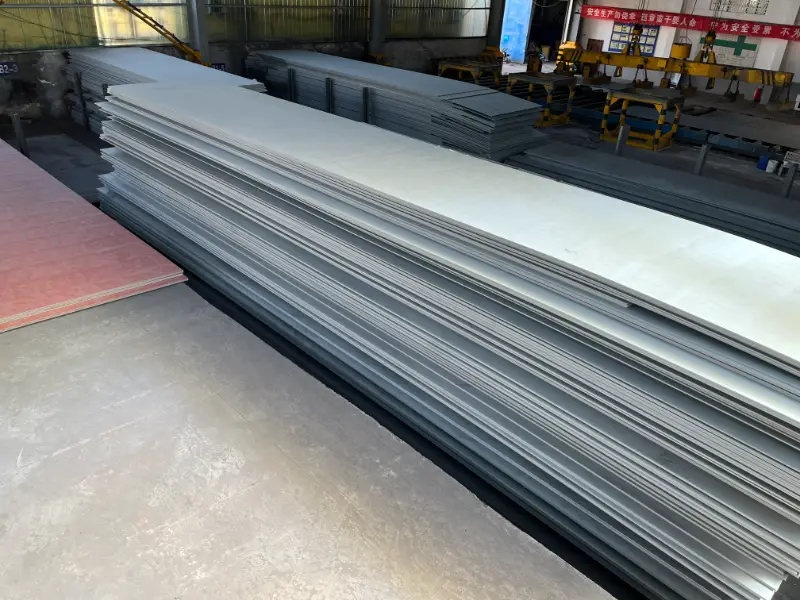
NK Grade D32 Shipbuilding Steel Plate
NK Grade D32 Shipbuilding Steel Plate: High Strength for Marine Structures
Comprehensive data for NK Grade D32 shipbuilding steel plate: chemical composition, mechanical and physical properties, equivalent grades, and application guide.
Hot rolling, controlled rolling (TMCP), normalizing, welding, cutting, forming, machining
- Phone : +8618037372205
- Email : [email protected]
- WhatsApp: Contact via Whtsapp
- WeChat: +8618037372205
NK Grade D32 Shipbuilding Steel Plate Introduction
NK Grade D32 is a high-strength structural steel plate for shipbuilding, certified by ClassNK (Nippon Kaiji Kyokai). It is designed for welded construction of hulls and marine structures, offering a minimum yield strength of 315 MPa and excellent toughness at -20°C. The 'D' designation indicates a required Charpy impact energy of 31 J (longitudinal) at -20°C. Typical applications include decks, bottom and side shells, and offshore platforms. This grade complies with the IACS Unified Requirements W28 for high-strength hull structural steel, ensuring global recognition and interchangeability with other IACS classification societies.
NK Grade D32 Shipbuilding Steel Plate Chemical Composition
The chemical composition of NK Grade D32 is specified to ensure weldability and toughness. Key elements include carbon, manganese, silicon for strength, with strict limits on phosphorus and sulfur for cleanliness. Grain-refining elements such as aluminium, niobium, vanadium, and titanium may be added singly or in combination to achieve fine ferrite grain size. Specified values are based on ClassNK Rules Part K, Table M10.12, derived from IACS UR W28.
| Element | Standard Value (%) | Remarks |
|---|---|---|
| C | ≤ 0.18 | Ladle analysis |
| Si | ≤ 0.50 | |
| Mn | 0.90 – 1.60 | |
| P | ≤ 0.035 | |
| S | ≤ 0.035 | |
| Al (acid soluble) | ≥ 0.015 | Total Al if Al added |
| Nb | 0.02 – 0.05 | Optional, alone or in combination |
| V | 0.05 – 0.10 | Optional, alone or in combination |
| Ti | ≤ 0.02 | Optional, alone or in combination |
| Cu | ≤ 0.35 | Residual |
| Cr | ≤ 0.20 | Residual |
| Ni | ≤ 0.40 | Residual |
| Mo | ≤ 0.08 | Residual |
| N | ≤ 0.009 | Residual, if not controlled by Al |
NK Grade D32 Shipbuilding Steel Plate Thermal and Electrical Physical Properties
Typical physical properties for high-strength shipbuilding steel at room temperature. Values are approximate and applicable to the grade under normal conditions. Density, elastic moduli, thermal expansion, and thermal conductivity are important for design calculations involving welding, heat treatment, and service in marine environments.
| Property | Typical Value | Unit | Test Condition |
|---|---|---|---|
| Density (ρ) | 7850 | kg/m³ | 20°C |
| Modulus of elasticity (E) | 205 | GPa | 20°C |
| Shear modulus (G) | 80 | GPa | 20°C |
| Poisson's ratio (ν) | 0.29 | – | 20°C |
| Thermal expansion coefficient (α) | 12.0 × 10⁻⁶ | /K | 20–100°C |
| Thermal expansion coefficient (α) | 12.5 × 10⁻⁶ | /K | 20–200°C |
| Thermal expansion coefficient (α) | 13.2 × 10⁻⁶ | /K | 20–400°C |
| Thermal conductivity (λ) | 50 | W/(m·K) | 20°C |
| Thermal conductivity (λ) | 47 | W/(m·K) | 200°C |
| Thermal conductivity (λ) | 41 | W/(m·K) | 400°C |
| Specific heat capacity (cp) | 460 | J/(kg·K) | 20–100°C |
| Specific heat capacity (cp) | 500 | J/(kg·K) | 100–200°C |
| Specific heat capacity (cp) | 550 | J/(kg·K) | 200–500°C |
| Electrical resistivity (ρe) | 0.22 | μΩ·m | 20°C |
NK Grade D32 Shipbuilding Steel Plate Mechanical Properties
Mechanical properties are determined on test specimens taken from finished plates in delivery condition. Values vary with product thickness (t) as shown. Yield strength and tensile strength are tested in transverse direction unless otherwise agreed. Charpy V-notch impact tests are carried out at -20°C. Requirements conform to ClassNK Rules and IACS UR W28.
| Property | Required Value | Unit | Test Condition |
|---|---|---|---|
| Yield strength (ReH) | ≥ 315 | MPa | t ≤ 100 mm |
| Tensile strength (Rm) | 440 – 590 | MPa | t ≤ 100 mm |
| Elongation (A5) | ≥ 22 | % | Gauge length 5.65√So, t ≤ 50 mm |
| Elongation (A5) | ≥ 21 | % | 50 < t ≤ 70 mm |
| Elongation (A5) | ≥ 20 | % | 70 < t ≤ 100 mm |
| Charpy V-notch impact energy (KV, longitudinal) | ≥ 31 | J | -20°C, test on standard 10×10 mm specimen |
| Charpy V-notch impact energy (KV, transverse) | ≥ 22 | J | -20°C, if required by specification |
NK Grade D32 Shipbuilding Steel Plate Fully Equivalent Materials & Recommended Substitute Grades
| Country/Region | Standard | Grade/Designation | Remarks |
|---|---|---|---|
| International (IACS) | IACS UR W28 | High Strength Hull Structural Steel D32 | Base standard recognized by all IACS members |
| USA | ABS Rules | ABS D32 | American Bureau of Shipping – identical requirements |
| Norway/Germany | DNV Rules | DNV D32 | Det Norske Veritas – fully equivalent |
| UK | LR Rules | LR D32 | Lloyd's Register – fully equivalent |
| France | BV Rules | BV D32 | Bureau Veritas – fully equivalent |
| China | CCS Rules | CCS D32 | China Classification Society – fully equivalent |
| Korea | KR Rules | KR D32 | Korean Register – fully equivalent |
| Italy | RINA Rules | RINA D32 | Registro Italiano Navale – fully equivalent |
| Japan | NK Rules | NK D32 | The analyzed material itself |
NK Grade D32 Shipbuilding Steel Plate Application Introduction
NK Grade D32 is widely employed in the shipbuilding and offshore industry where high strength and reliable low-temperature toughness are required. Its balanced composition and controlled processing ensure good weldability, making it suitable for automated welding in shipyards. Typical service conditions range from -20°C to +40°C. The steel can be formed, cut, and welded using standard shipyard practices.
Product Applications: Ship hulls – main deck, side shell, bottom shell, bulkheads, Hatch covers and coamings, Offshore platform decks and legs, Caissons and structural elements in marine terminals
Processed into products: Stiffeners for shell plating, Longitudinal and transverse framing members, Deck plates and stringers, Bilge keels and rudder horns, Crane pedestals and heavy-lift foundations (offshore)
Application industries: Shipbuilding (merchant ships, naval vessels), Offshore engineering (jack-up rigs, floating platforms, wind turbine substructures), Marine port and harbor structures, Bridge construction (if certified), Pressure vessel and storage tank (limited, when class-approved)
NK Grade D32 Shipbuilding Steel Plate Similar / Nearby Alternative Materials
| Country/Region | Standard | Grade/Designation | Remarks |
|---|---|---|---|
| International (IACS) | IACS UR W28 | D36 | Next higher strength level: min. yield 355 MPa; similar impact test temperature (-20°C) – may be used if higher strength is acceptable |
| International (IACS) | IACS UR W28 | A32 | Same strength but higher impact test temperature (0°C) – less stringent toughness, not generally interchangeable for D32 application where -20°C is required |
| International (IACS) | IACS UR W28 | E32 | Same strength but lower impact test temperature (-40°C) – superior toughness, can replace D32 in critical structures |
| International (IACS) | IACS UR W11 | D (Normal Strength) | Normal strength hull steel with min. yield 235 MPa; not a strength replacement but sometimes considered where strength demands are low |
Notes:
- For thicknesses above 100 mm, special agreement is required for mechanical property verification.
- Welding consumables should match the strength and toughness of D32; preheat may be necessary for thick sections or high restraint.
- Ultrasonic testing (UT) and other NDT are typically specified for critical applications.
- Where improved corrosion resistance is needed, additional surface coatings or cathodic protection are employed, as the steel itself is not inherently corrosion resistant.
- Share



