
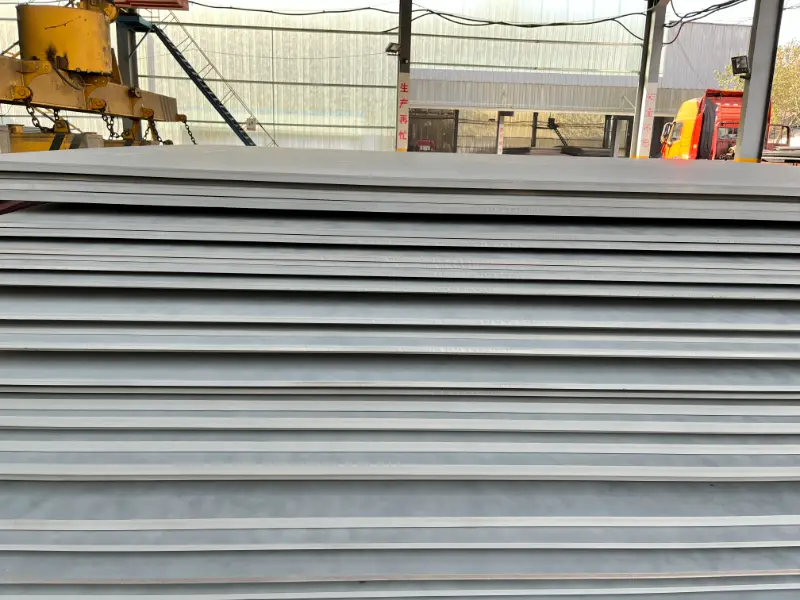
NK Grade E32 Shipbuilding Steel
NK Grade E32 Shipbuilding Steel | High Strength Marine Plate Properties & Equivalents
Explore the comprehensive properties of NK Grade E32 shipbuilding steel, including chemical composition, mechanical and thermo-electrical performances, equivalent grades, and typical applications for marine structures.
Welding, cutting, cold forming, hot forming, machining, and controlled rolling
- Phone : +8618037372205
- Email : [email protected]
- WhatsApp: Contact via Whtsapp
- WeChat: +8618037372205
NK Grade E32 Shipbuilding Steel Introduction
NK Grade E32 is a high-strength hull structural steel classified under the Nippon Kaiji Kyokai (ClassNK) rules. It belongs to the normalized or thermo-mechanically controlled processed (TMCP) fine-grain steel grade with a minimum yield strength of 315 MPa and tensile strength in the range of 440–590 MPa. The steel exhibits excellent weldability, good low-temperature toughness and is specifically designed for use in shipbuilding and offshore structures. It is typically supplied in normalized, TMCP, or quenched and tempered condition depending on thickness and end-user requirements.
NK Grade E32 Shipbuilding Steel Chemical Composition
Chemical composition as per ClassNK Rules, ensuring fine-grain practice with addition of grain refining elements.
- Ladle analysis limits for C, Mn, Si, P, S, and grain-refining elements are given.
- Carbon Equivalent (CEV) shall not exceed 0.38% for thicknesses ≤ 50 mm, calculated by IEC formula.
| Element | Specified Value (max or range) | Remarks |
|---|---|---|
| C (Carbon) | ≤ 0.18 | Ladle analysis |
| Mn (Manganese) | 0.90 – 1.60 | Ladle analysis |
| Si (Silicon) | ≤ 0.50 | Ladle analysis |
| P (Phosphorus) | ≤ 0.035 | Ladle analysis |
| S (Sulphur) | ≤ 0.035 | Ladle analysis |
| Al (Acid-soluble aluminium) | ≥ 0.015 | When aluminium is used as grain refiner |
| Nb (Niobium) | 0.02 – 0.05 | When added singly |
| V (Vanadium) | 0.05 – 0.10 | When added singly |
| Ti (Titanium) | 0.02 – 0.10 (or ≤ 0.02 if combined) | When added singly; max ≤ 0.02 when combined with other grain refiners |
| Ni (Nickel) | ≤ 0.40 | Residual content |
| Cr (Chromium) | ≤ 0.20 | Residual content |
| Mo (Molybdenum) | ≤ 0.08 | Residual content |
| Cu (Copper) | ≤ 0.35 | Residual content |
| CEV (Carbon Equivalent) | ≤ 0.38 | For t ≤ 50 mm; CEV = C + Mn/6 + (Cr+Mo+V)/5 + (Ni+Cu)/15 |
NK Grade E32 Shipbuilding Steel Thermal & Electrical Physical Properties
The following physical properties are typical for low-carbon high-strength structural steel. They are not mandatory specification values but serve as engineering references at room temperature unless otherwise stated.
| Property | Typical Value | Unit | Test Condition / Temperature |
|---|---|---|---|
| Density (ρ) | 7.85 | g/cm³ | 20°C |
| Modulus of Elasticity (E) | 200 – 210 | GPa | 20°C |
| Shear Modulus (G) | 78 – 82 | GPa | 20°C |
| Poisson's Ratio (ν) | 0.28 – 0.30 | – | 20°C |
| Thermal Expansion Coefficient (α) | 11.5 – 12.5 | 10⁻⁶/K | 20 – 100°C |
| Thermal Expansion Coefficient (α) | 12.5 – 13.5 | 10⁻⁶/K | 20 – 300°C |
| Thermal Conductivity (λ) | 50 – 55 | W/(m·K) | 20°C |
| Thermal Conductivity (λ) | 45 – 50 | W/(m·K) | 100°C |
| Specific Heat Capacity (c) | 420 – 480 | J/(kg·K) | 20°C |
| Electrical Resistivity (ρ_e) | 0.20 – 0.25 | μΩ·m | 20°C |
NK Grade E32 Shipbuilding Steel Mechanical Properties
Mechanical properties according to ClassNK Rules for NK E32 steel plates, based on thickness (t) categories. Transverse tensile and longitudinal impact test results are typical for normalized or TMCP condition.
| Property | Specified Value | Unit | Test Condition |
|---|---|---|---|
| Yield Strength (ReH) | ≥ 315 | MPa | t ≤ 50 mm, transverse |
| Yield Strength (ReH) | ≥ 315 | MPa | 50 < t ≤ 70 mm, transverse |
| Yield Strength (ReH) | ≥ 315 | MPa | 70 < t ≤ 100 mm, transverse |
| Tensile Strength (Rm) | 440 – 590 | MPa | t ≤ 50 mm, transverse |
| Tensile Strength (Rm) | 440 – 590 | MPa | t > 50 mm, transverse |
| Elongation (A) | ≥ 22 | % | t ≤ 50 mm, gauge length 5.65√So, transverse |
| Elongation (A) | ≥ 22 | % | 50 < t ≤ 70 mm, transverse |
| Elongation (A) | ≥ 22 | % | 70 < t ≤ 100 mm, transverse |
| Charpy V-notch Impact Energy (KV) | ≥ 24 (average), ≥ 17 (single) | J | t ≤ 50 mm, longitudinal, -40°C |
| Charpy V-notch Impact Energy (KV) | ≥ 24 (average), ≥ 17 (single) | J | 50 < t ≤ 70 mm, longitudinal, -40°C |
| Charpy V-notch Impact Energy (KV) | ≥ 27 (average), ≥ 20 (single) | J | 70 < t ≤ 100 mm, longitudinal, -40°C |
| Bend Test (d = bend diameter, a = specimen thickness) | No cracks | – | d = 3a, 180° bend, t ≤ 25 mm |
| Bend Test | No cracks | – | d = 3a, 180° bend, 25 < t ≤ 50 mm |
| Bend Test | No cracks | – | d = 3a, 180° bend, t > 50 mm, as agreed |
NK Grade E32 Shipbuilding Steel Completely Equivalent Material Standards and Substitute Grades
| Country/Region | Standard | Grade | Remarks |
|---|---|---|---|
| International | ABS (American Bureau of Shipping) | EH32 | Identical strength level and impact test at -40°C |
| International | DNV (Det Norske Veritas) | E32 | Same mechanical and chemical requirements |
| International | BV (Bureau Veritas) | E32 | Similar properties, fine-grain steel |
| International | LR (Lloyd's Register) | EH32 | High strength hull steel, -40°C impact |
| International | CCS (China Classification Society) | E32 | Conforms to same classification rules |
| International | RINA (Registro Italiano Navale) | E32 | Same specification as NK E32 |
| International | KR (Korean Register) | EH32 | Same strength and toughness class |
NK Grade E32 Shipbuilding Steel Application Introduction
NK E32 steel plates are widely used in marine and offshore engineering where a combination of high strength, good weldability and reliable low-temperature impact toughness is required.
- The fine-grain structure ensures resistance to brittle fracture in cold environments.
- It can be fabricated using standard shipyard methods: cutting, forming, welding.
Product Applications: Hull plates and stiffeners, Deck and bottom plating, Bulkhead and side shell panels, Offshore platform topside modules, Floating production storage and offloading (FPSO) hulls
Processed into products: Hull girder webs and flanges, Bracket plates and floor plates, Keel plates, Longitudinal and transverse frames, Superstructure panels and hatch coamings, Pontoon structures for floating docks
Application industries: Shipbuilding (commercial vessels, naval ships), Offshore oil & gas platforms (structural decks, modules), Marine cranes and lifting equipment, Port machinery and bulkheads, Wind turbine support structures (offshore monopiles, transition pieces)
NK Grade E32 Shipbuilding Steel Similar/Comparable Substitute Material Recommendations
| Country/Region | Standard | Grade | Remarks |
|---|---|---|---|
| International | NK | E36 | Higher strength version (min yield 355 MPa), may be used with reduced thickness but design recheck needed |
| International | EN 10025 | S355ML/S460ML | TMCP structural steels with similar toughness at low temperature, need to verify marine environment suitability |
| International | ASTM | A131 EH32 | ASTM standard for shipbuilding steel, equivalent to ABS EH32, very close properties |
| International | JIS | SM490YA | Japanese structural steel, yield ~365 MPa, good low-temperature toughness, not specifically ship grading, check impact temperature |
Notes:
Delivery Conditions: Plates are supplied in normalized (N), TMCP, or normalized rolled (NR) condition depending on thickness and application. Supplementary requirements such as Z-direction tensile test (through-thickness properties) or extra-low sulphur content may be specified for improved lamellar tearing resistance. ClassNK certificates (material test certificate 3.1 or 3.2) are issued after mandatory testing.
- Share



