
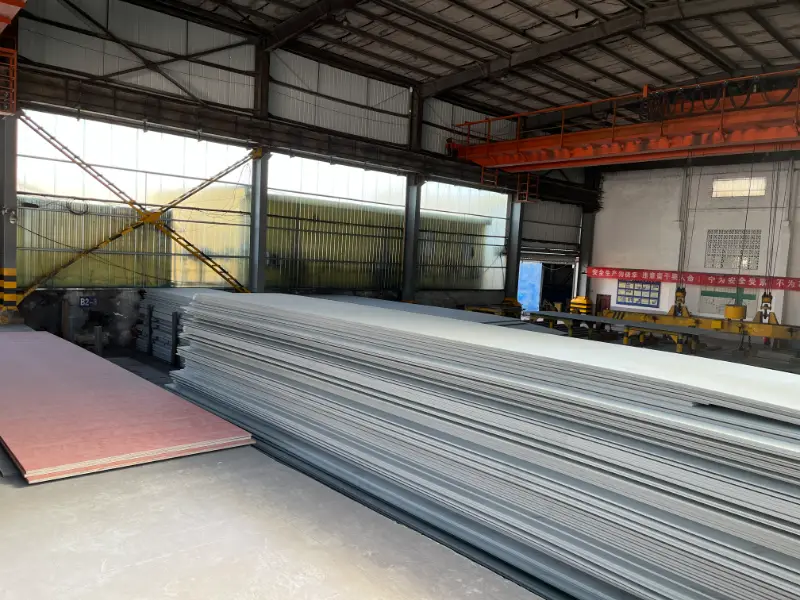
NK Grade F32 Shipbuilding Steel Plate
NK Grade F32 Shipbuilding Steel Plate: High-Strength Hull Structural Steel for Arctic Environments
NK Grade F32 is a high-strength shipbuilding steel plate certified by ClassNK with a minimum yield strength of 315 MPa, designed for critical structural applications in ship hulls operating at low temperatures. It offers excellent weldability and superior notch toughness at -60°C.
Hot rolling, Normalizing (N), Thermo-Mechanical Controlled Processing (TMCP), Quenching and Tempering (Q&T) upon agreement
- Phone : +8618037372205
- Email : [email protected]
- WhatsApp: Contact via Whtsapp
- WeChat: +8618037372205
NK Grade F32 Shipbuilding Steel Plate Introduction
NK Grade F32 is a normalized or thermo-mechanically controlled processed (TMCP) high-strength structural steel plate governed by the rules of Nippon Kaiji Kyokai (ClassNK). As a grade under the "F" category, it guarantees minimum impact energy of 27 J at an ultra-low temperature of -60 °C, making it suitable for critical hull structures in ice-going vessels and offshore platforms operating in harsh, frigid environments. Key characteristics include:
- Minimum yield strength of 315 MPa, providing a high strength-to-weight ratio.
- Excellent weldability with a low carbon equivalent (typically ≤0.38% for thickness ≤50 mm), eliminating the need for extensive preheating.
- Superior ductility and through-thickness properties, ensuring structural integrity under dynamic loads.
NK Grade F32 Shipbuilding Steel Plate Chemical Composition
The chemical composition adheres to the ClassNK rules for Grade F32 high-strength steel. The steel is fully killed and made with fine grain practice. Key alloying elements such as niobium (Nb), vanadium (V), and/or titanium (Ti) may be added individually or in combination to refine grain size and improve strength and toughness. The carbon equivalent (Ceq) is strictly controlled to ensure excellent field weldability, typically not exceeding 0.38% for thicknesses ≤ 50 mm.
| Element | Standard Value (%) | Remarks |
|---|---|---|
| Carbon (C) | ≤0.16 | Ladle analysis |
| Silicon (Si) | ≤0.50 | Fully killed steel |
| Manganese (Mn) | 0.90 - 1.60 | Sufficient for strength and toughness |
| Phosphorus (P) | ≤0.025 | Maximum limit |
| Sulfur (S) | ≤0.025 | Maximum limit |
| Chromium (Cr) | ≤0.20 | Residual element limit |
| Nickel (Ni) | ≤0.40 | Residual element limit |
| Molybdenum (Mo) | ≤0.08 | Residual element limit |
| Copper (Cu) | ≤0.35 | Residual element limit |
| Aluminum (Al) acid soluble | ≥0.015 | Minimum for grain refining |
| Niobium (Nb) | 0.02 - 0.05 | Micro-alloying element (grain refinement) |
| Vanadium (V) | 0.05 - 0.10 | Micro-alloying element (precipitation strengthening) |
| Titanium (Ti) | ≤0.02 | Grain refinement, if added |
| Nitrogen (N) | ≤0.009 | When Al is present; ≤0.012 when no Al |
| Carbon Equivalent (Ceq) | ≤0.38 | For thickness ≤50 mm. Ceq = C + Mn/6 + (Cr+Mo+V)/5 + (Ni+Cu)/15 |
NK Grade F32 Shipbuilding Steel Plate Thermal and Electrical Physical Properties
Physical properties are typical for normalized or TMCP micro-alloyed carbon-manganese structural steels. These values assist in engineering design calculations such as thermal stress analysis and welding procedure development. Note: The properties are influenced by temperature and microstructure. Data provided at room temperature unless otherwise stated.
| Property | Standard Required Value | Unit | Test Conditions / Remarks |
|---|---|---|---|
| Density (ρ) | ≈7.85 | g/cm³ | Room temperature |
| Elastic Modulus (E) | ≈205 | GPa | Room temperature (Tensile modulus) |
| Shear Modulus (G) | ≈80 | GPa | Calculated from E and Poisson's ratio |
| Poisson's Ratio (ν) | ≈0.29 | - | Typical for mild/low-alloy steels |
| Thermal Expansion Coefficient (α) | ≈11.7 ×10⁻⁶ | K⁻¹ | Mean value, 20 °C to 100 °C |
| Thermal Expansion Coefficient (α) | ≈12.5 ×10⁻⁶ | K⁻¹ | Mean value, 20 °C to 200 °C |
| Thermal Expansion Coefficient (α) | ≈13.6 ×10⁻⁶ | K⁻¹ | Mean value, 20 °C to 400 °C |
| Thermal Conductivity (λ) | ≈51 | W/(m·K) | At 20 °C |
| Thermal Conductivity (λ) | ≈47 | W/(m·K) | At 200 °C |
| Thermal Conductivity (λ) | ≈42 | W/(m·K) | At 400 °C |
| Specific Heat Capacity (cp) | ≈460 | J/(kg·K) | Room temperature |
| Electrical Resistivity (ρ_e) | ≈0.20 - 0.25 | µΩ·m | Room temperature, typical ferritic steel |
NK Grade F32 Shipbuilding Steel Plate Mechanical Properties
Mechanical properties are validated as per ClassNK rules on standard transverse test specimens. The values apply for plate thicknesses ≤ 100 mm. Key highlights:
- The specified minimum yield strength of 315 MPa ensures structural resilience and high load-bearing capacity.
- Charpy V-notch impact tests at -60 °C are mandatory, confirming the steel's fitness in the ductile-to-brittle transition region well below typical service temperatures.
For thicknesses >50 mm, tensile requirements may have a slight reduction, typically minimum 295 MPa yield strength.
| Property | Standard Required Value | Unit | Test Conditions |
|---|---|---|---|
| Yield Strength (ReH) | ≥315 | MPa | Transverse, t ≤ 100 mm |
| Yield Strength (ReH) | ≥295 | MPa | Transverse, 50 mm < t ≤ 100 mm |
| Tensile Strength (Rm) | 440 - 570 | MPa | Transverse, t ≤ 100 mm |
| Tensile Strength (Rm) | 440 - 570 | MPa | Transverse, 50 mm < t ≤ 100 mm |
| Elongation (A) | ≥22 | % | Gauge length L0 = 5.65√So, transverse |
| Charpy Impact Energy (KV) | ≥27 (mean), ≥20 (single) | J | Longitudinal, -60 °C, V-notch |
| Charpy Impact Energy (KV) | ≥27 (mean), ≥20 (single) | J | Transverse, -60 °C, V-notch (if specified) |
| Bend Test | No cracks (d=3a, 180°) | - | For original grades; for TMCP or N grades thickness range specific |
NK Grade F32 Shipbuilding Steel Plate Fully Equivalent Material Standards and Substitutable Grades
| Country/Region | Standard | Grade | Remarks |
|---|---|---|---|
| International | IACS UR W11 | F32 | Common classification society rules; F32 grade, -60 °C impact |
| American (USA) | ABS Rules | ABS F32 | American Bureau of Shipping; identical mechanical/impact requirements |
| Norwegian/German (NO/DE) | DNV Rules | DNV F32 | DNV (now DNV GL/DNV); fully equivalent |
| French (FR) | BV Rules | BV F32 | Bureau Veritas; fully equivalent |
| British (UK) | LR Rules | LR F32 | Lloyd's Register; fully equivalent |
| Chinese (CN) | CCS Rules | CCS F32 | China Classification Society; fully equivalent |
| Korean (KR) | KR Rules | KR F32 | Korean Register; fully equivalent |
| Italian (IT) | RINA Rules | RINA F32 | Registro Italiano Navale; fully equivalent |
| Russian (RU) | RS Rules | RS F32 | Russian Maritime Register of Shipping; fully equivalent |
NK Grade F32 Shipbuilding Steel Plate Application Introduction
NK Grade F32 is specifically engineered for the construction of ships and offshore structures operating in low-temperature environments, where the ductile-to-brittle transition must be avoided. Its high strength permits reduction of steel weight, and its superior weldability enhances fabrication efficiency. Typical applications involve heavy section plating and stiffeners subject to high stress and fatigue.
Product Applications: Hull envelopes (bottom, side, sheer strakes, deck plating) of ice-going vessels, Longitudinal stiffeners and transverse web frames, Floating production storage and offloading (FPSO) topside modules, Jack-up rig leg structures and spud cans, Wind turbine transition pieces and monopile foundations in Baltic or Arctic regions, LNG and LPG tanker inner hulls and secondary containment barriers
Processed into products: Bilge keels and stringer plates, Bulkhead plates and stiffeners, Hatch coaming plates and brackets, Anchor/windlass foundation pads, Helicopter deck supporting structures, Skewed shell plates in bow regions of icebreakers
Application industries: Shipbuilding (Commercial and Naval Vessels), Offshore Oil & Gas (Platforms, FPSOs, Subsea templates), Arctic Engineering (Icebreakers, Ice-resistant structures), Renewable Energy (Offshore Wind Turbine Foundations), Heavy Lifting and Construction Machinery (Crane booms, piling rigs, if certified for low-temp service)
NK Grade F32 Shipbuilding Steel Plate Similar / Nearby Alternative Material Recommendations
| Country/Region | Standard | Grade | Remarks / Analysis |
|---|---|---|---|
| European (EN) | EN 10025-4 | S355ML | Thermo-mechanical rolled weldable fine grain structural steel. Minimum yield 355 MPa, minimum impact 27 J at -50 °C. Slightly higher strength but lower guaranteed low-temp toughness than F32. |
| European (EN) | EN 10025-4 | S420ML | Higher strength (420 MPa min yield), -50 °C impact toughness. A potential overmatch from strength perspective if toughness requirement is relaxed. |
| American (USA) | ASTM A131 / A131M | Grade FH32 | ASTM standard for shipbuilding steel. FH32 provides a minimum yield of 315 MPa and impact test at -60 °C, nearly identical in chemistry and properties; however, ClassNK and ASTM rules have subtle differences in trace element limits. |
| American (USA) | API 2W | Grade 50T (TMCP) | Offshore structural steel plate with 345-517 MPa yield and up to -40 °C impact. Suitable for less severe cold service than F32. |
| Japanese (JIS) | JIS G 3106 | SM490B | Rolled steels for welded structures. Min yield 325 MPa, impact energy 27 J at 0 °C. Only suitable if low-temperature toughness is not required. |
Notes:
Tolerances and Surface Condition: Plates are usually supplied with mill edges as rolled, or trimmed edges by arrangement. Tolerances on thickness, width, length, and flatness are in accordance with ClassNK rules or EN 10029/10051 unless otherwise agreed. Welding: Although CE is controlled, welding consumables shall be selected to match the low-temperature toughness (e.g., AWS E7018-1 or E81T1-Ni2 flux-cored wires for F32). Inspection: Material is subject to ClassNK survey during manufacturing; ultrasonic testing (UT) to Class A or B (per EN 10160 or ASTM A578) may be specified. Supplementary Requirements: Can be ordered with Z-grade through-thickness properties (Z25, Z35), IACS UR W11 additional marking, and pre-fabrication primer (shop primer) application.
- Share



