
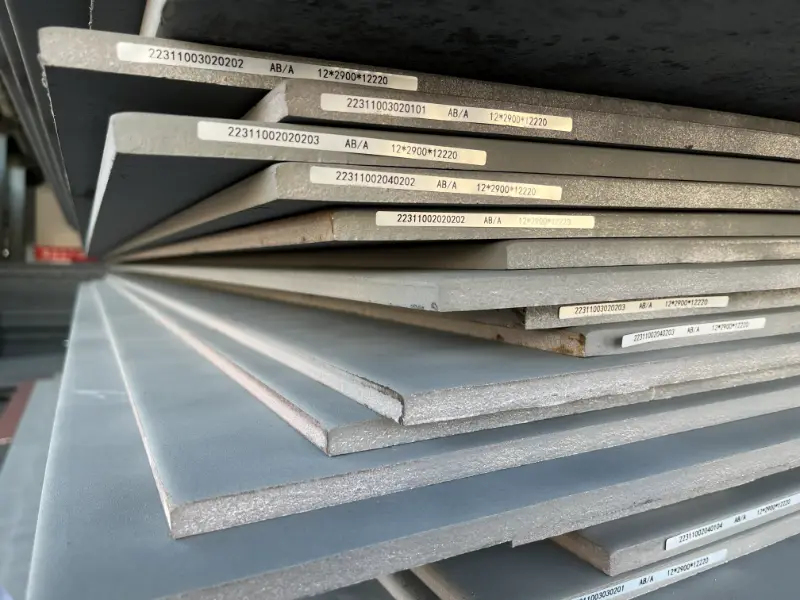
EN 10225 S355G7+M Offshore Structural Steel Plate
EN 10225 S355G7+M Offshore Structural Steel Plate - Technical Data & Equivalents
Comprehensive material data for S355G7+M steel plate per EN 10225, covering chemical composition, mechanical and thermal properties, international equivalents, and application guidance for fixed offshore structures.
Thermomechanical rolling, hot forming (with controlled cooling), welding, guillotine cutting, drilling, milling
- Phone : +8618037372205
- Email : [email protected]
- WhatsApp: Contact via Whtsapp
- WeChat: +8618037372205
EN 10225 S355G7+M Offshore Structural Steel Plate Introduction
S355G7+M is a thermomechanically rolled weldable fine-grain structural steel specified in EN 10225 for fixed offshore structures. It offers a minimum yield strength of 355 MPa for thicknesses up to 16 mm, excellent toughness down to -40 °C (longitudinal Charpy V-notch energy ≥50 J), and good weldability with controlled carbon equivalent values. The +M delivery condition ensures a fine, homogeneous microstructure that provides high strength combined with superior resistance to brittle fracture. Typical applications include primary and secondary members of offshore platforms, wind turbine foundations, and hull structures, where reliable performance under extreme environmental loads is required. The material is generally supplied as plates and can be processed by welding, forming, and machining.
EN 10225 S355G7+M Offshore Structural Steel Plate Chemical Composition
Values as specified in EN 10225:2009 +A1:2011 for S355G7, applicable for product thicknesses ≤100 mm. The steel is fully killed and fine-grain treated. Elements such as niobium, vanadium, and titanium may be added singly or in combination for grain refinement. CEV (Carbon Equivalent Value) typically ≤0.43% for thickness ≤40 mm and ≤0.45% for thickness >40 mm (based on CEV = C + Mn/6 + (Cr+Mo+V)/5 + (Ni+Cu)/15). This control ensures good weldability.
| Element | Grade Requirement (wt%) | Remarks |
|---|---|---|
| Carbon (C) | ≤ 0.14 | Mandatory element |
| Silicon (Si) | ≤ 0.50 | Deoxidizer |
| Manganese (Mn) | 1.00 – 1.65 | Improves hardenability and strength |
| Phosphorus (P) | ≤ 0.020 | Max. impurity content |
| Sulfur (S) | ≤ 0.010 | Max. impurity content; low S ensures through-thickness properties |
| Aluminium (Altotal) | ≥ 0.015 | Grain-refining element |
| Niobium (Nb) | ≤ 0.05 | Microalloying element for grain refinement |
| Vanadium (V) | ≤ 0.08 | Optional microalloying |
| Titanium (Ti) | ≤ 0.025 | Optional grain refiner |
| Chromium (Cr) | ≤ 0.25 | Residual element |
| Nickel (Ni) | ≤ 0.30 | Residual element |
| Molybdenum (Mo) | ≤ 0.10 | Residual element |
| Copper (Cu) | ≤ 0.30 | Residual element |
| Nitrogen (N) | ≤ 0.015 | Max. permitted; controlled for toughness |
| Other elements (As, Sb, Sn) | Restricted | When added intentionally or for special requirements, subject to agreement |
EN 10225 S355G7+M Offshore Structural Steel Plate Physical Properties
The physical properties listed are typical for structural steels of this type and are not mandatory requirements of EN 10225. They are useful for design calculations involving thermal expansion, heat transfer, and structural analysis. Density is slightly influenced by alloying elements but is practically constant. Thermal expansion and thermal conductivity values vary with temperature; the data below represent the range 20–100 °C. Electrical resistivity affects heating in electromagnetic fields.
| Property | Typical Value | Unit | Test Condition / Remarks |
|---|---|---|---|
| Density (ρ) | 7850 | kg/m³ | At 20 °C |
| Modulus of Elasticity (E) | 210 | GPa | At 20 °C |
| Shear Modulus (G) | ~ 81 | GPa | Calculated (E/[2(1+ν)]) |
| Poisson's Ratio (ν) | 0.3 | — | Elastic range |
| Thermal Expansion Coefficient (α) | 11.1 × 10⁻⁶ | K⁻¹ | 20–100 °C |
| Thermal Expansion Coefficient (α) | 12.5 × 10⁻⁶ | K⁻¹ | 20–200 °C |
| Thermal Conductivity (λ) | ~ 51 | W/(m·K) | At 20 °C |
| Specific Heat Capacity (c) | ~ 460 | J/(kg·K) | At 20 °C |
| Electrical Resistivity (ρₑ) | ~ 0.22 × 10⁻⁶ | Ω·m | At 20 °C |
EN 10225 S355G7+M Offshore Structural Steel Plate Mechanical Properties
Mechanical properties are specified according to EN 10225 for thicknesses up to 150 mm. Yield strength decreases with increasing plate thickness. Tensile strength range is relatively constant. Elongation is measured on a proportional gauge length 5.65√S₀ (S₀ = original cross-section area). Charpy V-notch impact energy is guaranteed down to -40 °C for the G7 quality. Bend test with 180° angle is required; no cracks must appear. Values apply to the designation +M condition.
| Property | Specified Value (min., unless range) | Unit | Test Condition / Remarks |
|---|---|---|---|
| Yield Strength (ReH) | ≥ 355 | MPa | Thickness t ≤ 16 mm |
| Yield Strength (ReH) | ≥ 345 | MPa | 16 mm < t ≤ 25 mm |
| Yield Strength (ReH) | ≥ 335 | MPa | 25 mm < t ≤ 40 mm |
| Yield Strength (ReH) | ≥ 325 | MPa | 40 mm < t ≤ 63 mm |
| Yield Strength (ReH) | ≥ 315 | MPa | 63 mm < t ≤ 80 mm |
| Yield Strength (ReH) | ≥ 305 | MPa | 80 mm < t ≤ 100 mm |
| Yield Strength (ReH) | ≥ 295 | MPa | 100 mm < t ≤ 150 mm |
| Tensile Strength (Rm) | 470 – 630 | MPa | All thicknesses |
| Elongation (A) | ≥ 22 | % | Thickness ≤ 40 mm, longitudinal, L₀ = 5.65√S₀ |
| Elongation (A) | ≥ 21 | % | 40 mm < t ≤ 63 mm, longitudinal |
| Elongation (A) | ≥ 20 | % | 63 mm < t ≤ 100 mm, longitudinal |
| Elongation (A) | ≥ 19 | % | 100 mm < t ≤ 150 mm, longitudinal |
| Charpy Impact Energy (KV) | ≥ 50 | J | At -40 °C, longitudinal, 10×10 mm specimen |
| Charpy Impact Energy (KV) | ≥ 35 | J | At -40 °C, transverse, 10×10 mm specimen (typical agreement value) |
| Bend Test (180°) | No cracks | — | Mandrel diameter: 3a for t≤16 mm; 4a for 16 |
EN 10225 S355G7+M Offshore Structural Steel Plate Fully Equivalent Material Standards & Replaceable Grades
| Country/Region | Standard | Grade | Remarks |
|---|---|---|---|
| Europe | EN 10225 | S355G7+M | Original specification; thermomechanical rolled |
| United Kingdom | BS EN 10225 | S355G7+M | Identical adoption of the European standard |
| Germany | DIN EN 10225 | S355G7+M | Identical adoption |
| France | NF EN 10225 | S355G7+M | Identical adoption |
| Sweden | SS-EN 10225 | S355G7+M | Identical adoption |
EN 10225 S355G7+M Offshore Structural Steel Plate Application Introduction
S355G7+M steel plates are designed for structural components that require high strength, excellent notch toughness at low temperatures, and reliable weldability under harsh environmental conditions. They are predominantly used in the offshore energy sector (oil & gas, wind) and in shipbuilding. The +M condition allows cost-efficient fabrication by avoiding post-weld heat treatment in many cases, while maintaining consistent through-thickness properties.
Product Applications: Jacket structures and braces, Platform decks and modules, Monopile and tripile foundations, Transition pieces for wind turbines, Tubular nodes and cast steel joints, Living quarter and process modules, FPSO hull girder and topside structures
Processed into products: Stiffeners and stringers, Brackets and gusset plates, Flanges and webs of built-up girders, Tubular members (legs, braces, piles), Box girders and crane pedestals, Base plates and load transfer plates, Lifting padeyes and structural attachments
Application industries: Offshore oil & gas exploration and production, Offshore wind energy (foundations and substations), Shipbuilding and marine engineering, Heavy civil construction (when offshore-like toughness is required), Arctic engineering and ice-resistant structures
EN 10225 S355G7+M Offshore Structural Steel Plate Similar / Closely Related Alternative Materials
| Country/Region | Standard | Grade | Remarks |
|---|---|---|---|
| Europe | EN 10225 | S355G8+M | Slightly more stringent chemistry and even better toughness, suitable for lower service temperatures |
| Europe | EN 10025-4 | S355ML | Thermomechanical rolled structural steel with similar strength but not specifically for offshore (no G quality, less strict toughness traceability) |
| USA | ASTM A572/A572M | Grade 50 [345] | Similar minimum yield, but different chemical limits and no guaranteed -40 °C impact unless supplementary requirements applied |
| USA | API 2W | Grade 50 | Offshore structural steel with controlled properties, not fully identical to EN 10225 but often considered exchangeable after qualification |
| International | ISO 630-3 | S355G2 | General structural steel for offshore use with lower toughness requirements compared to G7 |
| Norway | NORSOK M-120 | Y35 | Norwegian offshore standard with similar strength and toughness, may be used as alternative after engineering agreement |
Notes:
Carbon Equivalent Value (CEV): Typically supplied with CEV ≤0.43% for t≤40 mm and CEV ≤0.45% for t>40 mm to ensure good weldability without excessive preheat. Through-thickness properties: When Z-direction performance is required, S355G7+Z35 or similar can be ordered according to EN 10164. Weldability: Low hydrogen processes recommended; preheat and interpass temperature depend on combined thickness and CEV. Corrosion resistance: Not inherently corrosion resistant; protective coating or cathodic protection is mandatory in splash and atmospheric zones. Testing: Products are ultrasonically tested (e.g., according to EN 10160) for internal soundness upon request. All data shown are based on EN 10225:2009 edition incorporating Amendment A1:2011; verify current revision when specifying.
- Share



