
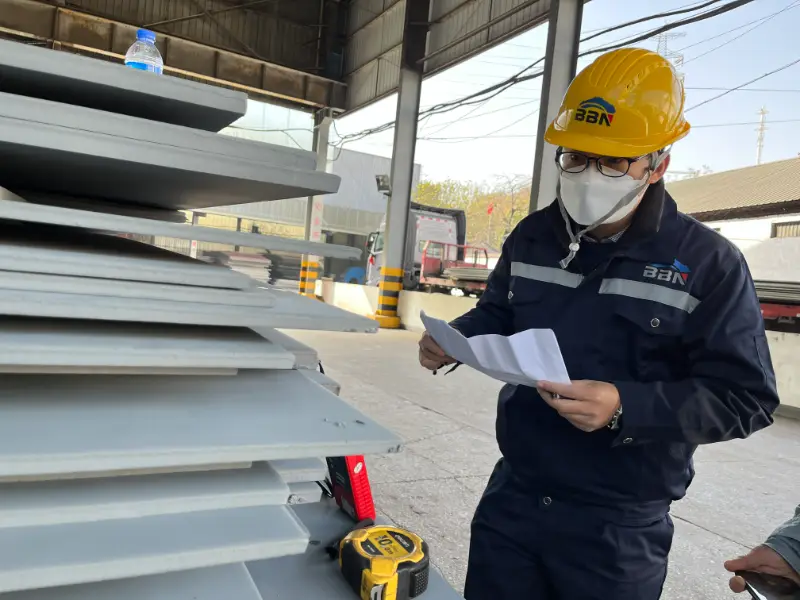
EN 10225 Grade S355G8+M Offshore Steel Plate
EN 10225 Grade S355G8+M Offshore Steel Plate: Properties, Equivalents & Applications
Comprehensive data sheet for EN 10225 S355G8+M steel, covering chemical composition, mechanical and physical properties, international equivalents, and typical applications in offshore structures.
Thermomechanical rolling (+M), Hot forming, Welding, Flame cutting, Cold forming (limited), Machining
- Phone : +8618037372205
- Email : [email protected]
- WhatsApp: Contact via Whtsapp
- WeChat: +8618037372205
EN 10225 Grade S355G8+M Offshore Steel Plate Introduction
EN 10225 S355G8+M is a thermomechanically rolled weldable structural steel specifically developed for fixed offshore structures. It combines a minimum yield strength of 355 MPa with excellent toughness at -40°C, making it suitable for demanding marine environments. The +M designation indicates that the plate is delivered in the as-rolled and accelerated-cooled condition, achieving its mechanical properties through a fine-grained microstructure without the need for subsequent heat treatment. It offers good weldability, consistent through-thickness properties when ordered with improved Z-quality, and compliance with stringent CTOD (Crack Tip Opening Displacement) requirements for fracture-critical applications. Typical thicknesses range from 8 mm to 150 mm, covering primary structural elements like braces, nodes, and deck beams on offshore platforms.
EN 10225 Grade S355G8+M Offshore Steel Plate Chemical Composition
Chemical composition limits according to EN 10225:2019 for grade S355G8. Elements not listed are not intentionally added. The steel is fully killed and grain-refined. Minimum aluminium for grain refinement is specified. A maximum carbon equivalent value (CEV) is guaranteed to ensure weldability. For products with improved Z-quality (Z25/Z35), lower sulphur content is mandatory.
| Chemical Element | Standard Value (wt%) | Remarks |
|---|---|---|
| Carbon (C) | ≤ 0.16 | |
| Silicon (Si) | ≤ 0.50 | |
| Manganese (Mn) | 0.90 - 1.65 | |
| Phosphorus (P) | ≤ 0.020 | |
| Sulphur (S) | ≤ 0.010 | ≤ 0.005 for Z25, ≤ 0.003 for Z35 when ordered |
| Aluminium (Al total) | ≥ 0.020 | Grain refinement |
| Nitrogen (N) | ≤ 0.012 | |
| Niobium (Nb) | ≤ 0.05 | |
| Vanadium (V) | ≤ 0.08 | |
| Titanium (Ti) | ≤ 0.05 | |
| Chromium (Cr) | ≤ 0.25 | |
| Nickel (Ni) | ≤ 0.35 | |
| Molybdenum (Mo) | ≤ 0.10 | |
| Copper (Cu) | ≤ 0.30 | |
| Carbon Equivalent (CEV) | t ≤ 63: ≤ 0.43; 63 < t ≤ 100: ≤ 0.45; 100 < t ≤ 150: ≤ 0.47 | CEV = C + Mn/6 + (Cr+Mo+V)/5 + (Ni+Cu)/15 |
EN 10225 Grade S355G8+M Offshore Steel Plate Thermal and Electrical Physical Properties
Typical ambient-temperature physical properties for S355G8+M structural steel. These values are representative for design calculations and are not explicitly mandated by the product standard. They may vary slightly depending on exact composition and processing history. Data apply to the temperature range 20–100 °C unless otherwise stated.
| Property | Standard Required Value | Unit | Test Condition |
|---|---|---|---|
| Density (ρ) | 7850 | kg/m³ | Room temperature |
| Elastic Modulus (E) | 205 - 215 | GPa | Ambient |
| Shear Modulus (G) | ~ 80 | GPa | Calculated from E and ν |
| Poisson's Ratio (ν) | 0.3 | - | Elastic range |
| Thermal Expansion Coefficient (α) | 12 x 10⁻⁶ | /K | 20 – 100 °C |
| Thermal Conductivity (λ) | 45 - 51 | W/(m·K) | 20 °C |
| Specific Heat Capacity (c) | 460 – 480 | J/(kg·K) | 20 – 100 °C |
| Electrical Resistivity (ρ_e) | 0.22 – 0.28 x 10⁻⁶ | Ω·m | 20 °C |
EN 10225 Grade S355G8+M Offshore Steel Plate Mechanical Properties
Minimum mechanical property values according to EN 10225 for S355G8+M plates. Values depend on product thickness and specimen orientation (longitudinal). Impact energy requirements are for full-size Charpy V-notch specimens at -40°C. For transverse specimens, minimum values are typically two-thirds of longitudinal requirements. Elongation is reported on a gauge length of 5.65√S0 (A5). Thickness ranges reflect common delivery sizes; for intermediate thicknesses, linear interpolation may apply.
| Property | Standard Required Value | Unit | Test Condition / Thickness |
|---|---|---|---|
| Yield Strength (ReH) | ≥ 355 | MPa | t ≤ 16 mm |
| Yield Strength (ReH) | ≥ 345 | MPa | 16 < t ≤ 25 mm |
| Yield Strength (ReH) | ≥ 335 | MPa | 25 < t ≤ 40 mm |
| Yield Strength (ReH) | ≥ 325 | MPa | 40 < t ≤ 63 mm |
| Yield Strength (ReH) | ≥ 315 | MPa | 63 < t ≤ 80 mm |
| Yield Strength (ReH) | ≥ 305 | MPa | 80 < t ≤ 100 mm |
| Yield Strength (ReH) | ≥ 295 | MPa | 100 < t ≤ 150 mm |
| Tensile Strength (Rm) | 450 - 610 | MPa | t ≤ 100 mm |
| Tensile Strength (Rm) | 440 - 600 | MPa | 100 < t ≤ 150 mm |
| Elongation (A5) | ≥ 22 | % | t ≤ 40 mm, longitudinal |
| Elongation (A5) | ≥ 21 | % | 40 < t ≤ 63 mm, longitudinal |
| Elongation (A5) | ≥ 20 | % | 63 < t ≤ 100 mm, longitudinal |
| Elongation (A5) | ≥ 19 | % | 100 < t ≤ 150 mm, longitudinal |
| Charpy Impact Energy (KV) | ≥ 50 (longitudinal) | J | -40 °C |
| Charpy Impact Energy (KV) | ≥ 33 (transverse) | J | -40 °C |
EN 10225 Grade S355G8+M Offshore Steel Plate Identical Material Standards and Direct Equivalent Grades
| Country / Region | Standard | Grade | Remarks |
|---|---|---|---|
| European Union | EN 10225 | S355G8+M | Original standard; thermomechanically rolled |
| United Kingdom | BS EN 10225 | S355G8+M | UK adoption of EN 10225; identical requirements |
| Germany | DIN EN 10225 | S355G8+M | German edition; fully equivalent |
| France | NF EN 10225 | S355G8+M | French edition; fully equivalent |
| Italy | UNI EN 10225 | S355G8+M | Italian edition; fully equivalent |
| Norway | NS-EN 10225 | S355G8+M | Norwegian adoption; NORSOK M-120 references similar grades |
| Denmark | DS/EN 10225 | S355G8+M | Danish edition; identical |
| Netherlands | NEN-EN 10225 | S355G8+M | Dutch edition; identical |
| Spain | UNE-EN 10225 | S355G8+M | Spanish edition; identical |
| Sweden | SS-EN 10225 | S355G8+M | Swedish edition; identical |
| International | ISO 19902:2020 – Annex A | S355G8 (similar) | ISO standard for offshore structures references equivalent grades |
EN 10225 Grade S355G8+M Offshore Steel Plate Application Introduction
S355G8+M is the workhorse grade for primary and secondary structural members in offshore fixed platforms and wind farm foundations operating in cold marine environments. It is selected where a combination of moderate strength, excellent toughness at -40°C, and proven weldability is required. The thermomechanical rolling path guarantees consistent mechanical properties through the thickness, reducing the need for post-weld heat treatment. When specified with through-thickness testing (Z25 or Z35), it becomes suitable for heavily stressed connections where lamellar tearing must be avoided. This material is commonly fabricated into large-scale welded assemblies using conventional arc welding processes and is compatible with automated cutting and robotic welding systems used in modern shipyards.
Product Applications: Jacket-type platform substructures (jacket legs, bracings), Topsides primary steel (deck plates, main girders), Monopile and transition piece subassemblies for wind turbines, Subsea structural frames and manifold support bases, Flare towers and helideck support structures, Jack-up rig leg chords and spudcans (with additional toughness)
Processed into products: Tubular nodes (K-joints, T-joints, Y-joints) in jackets, Wide flange (H-beam) stringers and stiffeners, Heavy plate inserts for concentrated load areas, Pad-eyes and lifting trunnions, Crane pedestal base plates and slewing rings, Mooring foundation plates (e.g., anchor pile sleeves), Transition pieces between monopile and wind turbine tower
Application industries: Offshore Oil & Gas Exploration and Production, Renewable Energy (Offshore Wind Farms), Marine Heavy Lifting and Transportation, Shipbuilding (special purpose vessels, crane pedestals), Port and Harbor Infrastructure (piles, dolphins)
EN 10225 Grade S355G8+M Offshore Steel Plate Similar or Closely Related Substitute Materials
| Country / Region | Standard | Grade | Remarks |
|---|---|---|---|
| European Union | EN 10225 | S355G10+M | Higher toughness at -40°C (min 80 J longitudinal); otherwise similar strength and chemistry, used for fracture-critical nodes |
| European Union | EN 10025-4 | S355ML | Thermomechanical rolled fine-grain steel for general structural use; CEV limits similar, but lacks offshore-specific CTOD and through-thickness guarantees. Not a direct replacement without additional testing. |
| United Kingdom | BS 7191 (obsolete) | 355EMZ | Predecessor to EN 10225; comparable strength and toughness, but replaced by EN standard |
| USA | ASTM A572/A572M | Grade 50 (345 MPa) / Grade 55 (380 MPa) | Common structural steel; not offshore-specific. Requires supplementary Charpy at -40°C, Z-quality, and restricted chemistry to approximate S355G8+M. |
| USA | API 2H | Grade 50 | Covers structural steel plates for offshore platforms; similar strength, but limited to specific thicknesses and less restrictive on impact testing. Must be verified against project specifications. |
| USA | API 2W | Grade 50T / 60T | Thermomechanically processed plates for offshore; close in concept, but TMCP and chemistry may differ from EN 10225 requirements. |
| Japan | JIS G 3106 | SM490YA / SM520B (modified) | With controlled rolling and additional low-temperature impact requirements, some grades can approach S355G8+M. Requires careful qualification. |
| Norway | NORSOK M-120 (revised) | Y05 (S355 equivalent) | NORSOK steel standards for offshore structural steel; Y05 can match S355G8+M if ordered with TMCP and -40°C impact. Often cross-referenced in North Sea projects. |
Notes:
Weldability: Low carbon equivalent ensures good cold cracking resistance with appropriate preheat. Welding consumables matching the base metal yield strength (e.g., E55 class) and providing sufficient toughness at -40°C are recommended. CTOD: When specified per EN 10225 Annex E, the steel must meet CTOD values typically ≥ 0.15 mm at -40°C in the heat-affected zone, making it suitable for fracture-critical connections. Z-quality: Through-thickness reduction of area (Z25 min 25%, Z35 min 35%) is available for details prone to lamellar tearing. Corrosion protection: Standard marine protective coatings or cathodic protection systems are required due to carbon steel composition. Forming: Cold forming is possible for nominal thicknesses, but post-forming heat treatment is not required if strain ageing is considered. Hot forming may degrade the TMCP microstructure and requires re-qualification. Inspection: Ultrasonic testing to EN 10160 or equivalent is mandatory for thicker plates in offshore projects.
- Share



