
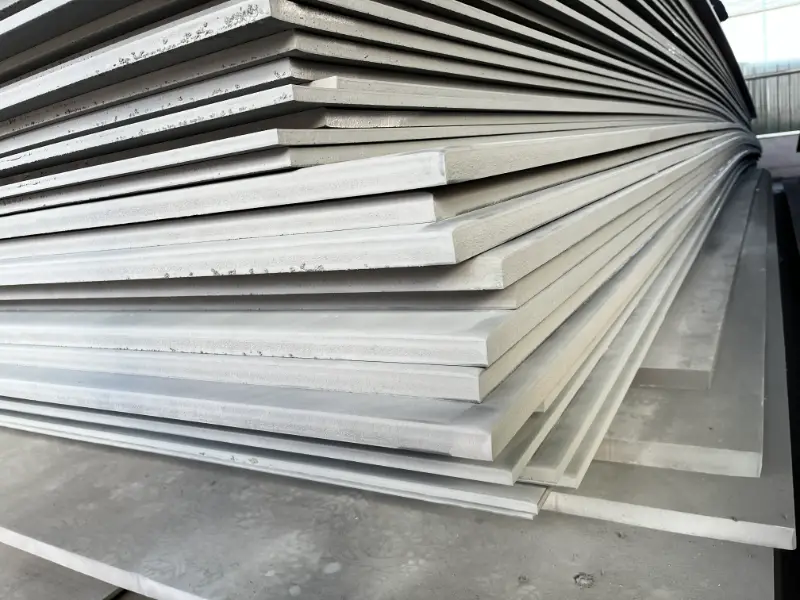
EN10225 S355G8+N Offshore Steel Plate
EN10225 S355G8+N Offshore Steel Plate: Properties, Standards & Equivalents
Detailed material data for EN10225 Grade S355G8+N offshore platform steel plate: chemical composition, mechanical properties, thermal & electrical physical properties, international equivalents, and application guidelines.
Welding (GMAW, SAW, SMAW), oxy-fuel and plasma cutting, cold forming, drilling, machining
- Phone : +8618037372205
- Email : [email protected]
- WhatsApp: Contact via Whtsapp
- WeChat: +8618037372205
EN10225 S355G8+N Offshore Steel Plate Introduction
EN10225 S355G8+N is a high-strength, weldable structural steel specifically designed for offshore structures. It is supplied in the normalized condition (+N) to ensure uniform microstructure and superior toughness. Key features include:
- Minimum yield strength of 355 MPa (up to 16 mm thickness)
- Excellent notch toughness down to -40 °C (G8 quality)
- Z35 through-thickness properties for critical welded joints
- Controlled carbon equivalent to guarantee excellent weldability without preheating in many situations
- Compliant with European standard EN 10225, widely used in the North Sea and global offshore projects
The steel exhibits a fine-grain structure achieved through normalizing, providing a good balance of strength, ductility, and resistance to lamellar tearing. It is suitable for highly stressed components in offshore platforms, wind turbine foundations, and other marine constructions.
EN10225 S355G8+N Offshore Steel Plate Chemical Composition
Chemical composition according to EN 10225-1:2009 for grade S355G8. The steel is fully killed and fine-grain treated. Low sulfur and controlled CEV ensure good weldability and resistance to lamellar tearing. Note: For product thicknesses > 40 mm, slight variations may apply subject to the standard. CEV = C + Mn/6 + (Cr+Mo+V)/5 + (Ni+Cu)/15 typically ≤ 0.43 % unless otherwise agreed.
| Element | Standard Value (%) | Remarks |
|---|---|---|
| C | ≤ 0.18 | Carbon content |
| Si | ≤ 0.55 | Silicon |
| Mn | ≤ 1.65 | Manganese |
| P | ≤ 0.020 | Phosphorus |
| S | ≤ 0.010 | Sulfur |
| Cr | ≤ 0.25 | Chromium |
| Ni | ≤ 0.50 | Nickel |
| Cu | ≤ 0.30 | Copper |
| Mo | ≤ 0.08 | Molybdenum |
| Nb | ≤ 0.030 | Niobium |
| V | ≤ 0.08 | Vanadium |
| Ti | ≤ 0.025 | Titanium |
| Al (total) | ≥ 0.015 | Aluminum, minimum for fine grain practice |
| N | ≤ 0.012 | Nitrogen |
| CEV | ≤ 0.43 (typically) | Carbon equivalent value, agreed for weldability; often controlled lower |
EN10225 S355G8+N Offshore Steel Plate Thermal & Electrical Physical Properties
These are typical physical properties for low-alloy structural steels like S355G8+N. They are not mandatory from EN 10225 but are commonly accepted engineering data at room temperature unless noted otherwise. For precise design, these values can be used for initial calculations.
| Property | Typical Value | Unit | Test Condition |
|---|---|---|---|
| Density (ρ) | 7.85 | g/cm³ | At 20 °C |
| Modulus of elasticity (E) | 210 | GPa | At 20 °C, longitudinal |
| Shear modulus (G) | 81 | GPa | At 20 °C, calculated |
| Poisson's ratio (ν) | 0.3 | – | At 20 °C, elastic |
| Thermal expansion coefficient (α) | 12.0 × 10⁻⁶ | 1/K | 20–100 °C |
| Thermal expansion coefficient (α) | 13.0 × 10⁻⁶ | 1/K | 20–200 °C |
| Thermal expansion coefficient (α) | 13.5 × 10⁻⁶ | 1/K | 20–300 °C |
| Thermal conductivity (λ) | 50 | W/(m·K) | At 20 °C |
| Specific heat capacity | 460 – 500 | J/(kg·K) | At 20 °C |
| Electrical resistivity (ρ_e) | 0.20 – 0.25 | Ω·mm²/m | At 20 °C |
EN10225 S355G8+N Offshore Steel Plate Mechanical Properties
Mechanical properties as specified in EN 10225-1 for normalized S355G8 steel plates. Values depend on product thickness. Impact test: Charpy V-notch longitudinal specimens, average ≥ 50 J at -40 °C, individual min ≥ 35 J. Through-thickness properties: Z35 reduction of area (mean ≥ 35 %, single ≥ 25 %) according to EN 10164.
| Property | Standard Requirement | Unit | Test condition / Thickness range |
|---|---|---|---|
| Yield Strength (ReH) | ≥ 355 | MPa | t ≤ 16 mm |
| Yield Strength (ReH) | ≥ 345 | MPa | 16 < t ≤ 40 mm |
| Yield Strength (ReH) | ≥ 335 | MPa | 40 < t ≤ 63 mm |
| Yield Strength (ReH) | ≥ 325 | MPa | 63 < t ≤ 80 mm |
| Yield Strength (ReH) | ≥ 315 | MPa | 80 < t ≤ 100 mm |
| Tensile Strength (Rm) | 470 – 630 | MPa | t ≤ 100 mm |
| Elongation (A) | ≥ 22 | % | t ≤ 40 mm, 5.65√S₀ (gauge length) |
| Elongation (A) | ≥ 21 | % | 40 < t ≤ 63 mm |
| Elongation (A) | ≥ 20 | % | 63 < t ≤ 100 mm |
| Impact energy (KV₂) longitudinal | ≥ 50 (avg) / ≥ 35 (single) | J | -40 °C, Charpy V-notch |
| Through-thickness reduction of area (Z) | ≥ 35 (avg) / ≥ 25 (single) | % | Z35 class, thickness ≤ 100 mm (usually) as per EN 10164 |
EN10225 S355G8+N Offshore Steel Plate Fully Equivalent Material Standards & Replaceable Grade Recommendations
| Country / Region | Standard | Grade | Remarks |
|---|---|---|---|
| International (API) | API Spec 2H | Grade 50 | Offshore structural steel plate, impact tested at -40 °C; normalized option available, Z35 by agreement. Very close to S355G8+N. |
| United Kingdom | BS 7191 | 355EMZ | Old British standard for extra-tough structural steel with Z35 through-thickness, comparable in composition and properties. |
| Norway (DNV) | DNV-OS-B101 | NV E36 (with Z35) | Ship and offshore steel, with similar strength and -40 °C impact test; Z35 can be specified to match S355G8+N. |
| Europe (EN) | EN 10025-3 | S355NL (Z35 optional) | Normalized fine-grain steel; similar base properties but not specifically for offshore; through-thickness can be added. CEV and sulfur limits may differ slightly. |
EN10225 S355G8+N Offshore Steel Plate Application Introduction
S355G8+N steel is engineered for the demanding conditions of offshore environments. Its combination of high strength, low-temperature toughness, and exceptional Z-direction resistance makes it a first choice for thick, highly restrained welded joints. Typical applications and products include:
Product Applications: Jacket structures and legs of fixed platforms, Deck plates, module support frames, and flare booms, Monopiles, pin piles, and suction buckets for wind turbines, Reinforced nodes and can sections (tubular joints), Offshore crane pedestals and A-frames
Processed into products: Welded tubular nodes (K, Y, T joints) requiring Z35 quality, Thick plate gussets and stiffeners in highly stressed areas, Sections for columns and diagonal braces (box or tubular), Transition pieces between monopile and tower flange, Heavy-duty lifting eyes and padeyes for offshore installation
Application industries: Oil & gas offshore exploration and production, Offshore wind energy (turbine foundations, transition pieces), Shipbuilding and heavy marine construction, Bridge and port infrastructure (marine environment), Heavy lifting and transport equipment
EN10225 S355G8+N Offshore Steel Plate Similar / Nearby Substitute Materials
| Country / Region | Standard | Grade | Remarks |
|---|---|---|---|
| Europe | EN 10225 | S355G7+N | Same strength, -40 °C toughness, but Z25 through-thickness performance (lower than Z35 of G8). Can be used if less critical lamellar tearing resistance required. |
| Europe | EN 10225 | S355G10+N | Higher toughness grade with impact test at -50 °C. Otherwise similar composition. Suitable for lower design temperatures. |
| Europe | EN 10025-3 | S355NL | Normalized structural steel for general use; impact test at -50 °C. May need additional through-thickness testing and offshore standard acceptance. Slightly different sulfur/phosphorus limits. |
| USA | ASTM A572/A572M | Grade 50 [345] (impact tested) | Standard high-strength low-alloy steel; lacks mandatory -40 °C impact and Z-quality in basic specification. Must be ordered with supplementary requirements for offshore. |
| International | ISO 19902 | 355 (modified) | Fixed steel offshore structures standard allows equivalent grades; S355G8+N meets the requirements when CEV, toughness and Z35 are verified. |
Notes:
Additional considerations:
- Z35 testing according to EN 10164 is mandatory for G8; through-thickness specimens must meet the reduction-of-area requirements.
- Weldability is excellent; preheating is generally not required for plate thickness up to 50 mm when hydrogen-controlled processes are used, but always follow EN 1011-2 guidelines.
- Ultrasonic testing per EN 10160 Class S2 (or higher) is often specified for critical applications.
- The steel can be galvanized or painted with standard marine coating systems without restriction.
- For use in sour service (H₂S), special compliance with NACE MR0175/ISO 15156 must be verified; S355G8+N is not specifically designed for sour environments but may be assessed case-by-case.
- Share



