
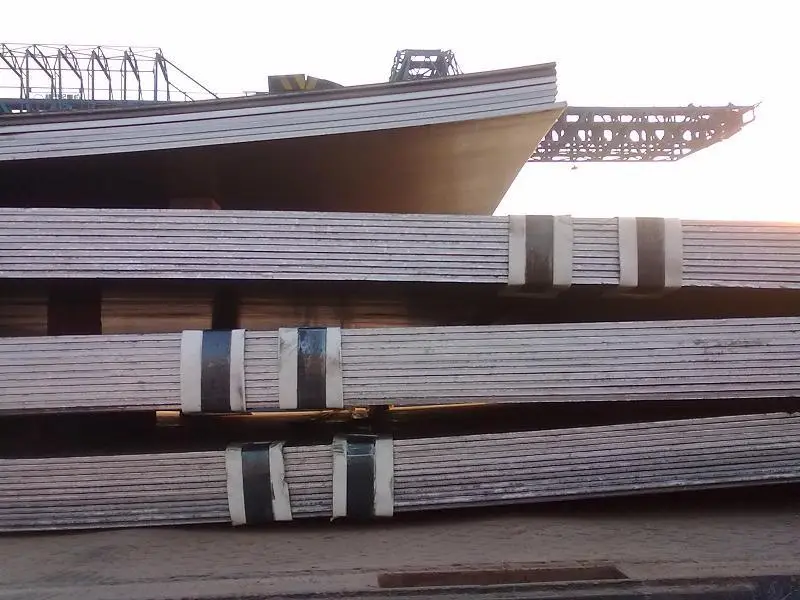
EN10225 S355G9+N Offshore Steel Plate
EN10225 S355G9+N Offshore Steel Plate – Composition, Mechanical & Physical Data
Comprehensive material data for EN10225 S355G9+N offshore structural steel plate, including chemical composition, mechanical and physical properties, equivalent grades, and application guidance.
Welding, bending, cutting, machining, drilling
- Phone : +8618037372205
- Email : [email protected]
- WhatsApp: Contact via Whtsapp
- WeChat: +8618037372205
EN10225 S355G9+N Offshore Steel Plate Introduction
EN10225 S355G9+N is a weldable, normalized structural steel specifically developed for offshore applications. It belongs to Group 9 within the EN 10225 standard, indicating enhanced low-temperature toughness with guaranteed impact energy at -40 °C. The steel is delivered in the normalized (or normalized rolled) condition, which refines the grain structure and improves both mechanical strength and notch toughness. It offers a minimum yield strength of 355 MPa and excellent weldability due to a controlled carbon equivalent (CEV). Typical applications include primary and secondary structural elements of fixed offshore platforms, wind turbine substructures, and jacket components, where reliability under severe marine conditions is essential. Its low sulfur and phosphorus content, together with fine grain practice, ensures good through-thickness ductility and resistance to lamellar tearing when specified with Z-quality options.
EN10225 S355G9+N Offshore Steel Plate Chemical Composition
Chemical composition according to EN 10225:2009 for grade S355G9. All values are maximum limits unless a range or minimum is shown. The carbon equivalent CEV = C + Mn/6 + (Cr+Mo+V)/5 + (Ni+Cu)/15 must not exceed 0.43% for thicknesses ≤40 mm. Low impurity elements ensure excellent weldability and toughness for offshore service.
| Element | Standard Value | Remarks |
|---|---|---|
| C | ≤0.12% | |
| Mn | ≤1.60% | |
| Si | ≤0.55% | |
| P | ≤0.020% | |
| S | ≤0.010% | |
| Cu | ≤0.30% | |
| Ni | ≤0.70% | |
| Cr | ≤0.30% | |
| Mo | ≤0.10% | |
| Nb | ≤0.050% | |
| V | ≤0.10% | |
| Ti | ≤0.025% | |
| Al (total) | ≥0.020% | |
| N | ≤0.010% | |
| CEV | ≤0.43% | Thickness ≤40 mm |
EN10225 S355G9+N Offshore Steel Plate Thermal and Electrical Physical Properties
Typical physical properties for EN10225 S355G9+N at room temperature unless otherwise stated. These values are representative for low carbon micro-alloyed offshore steels and are suitable for design calculations. Slight variations may occur depending on the exact composition and processing route, but they do not significantly affect engineering performance.
| Property | Typical Value | Unit | Test Condition |
|---|---|---|---|
| Density (ρ) | 7850 | kg/m³ | at 20 °C |
| Elastic modulus (E) | 210 | GPa | at 20 °C |
| Shear modulus (G) | 81 | GPa | at 20 °C |
| Poisson's ratio (ν) | 0.3 | - | at 20 °C |
| Thermal expansion coeff. (α) | 12.0 | 10⁻⁶ /K | 20 – 100 °C |
| Thermal conductivity (λ) | 52 | W/(m·K) | at 20 °C |
| Specific heat capacity (c) | 460 | J/(kg·K) | at 20 °C |
| Electrical resistivity (ρ_e) | 0.16 | µΩ·m | at 20 °C |
EN10225 S355G9+N Offshore Steel Plate Mechanical Properties
Mechanical properties for EN10225 S355G9+N at ambient temperature. Yield strength and tensile strength depend on the product thickness. Charpy V-notch impact energy is guaranteed down to -40 °C. When ordered with Z-quality (e.g., Z25, Z35), through-thickness reduction of area values are specified separately. The bending test is performed on longitudinal specimens; the bend diameter is dependent on thickness.
| Property | Specified Value | Unit | Test Condition |
|---|---|---|---|
| Yield strength (ReH) | ≥355 | MPa | t ≤ 16 mm |
| Yield strength (ReH) | ≥350 | MPa | 16 mm < t ≤ 25 mm |
| Yield strength (ReH) | ≥345 | MPa | 25 mm < t ≤ 40 mm |
| Yield strength (ReH) | ≥335 | MPa | 40 mm < t ≤ 63 mm |
| Yield strength (ReH) | ≥325 | MPa | 63 mm < t ≤ 80 mm |
| Yield strength (ReH) | ≥315 | MPa | 80 mm < t ≤ 100 mm |
| Tensile strength (Rm) | 470 – 630 | MPa | t ≤ 100 mm |
| Elongation (A) | ≥22 | % | Longitudinal, t ≤ 40 mm |
| Elongation (A) | ≥22 | % | Longitudinal, 40 mm < t ≤ 63 mm |
| Elongation (A) | ≥22 | % | Longitudinal, 63 mm < t ≤ 100 mm |
| Charpy impact (KV) | ≥50 | J | Longitudinal, -40 °C, t ≤ 40 mm |
| Charpy impact (KV) | ≥50 | J | Longitudinal, -40 °C, 40 mm < t ≤ 63 mm |
| Charpy impact (KV) | ≥50 | J | Longitudinal, -40 °C, 63 mm < t ≤ 100 mm |
| Bend test (bend diameter) | 3t | - | Longitudinal, 180°, t ≤ 16 mm |
| Bend test (bend diameter) | 4t | - | Longitudinal, 180°, 16 mm < t ≤ 40 mm |
| Bend test (bend diameter) | 5t | - | Longitudinal, 180°, t > 40 mm |
EN10225 S355G9+N Offshore Steel Plate Fully Equivalent Standards and Substitutable Grades
| Country/Region | Standard | Grade | Remarks |
|---|---|---|---|
| United Kingdom | BS 7191:1989 | 355EMZ | Identical technical delivery conditions; replaced by EN 10225 |
| International | ISO 24314:2006 | StE355 | Structurally and chemically equivalent normalized offshore steel |
EN10225 S355G9+N Offshore Steel Plate Application Introduction
EN10225 S355G9+N is designed for harsh offshore environments. Its fine grain structure and low-temperature toughness make it ideal for critical welded structures that must withstand dynamic loading, severe weather, and low service temperatures. The steel can be safely welded, formed, and machined using standard practices, and it is often specified with through-thickness (Z-quality) properties to prevent lamellar tearing in highly restrained joints.
Product Applications: Fixed offshore platforms, Jacket substructures and bracings, Wind turbine foundations (monopile, jacket, suction bucket), Deck structures and helidecks, Mooring and turret components, Subsea templates
Processed into products: Node cans and tubular joints, Transition pieces and tower flanges, Shear keys and pile sleeves, Stiffener plates and gussets, Lifting trunnions and padeyes, Heavy-wall structural beams and columns
Application industries: Offshore Oil & Gas, Offshore Renewable Energy (Wind, Tidal), Marine Construction, Heavy Civil Engineering
EN10225 S355G9+N Offshore Steel Plate Similar or Near-Equivalent Material Alternatives
| Country/Region | Standard | Grade | Remarks |
|---|---|---|---|
| USA | ASTM A572/A572M | Grade 50 [345] Type 5 | Similar yield strength; typical impact test at -20°C; may need supplementary requirements for -40°C toughness |
| USA | API 2H | Grade 50 | Offshore structural steel, comparable strength; chemical requirements differ slightly; Charpy at -40°C can be ordered with supplement S5 |
| Japan | JIS G3106 | SM490B | Rolled steel for welded structure, similar tensile range; impact test at 0°C or -20°C, not directly equal to -40°C |
| China | GB/T 712 | DH36 | High-strength hull structural steel; yield ≥355 MPa, often used for offshore; requires supplementary low-temperature impact agreement for -40°C |
Notes:
Z-quality options: When through-thickness ductility is required, the steel can be ordered with Z25 or Z35 characteristics per EN 10164.
Normalizing rolling: May be supplied instead of normalizing heat treatment if the manufacturer demonstrates achievement of equivalent properties.
Welding: Preheat and interpass temperature control are recommended based on CEV and plate thickness. Low-hydrogen consumables are required to avoid cold cracking.
Structural integrity: Typical offshore standards (e.g., NORSOK M-120, DNV-OS-C101) accept this steel grade for dynamic loading conditions.
- Share



