
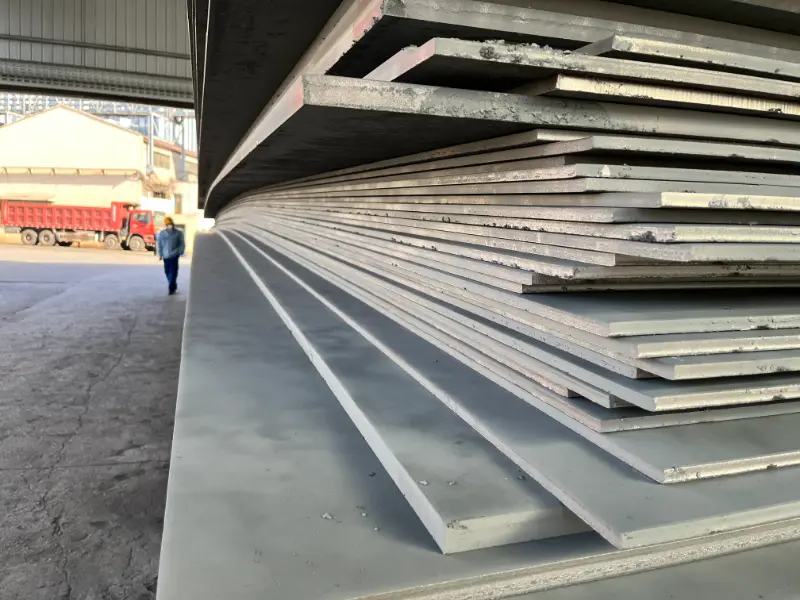
EN10225 S355G10+N Offshore Steel Plate
EN10225 S355G10+N Offshore Steel: High Strength, Exceptional Toughness for Extreme Marine Environments
In-depth technical data on S355G10+N offshore structural steel plate to EN10225. Includes chemical composition, mechanical and thermo-physical properties, international equivalents, and application guidance for marine and offshore engineering.
Hot rolled, normalized (+N), controlled rolling, oxygen cutting, welding, cold forming
- Phone : +8618037372205
- Email : [email protected]
- WhatsApp: Contact via Whtsapp
- WeChat: +8618037372205
EN10225 S355G10+N Offshore Steel Plate Introduction
S355G10+N is a high-strength, weldable structural steel specifically developed for fixed offshore structures in accordance with EN 10225. Delivered in the normalized (+N) condition, it offers a minimum yield strength of 355 MPa and outstanding resistance to brittle fracture, even at sub-zero temperatures down to -40°C. The grade features a fine-grain microstructure achieved through controlled rolling and normalizing, ensuring excellent toughness through thickness (Z-quality) and superior weldability. Its carefully balanced chemical composition, with low carbon and micro-alloying elements, provides reliable mechanical properties in heavy sections up to 150 mm.
- Excellent low-temperature impact toughness (≥50 J at -40°C)
- Guaranteed through-thickness tensile properties (Z35 option)
- High resistance to lamellar tearing and hydrogen-induced cracking
- Suitable for extreme marine service, including splash zones and submerged structures
EN10225 S355G10+N Offshore Steel Plate Chemical Composition According to EN 10225
The chemical composition of S355G10 is tightly controlled to ensure excellent weldability, low-temperature toughness, and resistance to lamellar tearing. Maximum carbon content is kept below 0.12%, while the carbon equivalent (CEV) is typically ≤0.43% for thicknesses up to 50 mm. Micro-alloying elements (Nb, V, Ti) are used for grain refinement. Strict limits on S and P minimize harmful inclusions. Aluminium is added as a grain refiner and to bind nitrogen.
| Element | Standard Value (%, max unless range given) | Notes |
|---|---|---|
| Carbon (C) | 0.12 | Max. |
| Silicon (Si) | 0.50 | Max. |
| Manganese (Mn) | 1.60 | Max. |
| Phosphorus (P) | 0.020 | Max. |
| Sulfur (S) | 0.010 | Max. |
| Chromium (Cr) | 0.25 | Max. |
| Nickel (Ni) | 0.70 | Max. |
| Molybdenum (Mo) | 0.08 | Max. |
| Copper (Cu) | 0.30 | Max. |
| Aluminium (Al, total) | 0.015 – 0.055 | Min. 0.015% for grain refinement |
| Niobium (Nb) | 0.05 | Max. |
| Vanadium (V) | 0.10 | Max. |
| Titanium (Ti) | 0.03 | Max. |
| Nitrogen (N) | 0.010 | Max. |
| Carbon Equivalent (CEV) | Typically ≤ 0.43 (t ≤ 50 mm) | CEV = C + Mn/6 + (Cr+Mo+V)/5 + (Ni+Cu)/15 |
EN10225 S355G10+N Offshore Steel Plate Thermal and Electrical Physical Properties
These physical properties are typical for normalized structural steel grades like S355G10 and can be used for engineering calculations. Density is taken as 7850 kg/m³ for all steel grades. Thermal conductivity and thermal expansion data vary with temperature; values provided are representative at 20°C and up to 200°C where indicated. Electrical resistivity is for standard structural steel and may vary slightly with chemical composition.
| Property | Typical Value | Unit | Test Condition |
|---|---|---|---|
| Density (ρ) | 7850 | kg/m³ | At 20°C |
| Modulus of elasticity (E) | 205 | GPa | At 20°C |
| Shear modulus (G) | 80 | GPa | At 20°C |
| Poisson's ratio (ν) | 0.3 | — | At 20°C |
| Thermal expansion coefficient (α) | 11.7 × 10⁻⁶ | K⁻¹ | 20°C – 100°C |
| Thermal expansion coefficient (α) | 12.5 × 10⁻⁶ | K⁻¹ | 20°C – 200°C |
| Thermal conductivity (λ) | 52 | W/(m·K) | At 20°C |
| Thermal conductivity (λ) | 50 | W/(m·K) | At 100°C |
| Thermal conductivity (λ) | 47 | W/(m·K) | At 200°C |
| Specific heat capacity (cp) | 460 | J/(kg·K) | At 20°C |
| Specific heat capacity (cp) | 490 | J/(kg·K) | At 100°C |
| Specific heat capacity (cp) | 520 | J/(kg·K) | At 200°C |
| Electrical resistivity (ρe) | 0.20 – 0.25 × 10⁻⁶ | Ω·m | At 20°C |
EN10225 S355G10+N Offshore Steel Plate Mechanical Properties
Mechanical properties apply to material in the normalized (+N) condition as per EN 10225. Yield strength decreases with increasing plate thickness. Tensile strength must be between 470 and 630 MPa. Minimum elongation is specified on a gauge length of 5.65√S₀. Charpy V-notch impact energy is guaranteed at -40°C in the longitudinal direction; transverse values are also available upon request. Through-thickness (Z35) reduction of area ≥35% is commonly specified for offshore structural nodes.
| Property | Required Value | Unit | Test Condition / Thickness |
|---|---|---|---|
| Yield strength (ReH) | 355 (min.) | MPa | t ≤ 16 mm |
| Yield strength (ReH) | 345 (min.) | MPa | 16 < t ≤ 25 mm |
| Yield strength (ReH) | 335 (min.) | MPa | 25 < t ≤ 40 mm |
| Yield strength (ReH) | 325 (min.) | MPa | 40 < t ≤ 63 mm |
| Yield strength (ReH) | 315 (min.) | MPa | 63 < t ≤ 80 mm |
| Yield strength (ReH) | 295 (min.) | MPa | 80 < t ≤ 100 mm |
| Yield strength (ReH) | 275 (min.) | MPa | 100 < t ≤ 150 mm |
| Tensile strength (Rm) | 470 – 630 | MPa | All thicknesses |
| Elongation (A) | 22 (min.) | % | t ≤ 16 mm, L₀ = 5.65√S₀ |
| Elongation (A) | 21 (min.) | % | 16 < t ≤ 25 mm |
| Elongation (A) | 20 (min.) | % | 25 < t ≤ 40 mm |
| Elongation (A) | 19 (min.) | % | 40 < t ≤ 63 mm |
| Elongation (A) | 18 (min.) | % | 63 < t ≤ 100 mm |
| Elongation (A) | 17 (min.) | % | 100 < t ≤ 150 mm |
| Charpy impact energy (KV, longitudinal) | 50 (min.) | J | At -40°C, average of 3 tests |
| Charpy impact energy (KV, transverse) | 35 (min.) | J | At -40°C, average of 3 tests (optional) |
| Through-thickness reduction of area (Z35) | 35 (min.) | % | Thickness direction, average of 3 tests |
EN10225 S355G10+N Offshore Steel Plate Completely Equivalent Material Standards and Alternative Grades
The following table lists standards and grades that are technically identical to EN 10225 S355G10+N. These materials share the same mechanical, chemical, and weldability requirements and can be used as direct substitutions in offshore projects, subject to project specifications and approval.
| Country/Region | Standard | Grade / Designation | Remarks |
|---|---|---|---|
| Europe/UK | BS EN 10225 | S355G10+N | Identical; the British adoption of the European standard. |
| Europe/UK | EN 10225 | S355G10+N | Original harmonized European standard. |
EN10225 S355G10+N Offshore Steel Plate Application Introduction
S355G10+N is specifically designed for the most demanding fixed offshore structures, where high strength, excellent weldability, and low-temperature toughness are non-negotiable. It is the preferred material for primary structural members in jackets, topsides, and transition pieces. The +N delivery condition ensures a refined, uniform microstructure, providing consistent mechanical properties and outstanding fracture resistance. This steel can be cut, welded, and cold-formed using standard shipyard and offshore fabrication techniques, provided that appropriate preheat and welding procedures are followed.
Product Applications: Jacket legs, braces, and nodes, Topside module main beams, deck plates, and crane pedestals, Monopile transition pieces (TPs) and reinforcement brackets, Helideck structures and flare booms, Conductor guides and wellhead support frames, Mooring system bollards and fairlead supports, Heavy-duty base plates and grouted connection sleeves
Processed into products: Welded tubular joints (Y, K, T nodes), Stiffened panels and diaphragm plates, Lifting padeyes and trunnions, Fatigue-critical gusset plates, Built-up box girders, Flanges and stiffening rings, Mud mats and subsea protective frames
Application industries: Offshore oil and gas, Offshore wind energy (fixed-bottom turbines), Marine civil engineering, Shipbuilding (specialized heavy-lift vessels and offshore support vessels)
EN10225 S355G10+N Offshore Steel Plate Similar / Near-Equivalent Material Recommendations
The following grades are not fully identical but offer comparable yield strength and improved toughness suitable for offshore applications. They may require additional qualification tests (e.g., through-thickness properties, CTOD) for use in place of S355G10+N. S355G10+N has stricter requirements regarding sulfur/phosphorus limits, impact temperature, and Z-quality than standard structural grades.
| Country/Region | Standard | Grade | Remarks |
|---|---|---|---|
| Europe | EN 10025-3 | S355NL (Normalized) | 425 MPa min. tensile, -50°C impact; order with Z35 option for through-thickness. |
| Europe | EN 10025-4 | S355ML (TMCP) | TMCP route, -50°C impact; may need additional normalizing to match +N condition. |
| UK | BS 7191 | 355EMZ | Offshore structural steel with guaranteed Z-properties; withdrawn but still referenced. |
Notes:
S355G10+N plate is usually supplied with EN 10204 Type 3.1 or 3.2 certification. Ultrasonic testing per EN 10160 Class S0E1 (or client-specified) is standard for offshore grades. Through-thickness tensile testing (Z35) is mandatory for most structural node applications. Welding consumables should be matched to achieve the required tensile and toughness properties. The steel is suitable for use in corrosive marine environments, but external coating (e.g., paint, thermal spray aluminium) or cathodic protection is necessary for long-term service.
- Share



