
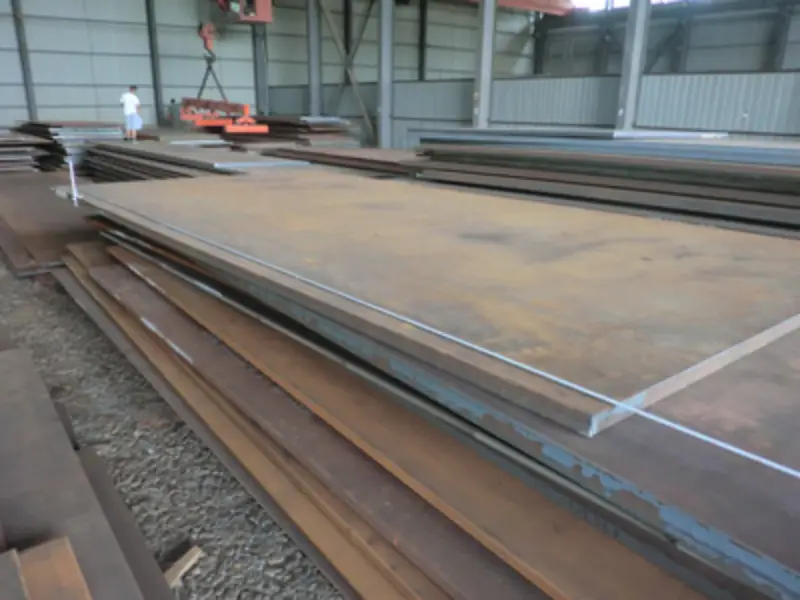
EN 10225 S355G5+M Offshore Platform Steel Plate
EN 10225 S355G5+M Offshore Platform Steel Plate - Full Material Data
Comprehensive technical data for S355G5+M thermomechanical rolled offshore structural steel plate: chemical composition, mechanical and physical properties, international equivalents, and typical applications.
Thermomechanical rolling (+M); suitable for cutting, forming, welding, and machining.
- Phone : +8618037372205
- Email : [email protected]
- WhatsApp: Contact via Whtsapp
- WeChat: +8618037372205
EN 10225 S355G5+M Offshore Platform Steel Plate Introduction
S355G5+M is a high-strength, low-alloy structural steel plate specifically designed for offshore structures, conforming to European standard EN 10225-1:2009. Delivered in the thermomechanically rolled (+M) condition, it offers a minimum yield strength of 355 MPa and excellent toughness at sub-zero temperatures. The 'G5' designation guarantees enhanced through-thickness properties (Z35 quality per EN 10164) and high impact energy absorption at -40°C. Typical applications include welded constructions on fixed offshore platforms, such as primary structural members, nodes, and heavy deck plates. Its fine-grained microstructure, achieved by controlled rolling, ensures good weldability and resistance to brittle fracture in harsh marine environments.
EN 10225 S355G5+M Offshore Platform Steel Plate Chemical Composition
The ladle analysis of S355G5+M is designed to ensure low carbon equivalent and good weldability. Microalloying with niobium, vanadium, and titanium provides grain refinement and precipitation strengthening. The very low sulfur content (≤0.010%) is essential for the Z35 quality through-thickness property requirement. Aluminum is added as a grain refiner and to bind nitrogen. Pcm and Ceq values are controlled to guarantee cold cracking resistance during welding.
| Chemical Element | Standard Value (wt. %) | Remarks |
|---|---|---|
| Carbon (C) | ≤0.14 | Typical aim ~0.07–0.11 |
| Silicon (Si) | ≤0.50 | Deoxidation element |
| Manganese (Mn) | ≤1.60 | Strength and toughness enhancer |
| Phosphorus (P) | ≤0.020 | Controlled for toughness |
| Sulfur (S) | ≤0.010 | Very low for Z35 quality |
| Chromium (Cr) | ≤0.25 | Residual element; may be intentionally added for strength in some casts |
| Nickel (Ni) | ≤0.30 | Residual; minor amount improves toughness |
| Molybdenum (Mo) | ≤0.08 | Residual element |
| Copper (Cu) | ≤0.30 | Residual element |
| Nitrogen (N) | ≤0.015 | Controlled; bound by Al, V, Ti |
| Aluminium (Al total) | ≥0.020 | Grain refining agent |
| Vanadium (V) | ≤0.06 | Microalloy for grain refinement and precipitation |
| Niobium (Nb) | ≤0.04 | Microalloy for grain refinement and strengthening |
| Titanium (Ti) | ≤0.03 | Grain refinement; improves HAZ toughness |
| Carbon Equivalent (CEV) | ≤0.43 | CEV = C + Mn/6 + (Cr+Mo+V)/5 + (Ni+Cu)/15; typical max for thickness ≤150 mm |
| Pcm (Welding Parameter) | Typically ≤0.24 (informative) | Pcm = C + Si/30 + (Mn+Cu+Cr)/20 + Ni/60 + Mo/15 + V/10 + 5B; used for weldability assessment |
EN 10225 S355G5+M Offshore Platform Steel Plate Thermal and Electrical Physical Properties
The following data represent typical physical properties for low‑alloy carbon steel plates of this type. They are not specified in EN 10225 and are provided for design guidance only. Actual values may vary slightly depending on the exact chemical composition and microstructure. Measurements are generally given for ambient temperature except where noted.
| Property | Typical Value | Unit | Test Condition / Temperature |
|---|---|---|---|
| Density (ρ) | 7850 | kg/m³ | At 20°C |
| Elastic Modulus (E) | 205 | GPa | 20°C, longitudinal |
| Shear Modulus (G) | 80 | GPa | 20°C, estimated |
| Poisson's Ratio (ν) | 0.29–0.30 | — | 20°C |
| Coefficient of Thermal Expansion (α) | 11.5–12.5 × 10−⁶ | K−¹ | 20–100°C; average value |
| Coefficient of Thermal Expansion (α) | 13.0–13.5 × 10−⁶ | K−¹ | 20–200°C |
| Thermal Conductivity (λ) | 45–52 | W/(m·K) | 20°C |
| Thermal Conductivity (λ) | 40–45 | W/(m·K) | 200°C |
| Specific Heat Capacity (cp) | 460–510 | J/(kg·K) | 20°C |
| Specific Heat Capacity (cp) | 520–550 | J/(kg·K) | 200°C |
| Electrical Resistivity (ρe) | 0.20–0.25 | µΩ·m | 20°C |
EN 10225 S355G5+M Offshore Platform Steel Plate Mechanical Properties
The mechanical properties are guaranteed in the +M delivery condition. Tensile testing is performed at ambient temperature, while impact testing confirms low-temperature toughness at -40°C. The 'G5' suffix implies Z35 through-thickness testing according to EN 10164, ensuring a minimum average reduction of area of 35% in the thickness direction. All values below refer to standard transverse specimens unless otherwise noted. Different thickness ranges dictate specific strength and ductility requirements.
| Property | Standard Required Value | Unit | Test Condition |
|---|---|---|---|
| Yield Strength (ReH) | 355 | MPa | Plate thickness t ≤ 16 mm |
| Yield Strength (ReH) | 345 | MPa | 16 mm < t ≤ 40 mm |
| Yield Strength (ReH) | 335 | MPa | 40 mm < t ≤ 63 mm |
| Yield Strength (ReH) | 325 | MPa | 63 mm < t ≤ 80 mm |
| Yield Strength (ReH) | 315 | MPa | 80 mm < t ≤ 100 mm |
| Yield Strength (ReH) | 295 | MPa | 100 mm < t ≤ 150 mm |
| Tensile Strength (Rm) | 470–630 | MPa | Plate thickness t ≤ 100 mm |
| Tensile Strength (Rm) | 450–600 | MPa | 100 mm < t ≤ 150 mm |
| Elongation (A5) | ≥22 | % | Gauge length 5.65√So, t ≤ 40 mm, longitudinal sample |
| Elongation (A200) | ≥19 | % | Gauge length 200 mm, t > 40 mm, longitudinal sample (approximate minimum) |
| Impact Energy (KV) | ≥50 (average), ≥35 (single value) | J | Charpy V-notch, longitudinal, -40°C |
| Impact Energy (KV) | ≥35 (average), ≥25 (single value) | J | Charpy V-notch, transverse, -40°C |
| Through-thickness Reduction of Area (Z) | ≥35 (average), ≥25 (single) | % | Z35 quality per EN 10164, test in thickness direction |
| Bend Test (180°) | No cracks or defects | — | Bend diameter 2t for t ≤ 16 mm; 3t for t > 16 mm (transverse sample) |
EN 10225 S355G5+M Offshore Platform Steel Plate Exact Equivalent Material Standards & Substitute Grades
| Country / Region | Standard | Grade | Remarks |
|---|---|---|---|
| European Union | EN 10225-1:2009 | S355G5+M | Original designation; covers all required properties (including Z35) |
EN 10225 S355G5+M Offshore Platform Steel Plate Application Introduction
S355G5+M is specifically engineered for offshore structural applications where reliability at low ambient temperatures and resistance to lamellar tearing are critical. It is widely used in welded fabrications that require high strength, excellent toughness, and guaranteed through‑thickness properties. Typical industries and components include:
Product Applications: Primary structural members of fixed offshore platforms, Heavy‑duty deck plates and stiffeners, Transition pieces and monopile components for offshore wind turbines, Tubular nodes, braces, and legs for jackets, Crane pedestals and flare booms
Processed into products: Welded tubular joints (K-, Y-, and T‑nodes), Legs and braces for jackets, Topside main girders and floor plates, Pile sleeves and reinforcing rings, Support structures for living quarters and helidecks, Base plates and flanges for offshore cranes, Structural elements of subsea templates
Application industries: Offshore oil & gas platform construction, Offshore wind turbine foundation fabrication, Jacket, topside, and module construction for marine environments, Shipbuilding (special structural elements when offshore standards extend)
EN 10225 S355G5+M Offshore Platform Steel Plate Similar / Comparable Material Alternatives
The grades listed below can be considered for substitution, but they often require additional agreements on through‑thickness (Z‑direction) properties and low‑temperature toughness to achieve the S355G5+M performance. Verification against the project specification is essential.
| Country / Region | Standard | Grade | Remarks |
|---|---|---|---|
| United Kingdom | BS 7191:1989 | 355EMZ | Very close; includes Z-quality (Z35). Check toughness at -40°C; covered by BS 7191 category "Z". |
| USA (API) | API 2W | Grade 50 with Z35 and supplementary Charpy at -40°C | API 2W covers offshore structural plates. Must specify Z35 and Charpy requirements separately. |
| USA (ASTM) | ASTM A572 / A572M | Grade 50 [345] with Supplementary S5 (Z35) and S18 (-40°C impact) | A572-50 base properties are slightly lower (yield 345 MPa). Enhanced toughness and Z-quality require additional ordering options. |
| Japan | JIS G 3106 | SM490YB with Z35 & -40°C Charpy agreement | SM490YB has nominal yield 365 MPa (t≤16mm). Through‑thickness and low‑temperature toughness must be negotiated. |
Notes:
Additional notes:
- Plates are usually supplied with a mill test certificate (EN 10204 Type 3.1 or 3.2) verifying chemical composition, mechanical properties, Z‑quality, and Charpy impact results.
- Ultrasonic testing to EN 10160 Class S1 or S2 is frequently specified for through‑thickness guarantee.
- Weldability is excellent due to the low carbon equivalent and fine‑grained microstructure; preheating is generally not required for moderate thicknesses when following correct welding procedures.
- For sour service or hydrogen‑induced cracking (HIC) resistance, additional requirements (e.g., HIC testing per NACE TM0284) must be agreed upon.
- Dimensional tolerances conform to EN 10029 or as agreed.
- Share



