
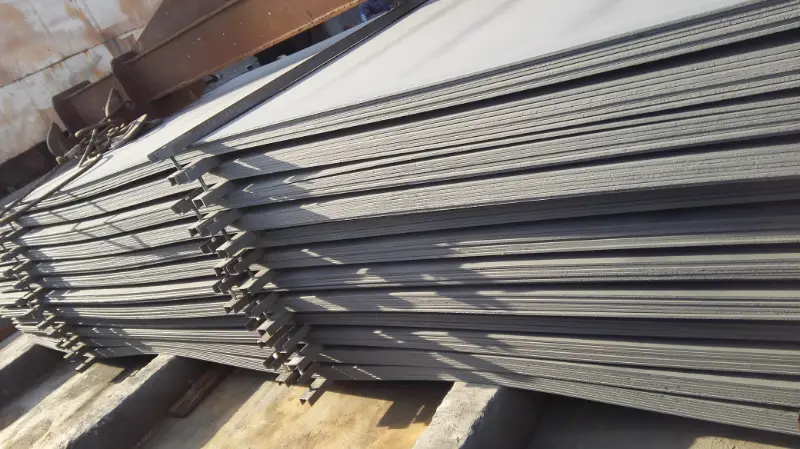
S355G6+M Offshore Platform Steel
S355G6+M Offshore Platform Steel: Arctic Toughness & 355 MPa Min Yield (EN 10225)
S355G6+M is a thermomechanically rolled offshore structural steel under EN 10225, delivering a minimum 355 MPa yield strength with guaranteed impact toughness of 50 J at -40 °C.
Welding, cold forming, cutting, machining, normalizing (optional), tempering (optional)
- Phone : +8618037372205
- Email : [email protected]
- WhatsApp: Contact via Whtsapp
- WeChat: +8618037372205
S355G6+M Offshore Platform Steel Introduction
S355G6+M is a high-strength low-alloy (HSLA) structural steel specified in EN 10225 for welded fixed offshore structures. It offers a minimum yield strength of 355 MPa and is supplied in the thermomechanically rolled (+M) condition, providing enhanced toughness at sub-zero temperatures down to -40 °C. The G6 notation indicates guaranteed Charpy V-notch impact energy of 50 J (longitudinal) at -40 °C. With its fine-grained microstructure and controlled alloying, S355G6+M exhibits excellent weldability, formability, and resistance to brittle fracture, making it ideal for primary and secondary structural components in offshore platforms, wind turbine foundations, and subsea installations. The material is fully killed and produced through a tightly controlled TMCP route, often with optional N (normalizing) or QT (quenching and tempering) treatments by agreement. Its balanced chemistry ensures low carbon equivalent (CEV ≤0.43 for t≤50 mm), allowing efficient welding without preheat under most fabrication conditions.
S355G6+M Offshore Platform Steel Chemical Composition
Values are maximum unless noted otherwise. CEV (Carbon Equivalent Value) ≤0.43% for thickness ≤50 mm ensures good weldability. The steel is fully killed with a minimum total aluminum content of 0.020%. Fine grain practice is achieved through controlled additions of niobium, vanadium, and titanium.
| Element | Specified Value (wt%) | Remarks |
|---|---|---|
| Carbon (C) | ≤0.14 | Typical for enhanced toughness and weldability |
| Silicon (Si) | ≤0.50 | Deoxidizer and strength contributor |
| Manganese (Mn) | ≤1.60 | Improves strength and hardenability |
| Phosphorus (P) | ≤0.020 | Control for low-temperature toughness |
| Sulfur (S) | ≤0.010 | Stringent control for cleanliness and through-thickness properties |
| Chromium (Cr) | ≤0.30 | Residual element, limited to avoid hardening |
| Molybdenum (Mo) | ≤0.10 | Trace element restriction |
| Nickel (Ni) | ≤0.70 | Beneficial for toughness at low temperatures |
| Copper (Cu) | ≤0.30 | Residual element |
| Aluminum (Al, total) | ≥0.020 | Grain refining and deoxidation |
| Niobium (Nb) | ≤0.05 | Microalloying for grain refinement and precipitation strengthening |
| Vanadium (V) | ≤0.10 | Microalloying element |
| Titanium (Ti) | ≤0.03 | Grain size control and nitrogen fixing |
| Nitrogen (N) | ≤0.012 | Strict limit to avoid aging and brittle fracture |
| CEV (IIW) | ≤0.43 | For thickness ≤50 mm; higher thickness may require lower CEV per standard |
S355G6+M Offshore Platform Steel Thermal and Electrical Physical Properties
The values below are generic for medium‑carbon structural steels and are provided as guidance for design and fabrication. Actual properties may vary slightly depending on exact chemistry and microstructure. Density is used for weight estimation, moduli for stiffness calculations, and thermal expansion for fit‑up and stress analysis. Thermal conductivity and specific heat influence weld cooling rates and pre‑/post‑weld heat treatments.
| Property | Typical Value | Unit | Temperature / Condition |
|---|---|---|---|
| Density (ρ) | 7850 | kg/m³ | Room temperature |
| Elastic modulus (E) | 210 | GPa | Room temperature |
| Shear modulus (G) | ≈81 | GPa | Room temperature |
| Poisson's ratio (ν) | 0.3 | – | Room temperature |
| Thermal expansion (α) | 11.1 | 10⁻⁶/K | 20 – 100 °C |
| Thermal expansion (α) | 12.5 | 10⁻⁶/K | 20 – 300 °C |
| Thermal expansion (α) | 13.5 | 10⁻⁶/K | 20 – 500 °C |
| Thermal conductivity (λ) | 53 | W/(m·K) | 20 °C |
| Thermal conductivity (λ) | 51 | W/(m·K) | 100 °C |
| Thermal conductivity (λ) | 46 | W/(m·K) | 300 °C |
| Specific heat capacity (c) | 460 | J/(kg·K) | 20 °C |
| Electrical resistivity (ρₑ) | ≈0.25 | µΩ·m | 20 °C |
S355G6+M Offshore Platform Steel Mechanical Properties
Properties are determined on flat test pieces in accordance with EN ISO 6892-1. Yield strength and tensile strength vary with plate thickness. Elongation is measured on a gauge length of 5.65√Sₒ. Charpy V‑notch impact test is performed at -40 °C; longitudinal values ≥50 J ensure reliable performance in Arctic conditions. Bend testing to 180° verifies ductility.
| Property | Specified Value | Unit | Test Condition / Thickness |
|---|---|---|---|
| Yield Strength (ReH) | ≥355 | MPa | t ≤16 mm |
| Yield Strength (ReH) | ≥345 | MPa | 16 < t ≤40 mm |
| Yield Strength (ReH) | ≥335 | MPa | 40 < t ≤63 mm |
| Yield Strength (ReH) | ≥325 | MPa | 63 < t ≤80 mm |
| Yield Strength (ReH) | ≥315 | MPa | 80 < t ≤100 mm |
| Yield Strength (ReH) | ≥295 | MPa | 100 < t ≤150 mm |
| Tensile Strength (Rm) | 470 – 630 | MPa | t ≤150 mm |
| Elongation (A₅) | ≥22 | % | t ≤40 mm, proportional test piece |
| Elongation (A₅) | ≥21 | % | 40 < t ≤63 mm |
| Elongation (A₅) | ≥20 | % | 63 < t ≤100 mm |
| Elongation (A₅) | ≥19 | % | 100 < t ≤150 mm |
| Charpy Impact Energy (KV₂) | ≥50 (longitudinal) | J | -40 °C, 10×10 mm V-notch |
| Charpy Impact Energy (KV₂) | ≥33 (transverse) | J | -40 °C, 10×10 mm V-notch |
| Bend Test (180°) | 3t | – | t ≤16 mm, no cracks |
| Bend Test (180°) | 4t | – | 16 < t ≤30 mm, no cracks |
| Bend Test (180°) | 5t | – | 30 < t ≤50 mm, no cracks |
| Bend Test (180°) | 6t | – | 50 < t ≤100 mm, no cracks |
S355G6+M Offshore Platform Steel Exact Equivalent Standards and Substitutable Grades
| Country / Region | Standard | Grade | Remarks |
|---|---|---|---|
| International | ISO 19902 | S355G6 | Fixed offshore structures; requirements identical to EN 10225 S355G6+M |
| Norway | NORSOK M-120 | Y35 (S355G6+M) | Standard for offshore structural steel; fully interchangeable |
| Denmark / Germany | DNV-OS-B101 | VL S355G6 | DNV rules for offshore structures; same chemistry and mechanical properties |
S355G6+M Offshore Platform Steel Application Introduction
S355G6+M is engineered for the demanding conditions of marine and offshore environments, where high strength, excellent weldability, and reliable low‑temperature toughness are critical. Its TMCP production route provides a favorable strength‑to‑weight ratio and allows for efficient fabrication of large, complex welded structures.
Product Applications: Offshore jacket platforms and topside modules, Monopile foundations, transition pieces, and tower sections for wind turbines, Subsea templates, manifolds, and suction anchors, Heavy-lift crane booms and offshore access structures
Processed into products: Primary beams, columns, and bracings, Tubular joints and node assemblies, Stiffeners, bulkheads, and diaphragm plates, Base plates, lifting lugs, and padeyes, Pile sleeves and mud mats
Application industries: Oil & Gas (upstream offshore), Renewable Energy (offshore wind), Shipbuilding & Marine Engineering, Heavy Civil Construction (bridges, locks)
S355G6+M Offshore Platform Steel Closely Related / Alternative Materials
| Country / Region | Standard | Grade | Remarks |
|---|---|---|---|
| European Union | EN 10025-4 | S355ML | Hot-rolled quenched and tempered fine-grain steel; similar yield and impact toughness, but not specifically for offshore. May require additional testing. |
| European Union | EN 10225 | S355G2+N | Same standard, lower toughness (G2 = -20 °C impact). Less suitable for Arctic conditions. |
| USA | ASTM A572/A572M | Grade 50 [345 MPa] | General structural steel; similar strength, but impact requirements and chemistry differ. Not offshore certified. |
| International | API RP 2A (API 2W) | Grade 50 / 50W | Offshore structural steel with enhanced through-thickness properties; requires supplementary requirements to match S355G6+M. |
Notes:
Welding: S355G6+M is readily weldable by all common arc processes. Preheat and interpass temperature control should follow EN 1011‑2 based on the calculated CEV. Z‑through‑thickness properties: When resistance to lamellar tearing is required, specify Z35 quality according to EN 10164. Certification: Material is supplied with EN 10204 3.2 inspection certificates; additional testing (e.g., CTOD, NACE MR0175) may be agreed upon.
- Share



