
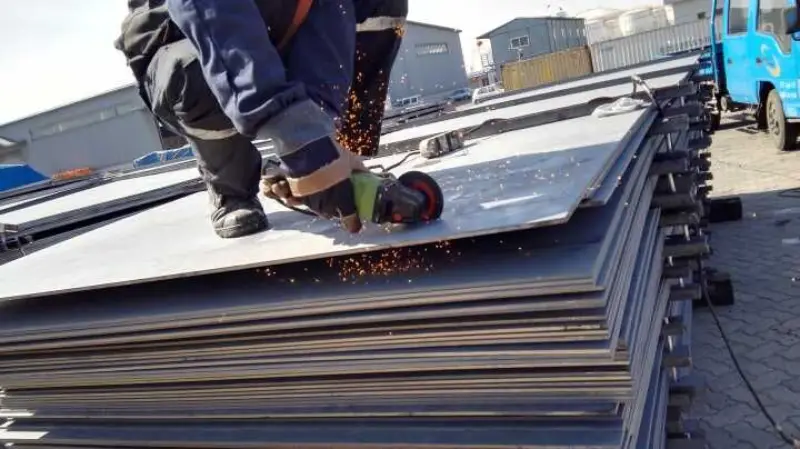
EN10225 Grade S355G2+N Offshore Platform Steel
EN10225 Grade S355G2+N Offshore Platform Steel - Data Sheet & Properties
Complete technical data for S355G2+N offshore structural steel to EN 10225: chemical composition, mechanical and physical properties, international equivalents and application guide for welded offshore platforms.
Welding, cutting, cold forming, hot forming, machining
- Phone : +8618037372205
- Email : [email protected]
- WhatsApp: Contact via Whtsapp
- WeChat: +8618037372205
EN10225 Grade S355G2+N Offshore Platform Steel Introduction
EN10225 S355G2+N is a normalized fine-grain structural steel specifically developed for fixed offshore structures. It combines a minimum yield strength of 355 MPa with excellent weldability and guaranteed Charpy impact toughness down to -20°C, making it suitable for harsh marine environments.
Key features:
- Hot-rolled and normalized (+N) condition for uniform properties through the thickness up to 100 mm
- Low carbon equivalent (CEV ≤0.43 for t≤40 mm) to ensure high weldability without preheating in moderate thicknesses
- Controlled chemical composition with fine-grain elements (Al, Nb, V, Ti) to achieve superior low-temperature toughness
- Compliance with classification society rules (DNV, ABS, LR) for offshore structures
- Excellent resistance to lamellar tearing and fatigue, critical for dynamically loaded jacket and foundation nodes.
The grade is widely used in jackets, topsides, transition pieces and other critical welded assemblies for oil & gas platforms and offshore wind farms.
EN10225 Grade S355G2+N Offshore Platform Steel Chemical Composition
The chemical composition is designed to provide high strength, good weldability and low-temperature toughness. All values are maxima unless a range is given. The fine-grain practice ensures grain refinement during normalizing. Aluminium is present to bind nitrogen and to guarantee the minimum grain size.
| Chemical Element | Standard Value (wt%) | Remarks |
|---|---|---|
| Carbon, C | ≤0.18 | |
| Silicon, Si | ≤0.55 | |
| Manganese, Mn | 0.90 – 1.65 | |
| Phosphorus, P | ≤0.020 | For thickness ≤100 mm |
| Sulfur, S | ≤0.010 | |
| Chromium, Cr | ≤0.25 | |
| Nickel, Ni | ≤0.30 | |
| Molybdenum, Mo | ≤0.08 | |
| Copper, Cu | ≤0.35 | |
| Niobium, Nb | ≤0.05 | |
| Vanadium, V | ≤0.10 | |
| Titanium, Ti | ≤0.03 | |
| Aluminium (total), Al | ≥0.015 | Minimum for grain refinement |
| Nitrogen, N | ≤0.012 | |
| Carbon Equivalent, CEV | ≤0.43 (t ≤40 mm) | Based on ladle analysis; CEV = C+Mn/6+(Cr+Mo+V)/5+(Ni+Cu)/15 |
EN10225 Grade S355G2+N Offshore Platform Steel Physical Properties
The following physical constants are representative of normalized S355G2 steel at room temperature unless otherwise noted. They are not mandatory requirements of EN 10225 but are useful for design calculations. Values can vary slightly with actual composition and processing.
| Property | Typical Value | Unit | Test Condition |
|---|---|---|---|
| Density (ρ) | 7850 | kg/m³ | At 20°C |
| Modulus of Elasticity (E) | 210 | GPa | At 20°C |
| Shear Modulus (G) | 81 | GPa | Typical |
| Poisson Ratio (ν) | 0.3 | – | Typical |
| Thermal Expansion Coefficient (α) | 11.1×10⁻⁶ | K⁻¹ | 20 – 100°C |
| Thermal Expansion Coefficient (α) | 12.3×10⁻⁶ | K⁻¹ | 20 – 200°C |
| Thermal Conductivity (λ) | 52 | W/(m·K) | At 20°C |
| Specific Heat Capacity (c) | 470 | J/(kg·K) | At 50°C |
| Electrical Resistivity (ρₑ) | 0.18×10⁻⁶ | Ω·m | At 20°C |
EN10225 Grade S355G2+N Offshore Platform Steel Mechanical Properties
Mechanical properties are determined on specimens taken from the normalized plate in accordance with EN 10225. Minimum values are guaranteed for thicknesses up to 100 mm. The Charpy V-notch impact test is performed at -20°C (G2 quality level) on longitudinal samples. Bend test is a routine quality check; for thicknesses not covered by standard ones, the largest tabulated value applies or can be agreed upon.
| Property | Required Value | Unit | Test Condition |
|---|---|---|---|
| Yield Strength (ReH) | 355 | MPa | Thickness ≤ 16 mm, longitudinal |
| Yield Strength (ReH) | 345 | MPa | Thickness >16 ≤ 40 mm |
| Yield Strength (ReH) | 335 | MPa | Thickness >40 ≤ 63 mm |
| Yield Strength (ReH) | 325 | MPa | Thickness >63 ≤ 80 mm |
| Yield Strength (ReH) | 315 | MPa | Thickness >80 ≤ 100 mm |
| Tensile Strength (Rm) | 470 – 630 | MPa | Thickness ≤ 100 mm, longitudinal |
| Elongation (A) | ≥22 | % | Gauge length 5.65√S₀, thickness ≤ 100 mm, longitudinal |
| Bend Test (180°) | D=2a (t≤16mm), D=3a (16<t≤63mm), D=4a (63<t≤100mm) | – | Transverse or longitudinal; a = specimen thickness |
| Charpy Impact (KV₂) | ≥50 (average) | J | At -20°C, longitudinal, V-notch; min. single ≥35 J |
EN10225 Grade S355G2+N Offshore Platform Steel Fully Equivalent Material Standards and Replaceable Grades
| Country/Region | Standard | Grade | Remarks |
|---|---|---|---|
| Europe | EN 10225:2009 | S355G2+N | Original material designation, normalized |
| International | ISO 19902 (referencing) | S355G2 | Fixed steel offshore structures – equivalent designation, directly refers to EN 10225 |
| United Kingdom | BS EN 10225 | S355G2+N | Identical British adoption |
| Germany | DIN EN 10225 | S355G2+N | Identical German adoption |
| France | NF EN 10225 | S355G2+N | Identical French adoption |
| Spain | UNE EN 10225 | S355G2+N | Identical Spanish adoption |
EN10225 Grade S355G2+N Offshore Platform Steel Application Introduction
S355G2+N plates are purpose-built for the demanding conditions of offshore structures. Their combination of high strength, excellent weldability and verified low-temperature toughness makes them the material of choice for primary load paths in fixed platforms and wind turbine foundations. Typical areas of use include:
Product Applications: Jacket structures (legs, braces, nodes), Topside modules (deck beams, stiffened panels), Monopile transition pieces, Tubular connections (Y, K, T joints), Subsea structural components
Processed into products: Welded tubular nodes and can sections, Cantilever beams and flare booms, Stiffened panels under fatigue loading, Flanges and gusset plates, Lifting padeyes and trunnion supports, Transition pieces between monopile and tower
Application industries: Offshore Oil & Gas (platforms, FPSOs), Renewable Energy (offshore wind turbine foundations, transition pieces), Marine & Civil Engineering (coastal protection, port structures)
EN10225 Grade S355G2+N Offshore Platform Steel Similar/Alternative Materials
| Country/Region | Standard | Grade | Remarks |
|---|---|---|---|
| Europe | EN 10225 | S355G1+M | Thermomechanical rolled, yield ~355 MPa, but Charpy test at -10°C (lower toughness); often used where lower toughness is acceptable |
| Europe | EN 10225 | S355G3+N | Normalized, yield ~355 MPa, Charpy at -40°C (higher toughness); used in severe low-temperature offshore locations |
| Europe | EN 10025-3 | S355N | Normalized structural steel for general construction; similar chemistry and strength but not specifically offshore certified (no through-thickness property guarantee) |
| Europe | EN 10025-6 | S500QL1 | Quenched and tempered high-strength steel, much higher yield but different carbon equivalent and welding requirement |
| USA | ASTM A572/A572M | Grade 50 [345] | Similar yield but lower guarantee on toughness (typically not impact tested unless specified); not a direct offshore grade |
| USA | API 2W | Grade 50 | Weldable offshore structural steel, minimum yield 345 MPa, Charpy at specified temperature; can substitute with careful design and welding procedure qualification |
Notes:
For thicknesses >100 mm, mechanical properties may be modified by agreement. The steel is normally certified by a notified body or classification society (e.g., DNV, ABS, LR). Welding: Preheating is generally not required for thicknesses ≤40 mm when CEV ≤0.43; for thicker sections or higher CEV, follow EN 1011-2 recommendations. Through-thickness properties (Z-quality) can be specified according to EN 10164 if required to avoid lamellar tearing. Surface condition is typically as-rolled or blast-cleaned to SA 2½.
- Share



