
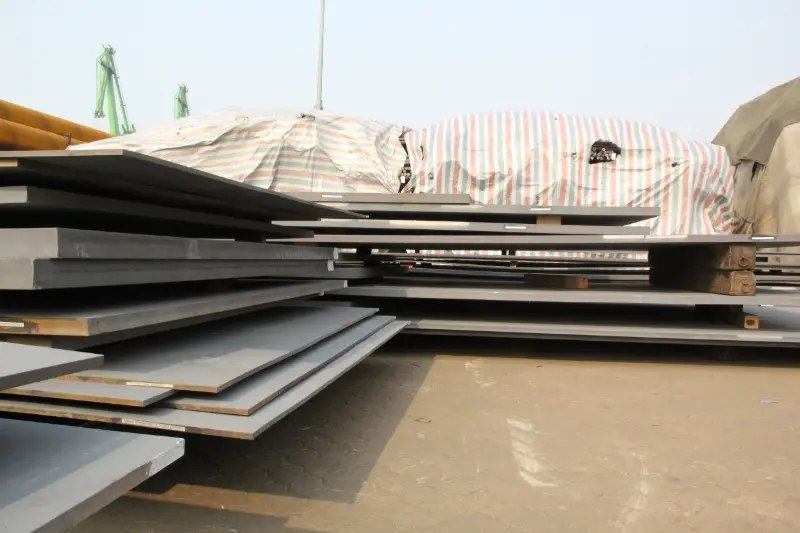
NK Grade F70 Shipbuilding Steel Plate
NK Grade F70 Shipbuilding Steel Plate: High-Strength Structural Steel for Arctic-Class Vessels
Comprehensive technical data for NK Grade F70 shipbuilding steel plate: chemical composition, mechanical properties, thermal and electrical physical properties, international equivalents, and application guidelines.
Hot rolling, TMCP, quenching and tempering; subsequent processing: welding (all common methods), flame/plasma/laser cutting, cold and hot forming, machining
- Phone : +8618037372205
- Email : [email protected]
- WhatsApp: Contact via Whtsapp
- WeChat: +8618037372205
NK Grade F70 Shipbuilding Steel Plate Introduction
NK Grade F70 is a high-strength shipbuilding structural steel plate classified by Nippon Kaiji Kyokai (ClassNK) for use in the construction of hulls and marine structures. It belongs to the 460 MPa minimum yield strength category with guaranteed impact toughness at -60 °C (F-grade), making it suitable for ships operating in arctic or severe cold environments.
The steel is typically supplied in the thermo-mechanical control processed (TMCP) or quenched and tempered (QT) condition to achieve a fine-grained microstructure that balances high strength, excellent weldability, and superior low-temperature toughness. Stringent limits on carbon equivalent (CEV) and controlled additions of microalloying elements such as niobium, vanadium, and titanium ensure good cold formability and resistance to brittle fracture. NK F70 plates are widely used for critical structural components like decks, bottom shells, and bulkheads in large container ships, LNG carriers, and offshore platforms.
NK Grade F70 Shipbuilding Steel Plate Chemical Composition
The chemical composition of NK Grade F70 is governed by the NK Rules, which incorporate IACS UR W11 requirements for high-strength shipbuilding steels. Values are specified as ladle analysis percentages. Maximum limits apply unless a range is given. The carbon equivalent (CEV) shall not exceed 0.41% (for thickness ≤100 mm) to ensure good weldability. Fine grain practice with sufficient aluminum or other grain-refining elements is mandatory.
| Element | Specified Value (max unless shown) | Remarks |
|---|---|---|
| Carbon (C) | ≤0.20 | Ladle analysis; typical aim 0.08–0.14 |
| Silicon (Si) | ≤0.55 | Killed steel practice |
| Manganese (Mn) | ≤1.70 | Higher Mn contributes to strength and toughness |
| Phosphorus (P) | ≤0.025 | Strictly controlled for low-temperature toughness |
| Sulfur (S) | ≤0.025 | Low sulfur for ductility and through-thickness properties |
| Aluminum (Al) total | ≥0.015 | Grain refining element; if not used, other grain refiners to be agreed |
| Niobium (Nb) | ≤0.06 | Microalloying for grain refinement and precipitation strengthening |
| Vanadium (V) | ≤0.10 | May be used in combination with Nb |
| Titanium (Ti) | ≤0.02 | Enhances high-heat-input weldability |
| Copper (Cu) | ≤0.35 | Residual element; beneficial for atmospheric corrosion resistance |
| Chromium (Cr) | ≤0.25 | Maximum residual |
| Nickel (Ni) | ≤0.40 | Improves toughness at low temperatures; may be higher by agreement |
| Molybdenum (Mo) | ≤0.08 | Optional, improves strength after tempering |
| Nitrogen (N) | ≤0.012 | Bound by nitride-forming elements |
| Carbon Equivalent (CEV) | ≤0.41 | CEV = C + Mn/6 + (Cr+Mo+V)/5 + (Ni+Cu)/15; for thickness ≤100 mm |
NK Grade F70 Shipbuilding Steel Plate Thermal and Electrical Physical Properties
The following physical properties are typical for low-carbon microalloyed steel of this strength level and are provided as engineering reference data. They are not mandatory acceptance criteria in the NK Rules. Values are valid at room temperature (20 °C) unless otherwise noted. Properties like thermal conductivity and thermal expansion vary with temperature; several values are given for a range.
| Property | Value | Unit | Test Condition / Temperature |
|---|---|---|---|
| Density (ρ) | 7850 | kg/m³ | 20 °C |
| Elastic Modulus (E) | 205 – 210 | GPa | 20 °C, typical for constructional steel |
| Shear Modulus (G) | ~80 | GPa | 20 °C |
| Poisson's Ratio (ν) | 0.28 – 0.30 | — | Elastic range |
| Thermal Expansion Coefficient (α) | 11.5 × 10⁻⁶ | 1/K | 20–100 °C |
| Thermal Expansion Coefficient (α) | 12.5 × 10⁻⁶ | 1/K | 20–300 °C |
| Thermal Conductivity (λ) | 51 | W/(m·K) | 20 °C |
| Thermal Conductivity (λ) | 46 | W/(m·K) | 200 °C |
| Specific Heat Capacity | 460 | J/(kg·K) | 20–100 °C |
| Electrical Resistivity (ρ_e) | 0.22 – 0.27 | μΩ·m | 20 °C |
NK Grade F70 Shipbuilding Steel Plate Mechanical Properties
Mechanical properties are determined on samples taken in the longitudinal direction, as required by NK Rules. The values below apply to plates of thickness ≤50 mm unless stated otherwise. For thicker plates (e.g., 50–70 mm), the minimum yield strength is reduced to 440 MPa. Charpy impact test temperature is -60 °C (F-grade). Bending test shall be performed with a mandrel diameter of 4 times the plate thickness for thicknesses up to 50 mm, and no cracks shall appear.
| Property | Specified Value | Unit | Test Condition |
|---|---|---|---|
| Yield Strength (ReH) | ≥460 | MPa | Transverse or longitudinal, t ≤ 50 mm; 0.2% proof stress for thickness > 70 mm |
| Tensile Strength (Rm) | 570 – 720 | MPa | Longitudinal test piece, all thicknesses |
| Elongation (A) | ≥17 | % | Gauge length 5.65√So, longitudinal, t ≤ 50 mm |
| Elongation (A) | ≥16 | % | Transverse, t ≤ 50 mm (for information); longitudinal may be used for acceptance |
| Charpy Impact Energy (KV) | ≥46 | J | Longitudinal, -60 °C, average of 3 specimens; minimum individual 30 J |
| Charpy Impact Energy (KV) | ≥31 | J | Transverse, -60 °C, average of 3 specimens (if required by buyer) |
| Bending Test | d = 4a (180°) | — | Mandrel diameter 4 × plate thickness (a); no cracks; all thicknesses ≤50 mm |
NK Grade F70 Shipbuilding Steel Plate Exact Equivalent Material Standards and Substitution Designations
| Country / Region | Standard / Classification Society | Grade / Designation | Remarks |
|---|---|---|---|
| International | IACS UR W11 | EH46 / FH46 (yield 460, -60°C) | Unified Requirement for extra-high strength ship steel |
| USA | ABS (American Bureau of Shipping) | EH46 | Charpy at -60 °C; all essential requirements identical |
| UK | LR (Lloyd's Register) | FH46 | F-grade denotes -60 °C test temperature |
| Norway / Germany | DNV (Det Norske Veritas) | F460 | Yield strength 460 MPa; F = -60 °C |
| France | BV (Bureau Veritas) | A460 | A-grade represents -60 °C (BV notation) |
| China | CCS (China Classification Society) | F460 | Equivalent to IACS UR W11 |
| Korea | KR (Korean Register) | FH46 | Same mechanical and toughness requirements |
| Italy | RINA (Registro Italiano Navale) | F460 | Full equivalence |
| Russia | RS (Russian Maritime Register of Shipping) | F460 | According to RS Rules Part XIII |
NK Grade F70 Shipbuilding Steel Plate Application Introduction
NK Grade F70 steel is engineered for demanding structural applications where high strength, weldability, and superior low-temperature toughness are essential. The following list highlights typical industries, products, and components that benefit from this grade.
Product Applications: Ocean-going container ship hull plates and stiffeners, Bulk carrier and tanker deck and bottom plates, Offshore platform deck girders and legs, Wind turbine installation vessel crane pedestals, Ice-strengthened hull structures for polar-class ships
Processed into products: Longitudinal frames and stringers, Transverse web frames and floors, Bilge keels and shell plating, Hat coamings and hatch covers (heavy sections), Offshore crane booms and king posts, Mooring equipment supports and bollard foundations, Transition pieces in jacket structures
Application industries: Shipbuilding (commercial and naval vessels), Offshore oil and gas (jack-up rigs, semisubmersibles, FPSOs), LNG/LPG carrier construction, Arctic engineering and icebreaker hulls, Heavy machinery and lifting equipment (offshore cranes, heavy-lift frames), Bridge construction (particularly in cold climates)
NK Grade F70 Shipbuilding Steel Plate Similar and Nearly Equivalent Alternative Materials
| Country / Region | Standard | Grade | Comparative Remarks |
|---|---|---|---|
| Europe | EN 10025-4 | S460MLO (EN 10025-4) | Thermomechanical rolled, minimum yield 460 MPa, impact tested at -50 °C (LO option for longitudinal). Not identical due to higher impact temperature, but suitable for less severe conditions. |
| Japan | JIS G 3106 | SM570 | Rolled steel for welded structure, min yield 460 MPa, but no mandatory low-temperature impact requirement. Can be ordered with supplementary impact test to -40 °C or -50 °C, but not to -60 °C as standard. |
| USA | ASTM A709 / A709M | Grade 50S (345 MPa) | Lower strength; for 460 MPa see ASTM A913 Grade 65 or A572 Grade 65. However, low-temperature toughness up to -60 °C is not guaranteed; typically only down to -34 °C. |
| China | GB/T 712 | F460 | Chinese shipbuilding steel with equivalent chemistry and mechanical properties, but mandatory impact test temperature is -60 °C, just like NK F70. Often used interchangeably. |
Notes:
Welding recommendations: Preheat and interpass temperatures must be controlled according to plate thickness and applicable welding consumables (typically 50–150 °C). Low-hydrogen welding processes (SMAW with basic electrodes, SAW, GMAW) are required to avoid hydrogen-induced cold cracking.
Through-thickness properties: If Z-direction tensile or impact requirements are needed (e.g., for lamellar tearing resistance), the steel should be ordered with Z-grade supplementary designation (e.g., Z25, Z35) and tested per NK Rules.
Surface condition and inspection: Plates are normally delivered with as-rolled or descaled surface. Ultrasonic testing per class society rules (e.g., ASTM A578, EN 10160) may be agreed upon for critical areas.
Certification: Material certification according to EN 10204 type 3.1 or 3.2 (with surveyor's inspection) is standard for shipbuilding plates.
- Share



