
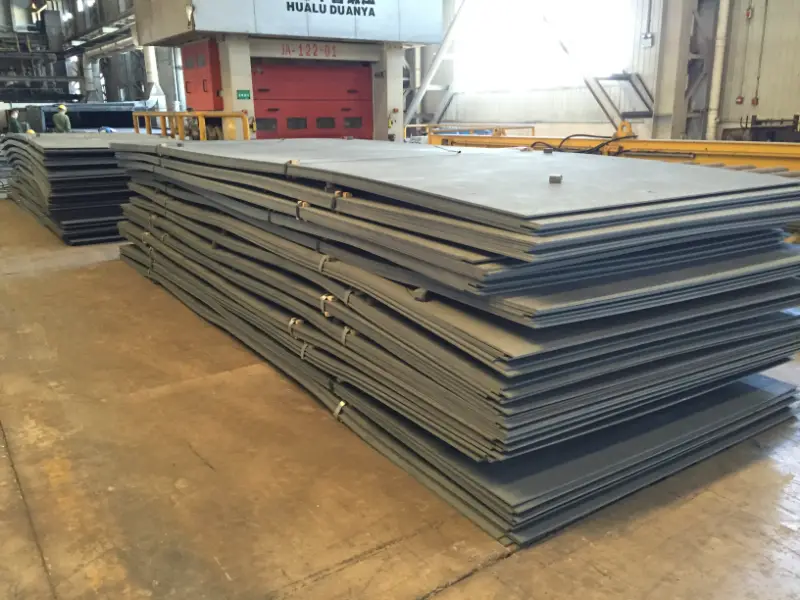
NK Grade E70 Shipbuilding Steel Plate
NK Grade E70 Shipbuilding Steel Plate – High-Strength Hull Structural Steel with -40°C Impact Toughness
Comprehensive material data for NK Grade E70 shipbuilding steel plate according to ClassNK rules. Includes chemical composition, mechanical properties, thermal and electrical physical properties, international equivalent grades, similar alternatives, and application guidance for marine and offshore structures.
Welding (SMAW, SAW, GMAW, FCAW), bending, cold forming (with attention to minimum bend radius), cutting (plasma, laser, oxy-fuel), machining
- Phone : +8618037372205
- Email : [email protected]
- WhatsApp: Contact via Whtsapp
- WeChat: +8618037372205
NK Grade E70 Shipbuilding Steel Plate Introduction
NK Grade E70 is a high-strength shipbuilding structural steel plate classified by Nippon Kaiji Kyokai (ClassNK) for marine and offshore applications. It belongs to the EH70 category, indicating a minimum yield strength of 70 ksi (483 MPa) and guaranteed Charpy V-notch impact energy at -40°C. This quenched and tempered steel is designed for critical hull members such as deck plating, shell plating, and longitudinal strength members that require excellent strength-to-weight ratios and reliable low-temperature toughness. The steel is produced to fine grain practice and often microalloyed with niobium, vanadium, or titanium to achieve the required mechanical properties. Delivery condition is typically in the normalized or quenched and tempered state, ensuring uniform properties through thickness for plates up to 100 mm.
NK Grade E70 Shipbuilding Steel Plate Chemical Composition
The chemical composition of NK Grade E70 steel complies with ClassNK regulations for high-strength hull structural steels. The values below represent the maximum limits unless a range is stated. Microalloying elements such as Nb, V, Ti may be added singly or in combination to ensure fine grain size and enhanced mechanical properties. The carbon equivalent (CE) is typically controlled to ensure good weldability; CE = C + Mn/6 + (Cr+Mo+V)/5 + (Ni+Cu)/15 usually limited to ≤0.45% for sections over 50 mm.
| Element | Standard Value (wt%) | Remarks |
|---|---|---|
| Carbon (C) | ≤0.20 | Ladle analysis; typical 0.14–0.18 |
| Manganese (Mn) | 0.90–1.60 | Higher end for thicker plates |
| Silicon (Si) | ≤0.55 | Deoxidation element |
| Phosphorus (P) | ≤0.035 | Maximum allowed |
| Sulfur (S) | ≤0.035 | Maximum allowed |
| Chromium (Cr) | ≤0.25 | Residual or intentional; may be specified to 0.30 max |
| Nickel (Ni) | ≤0.40 | May be higher for improved toughness |
| Molybdenum (Mo) | ≤0.08 | Residual or intentional |
| Copper (Cu) | ≤0.35 | Residual from scrap |
| Aluminium (Al, acid soluble) | ≥0.015 | Grain refining; typical 0.020–0.050 |
| Niobium (Nb) | ≤0.05 | Microalloy for grain refinement and precipitation strengthening |
| Vanadium (V) | ≤0.10 | Optional microalloy |
| Titanium (Ti) | ≤0.02 | Optional; used as grain refiner |
| Nitrogen (N) | ≤0.012 | Controlled for fine grain practice |
NK Grade E70 Shipbuilding Steel Plate Thermal and Electrical Physical Properties
The physical properties listed below are typical for low-alloy, quenched and tempered structural steels and are not part of the mandatory ClassNK specification. They are provided for design calculations. Values are at room temperature unless stated otherwise.
| Property | Standard Requirement (Typical) | Unit | Test Condition / Remarks |
|---|---|---|---|
| Density (ρ) | 7850 | kg/m³ | At 20°C |
| Modulus of Elasticity (E) | 205 | GPa | At 20°C; in tension |
| Shear Modulus (G) | 80 | GPa | At 20°C; calculated from E and ν |
| Poisson's Ratio (ν) | 0.3 | – | Elastic range |
| Thermal Expansion Coefficient (α) | 11.5 × 10⁻⁶ | 1/K | Mean value between 20°C and 100°C |
| Thermal Conductivity (λ) | 42 | W/(m·K) | At 20°C |
| Specific Heat Capacity (cp) | 460 | J/(kg·K) | At 20°C |
| Electrical Resistivity (ρe) | 0.22 × 10⁻⁶ | Ω·m | At 20°C |
NK Grade E70 Shipbuilding Steel Plate Mechanical Properties
Mechanical properties are determined in accordance with ClassNK rules using test specimens taken in the transverse direction unless otherwise agreed. Yield strength is 0.2% offset or lower yield point. Impact testing is performed on longitudinal Charpy V-notch specimens at -40°C, with a minimum average energy of 34 J (27 J for single value). Properties below are for quenched and tempered condition and apply to plates up to 100 mm thickness; for thicker plates, slightly reduced strength may be accepted.
| Property | Standard Requirement (Typical) | Unit | Test Condition / Remarks |
|---|---|---|---|
| Yield Strength (ReH) | ≥483 (70 ksi) | MPa (ksi) | Transverse, t ≤ 100 mm |
| Tensile Strength (Rm) | 552–689 (80–100 ksi) | MPa (ksi) | Transverse, all thicknesses |
| Elongation (A, 5.65√So) | ≥16 | % | Gauge length 50 mm (2 in) or proportional; minimum for plates |
| Charpy V-Notch Impact Energy (KV) | ≥34 (average), ≥27 (single) | J | -40°C, longitudinal specimen |
| Bend Test (180°) | No cracks or defects | D = 3t (t = plate thickness) for tensile side; mandrel diameter may vary with strength |
NK Grade E70 Shipbuilding Steel Plate Fully Equivalent Material Standards and Replaceable Grade Recommendations
The following grades are recognized by various classification societies as direct equivalents to NK Grade E70 for high-strength shipbuilding structural steel with 70 ksi yield and -40°C impact toughness. They can be used interchangeably under the respective society's rules, subject to any additional requirements.
| Country / Region | Standard | Grade | Remarks |
|---|---|---|---|
| USA / International | ABS Rules | ABS EH70 | Same chemical and mechanical requirements |
| UK / International | LR Rules | LR EH70 | Identified as EH70 in Lloyd's Register |
| Norway / International | DNV Rules | DNV E70 | Matches property requirements |
| France / International | BV Rules | BV EH70 | Bureau Veritas equivalent |
| China / International | CCS Rules | CCS EH70 | China Classification Society |
| Italy / International | RINA Rules | RINA E70 | Registro Italiano Navale |
| South Korea / International | KR Rules | KR EH70 | Korean Register |
| Russia / International | RS Rules | RS E70 | Russian Maritime Register |
| India / International | IRS Rules | IRS EH70 | Indian Register of Shipping |
NK Grade E70 Shipbuilding Steel Plate Application Introduction
NK Grade E70 plate is extensively used in shipbuilding and offshore engineering where high strength and low-temperature toughness are essential. Its combination of 70 ksi yield strength and -40°C impact property makes it suitable for ice-class vessels, heavy-lift ships, and structural components exposed to Arctic environments. The steel can be welded with low-hydrogen processes and is compatible with standard fabrication techniques. Preheating and post-weld heat treatment requirements depend on thickness and applicable welding codes.
Product Applications: Cargo ship hull plates (shell, deck, bottom), Transverse and longitudinal bulkheads, Rudder horns and stern frames, Container vessel cell guides and hatch coamings, Jack-up rig leg segments, Crane pedestals and boom sections for heavy-lift vessels, Arctic-class vessel ice belts
Processed into products: Deck plating panels, Shell plating strakes (sheer, sheerstroke), Bottom plating and bilge keels, Web frames and longitudinal stiffeners, Bracket plates and floor plates, Hatch cover panels, Reinforcement plates for mooring and towing arrangements, Skeg and skeg horns
Application industries: Shipbuilding (container ships, bulk carriers, tankers, LNG carriers, icebreakers), Offshore oil & gas (platform decks, jacket legs, helideck structures), Marine renewable energy (offshore wind turbine foundations, wave energy structures), Heavy-lift and salvage vessels, Naval architecture and marine engineering consulting
NK Grade E70 Shipbuilding Steel Plate Similar / Alternative Material Recommendations
The following grades offer comparable yield strength to NK E70 but may have different impact test temperatures, chemical compositions, or delivery conditions. They can be considered as alternatives after engineering evaluation, especially when identical certifying society approval is not mandatory. ND: normalized, Q&T: quenched and tempered, TM: thermo-mechanical.
| Country / Region | Standard | Grade | Remarks |
|---|---|---|---|
| Europe | EN 10025-6 | S460Q / S460QL / S460QL1 | 460 MPa yield, Q&T; impact down to -40°C or lower; slightly lower yield but often acceptable with thickness adjustment |
| USA | ASTM A514/A514M | Grade E (690 MPa UTS) | 690 MPa tensile, 100 ksi min; Q&T plate for structural use; yield ~620 MPa; higher strength, requires careful welding |
| USA | ASTM A710/A710M | Grade A, Class 3 (70 ksi yield) | Age-hardening ferritic steel, 70 ksi yield; used in naval and marine applications; similar strength but different alloy concept |
| International | ABS Rules | ABS EH47 | Yield 460 MPa, -40°C impact; slightly lower strength than 483 MPa but often considered a direct substitute in many designs |
| Japan | JIS G 3128 | SHY 685 / SHY 685N | High yield strength steel for welded structures; 685 N/mm² tensile, yield ~550 MPa; higher strength level, may require re-evaluation |
Notes:
Weldability: NK E70 steel has a controlled carbon equivalent (typical ≤0.45%) and is suitable for welding with conventional low-hydrogen consumables. Preheating is recommended when plate thickness exceeds 30 mm or when ambient conditions are cold. Corrosion resistance: As a standard structural steel, adequate protective coatings (paint, epoxy) must be applied for marine service. Special modifications for increased atmospheric corrosion resistance are available upon request (e.g., weathering grade). Availability: Plates are normally supplied with ClassNK certification (3.1 or 3.2 per EN 10204). Thickness range generally up to 100 mm; wider and longer plates can be produced from TMCP rolling. Additional testing: Ultrasonic testing (UT) per EN 10160 or ASTM A435/A435M is often performed to ensure internal soundness. Z-direction properties (through-thickness tensile) may be specified for critical welded joints according to ClassNK guidelines.
- Share



