
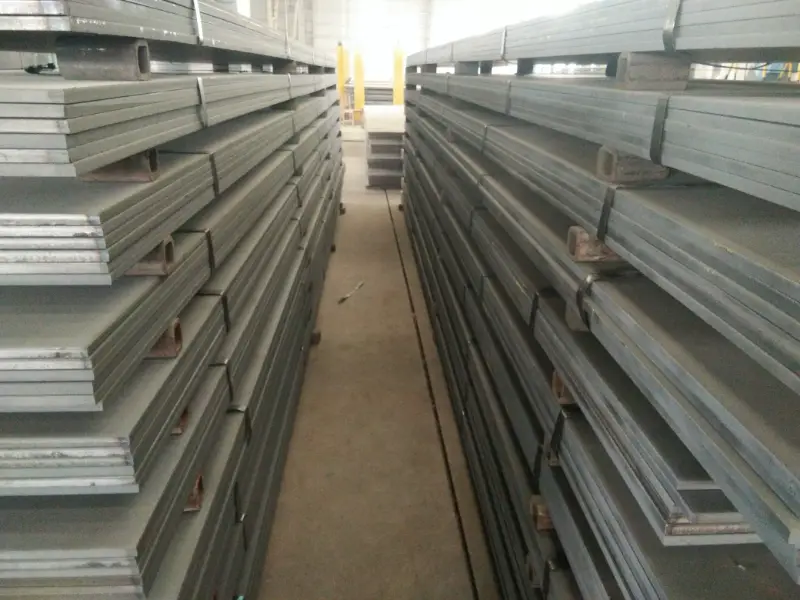
NK Grade D70 Shipbuilding Steel Plate
NK Grade D70 Shipbuilding Steel Plate - Technical Data & Equivalents
Comprehensive material properties of NK Grade D70 shipbuilding plate, a high-tensile steel with minimum yield strength 685 MPa for offshore and marine structures.
Quenched and tempered (Q&T); can be cut, cold-formed, and welded using appropriate preheating and low-hydrogen processes
- Phone : +8618037372205
- Email : [email protected]
- WhatsApp: Contact via Whtsapp
- WeChat: +8618037372205
NK Grade D70 Shipbuilding Steel Plate Introduction
NK Grade D70 is a high-strength shipbuilding steel plate certified by Nippon Kaiji Kyokai (ClassNK). It is classified under the HT70 (High Tensile 70 kgf/mm²) category, offering a minimum yield strength of 685 MPa. The letter 'D' indicates excellent notch toughness, with Charpy V-notch impact testing at -20°C. This quenched and tempered steel delivers an outstanding combination of high strength, good weldability, and reliable low-temperature toughness, making it ideal for critical structural components in large container ships, offshore platforms, and heavy-lift crane vessels. Its controlled rolling and heat treatment ensure uniform mechanical properties across thick sections, while strict ladle analysis limits guarantee consistent quality for demanding marine environments.
NK Grade D70 Shipbuilding Steel Plate Chemical Composition
The chemical composition of NK Grade D70 (HT70) complies with the requirements of the NK Rules for high-tensile steel. Strict limits on phosphorus and sulfur ensure high purity, while microalloying with elements like niobium, vanadium, titanium, or chromium improves strength and toughness. A low carbon equivalent (Ceq) is mandatory to maintain good weldability. Values shown are maximum unless a range is given.
| Chemical Element | Standard Value (max %) | Remarks |
|---|---|---|
| Carbon (C) | 0.18 | Ladle analysis; lower C improves weldability |
| Silicon (Si) | 0.55 | Deoxidizing agent; may be lower in thin plates |
| Manganese (Mn) | 1.60 | Primary solid-solution strengthening element |
| Phosphorus (P) | 0.025 | Strictly limited for toughness |
| Sulfur (S) | 0.025 | Strictly limited for toughness (low HIC risk) |
| Chromium (Cr) | 0.30 | Optional alloying; may be higher by agreement |
| Nickel (Ni) | 0.50 | Optional for low-temperature toughness |
| Molybdenum (Mo) | 0.15 | Enhances hardenability and temper resistance |
| Copper (Cu) | 0.20 | May be present from scrap or by design for corrosion resistance |
| Niobium (Nb) | 0.06 | Microalloying for grain refinement |
| Vanadium (V) | 0.10 | Microalloying for precipitation strengthening |
| Titanium (Ti) | 0.02 | Optional; refines grain size |
| Aluminum (Al) | 0.020 min. (total) | Sufficient aluminum is required for fine-grain practice |
| Nitrogen (N) | 0.012 | Typically bound by microalloyed Ti or Al |
| Carbon Equivalent (Ceq) | 0.42 (typically) | Ceq = C + Mn/6 + (Cr+Mo+V)/5 + (Ni+Cu)/15; must meet weldability criteria |
NK Grade D70 Shipbuilding Steel Plate Thermal and Electrical Physical Properties
The following physical properties are representative for quenched and tempered high-strength low-alloy steel of similar composition to NK D70. Actual values may vary slightly with heat treatment and exact chemical composition. These data are useful for design calculations involving thermal expansion, heat transfer, and structural stiffness.
| Property | Typical Value | Unit | Test Condition / Reference Temperature |
|---|---|---|---|
| Density (ρ) | 7850 | kg/m³ | Room temperature |
| Modulus of Elasticity (E) | 205 – 210 | GPa | Room temperature, static tensile |
| Shear Modulus (G) | 79 – 81 | GPa | Room temperature (calculated from E and ν) |
| Poisson's Ratio (ν) | 0.28 – 0.30 | — | Elastic range |
| Mean Coefficient of Thermal Expansion (α) | 11.5 × 10⁻⁶ | 1/K | Between 20°C and 100°C |
| Mean Coefficient of Thermal Expansion (α) | 12.5 × 10⁻⁶ | 1/K | Between 20°C and 400°C |
| Thermal Conductivity (λ) | 38 – 42 | W/(m·K) | At 20°C |
| Specific Heat Capacity (cₚ) | 460 – 500 | J/(kg·K) | At 20°C |
| Electrical Resistivity (ρₑ) | 0.16 – 0.22 | μΩ·m | At 20°C |
NK Grade D70 Shipbuilding Steel Plate Mechanical Properties
Mechanical properties are determined after quenching and tempering in accordance with NK Rules. The steel exhibits very high strength and good ductility. Tensile and Charpy tests are performed on samples taken from the plate in the transverse direction unless otherwise agreed. The minimum yield strength of 685 MPa is valid for thicknesses up to a specified limit (typically 100 mm depending on the manufacturer); for thicker plates, slightly reduced minimum values may apply upon agreement.
| Property | Required Value | Unit | Test Condition |
|---|---|---|---|
| Yield Strength (ReH) | ≥ 685 | MPa | Ambient temperature; guaranteed for thickness ≤ 50 mm (may be lower for thicker sections per NK approval) |
| Tensile Strength (Rm) | 770 – 940 | MPa | Ambient temperature |
| Elongation (A5) | ≥ 14 | % | Gauge length 50 mm; transverse specimen |
| Bend Test (D - bend diameter, a - specimen thickness) | No cracks or defects | — | Bend angle 180°; D = 4a for thickness ≤ 25 mm (extended requirements may apply) |
| Charpy V-notch Impact Energy (KV2) | ≥ 41 (longitudinal) | J | At -20°C, average of three specimens; minimum single value 28 J |
| Charpy V-notch Impact Energy (KV2) | ≥ 27 (transverse) | J | At -20°C, when transverse tests are required (e.g., for certain structures) |
| Hardness | ≤ 270 HBW (typical) | HBW | Not normally required by NK but may be specified; indicative value |
NK Grade D70 Shipbuilding Steel Plate Completely Equivalent Standards and Substitute Grades
| Country / Region | Standard | Grade | Remarks |
|---|---|---|---|
| International (IACS) | UR W11 | DH70 | Harmonized rule for offshore structural steel; D indicates -20°C impact |
| Japan | NK Rules Part K | D70 | Base specification – HT70 quality |
| USA | ABS | DH70 | American Bureau of Shipping – High-strength structural steel |
| UK | LR | DH70 | Lloyd's Register – Hull structure steel |
| France | BV | DH70 | Bureau Veritas – Marine steel grade |
| Norway/Germany | DNV | DH70 / NVE70 | DNV rules; may be specified as NVE70 for offshore extra toughness |
| China | CCS | DH70 | China Classification Society – Equivalent to NK D70 |
| South Korea | KR | DH70 | Korean Register of Shipping – identical to IACS DH70 |
| Italy | RINA | DH70 | Registro Italiano Navale – Marine grade DH70 |
NK Grade D70 Shipbuilding Steel Plate Application Introduction
NK Grade D70 is specifically designed for heavy-load-bearing structural parts in the marine and offshore sector. Its high strength-to-weight ratio allows significant material savings and lighter construction without compromising safety. Thanks to its guaranteed toughness at -20°C, the steel can be deployed in cold climates. Both welding and cold forming are possible with standard workshop practices after proper preheat and interpass temperature control.
Product Applications: Hull girders and deck longitudinal members, Offshore platform columns and bracings, Crane pedestals and lifting frames, Heavy-lift mast structures, Subsea structural templates, Strengthened rudder horns and stern frames
Processed into products: Ship side shell plates in high-stress areas, Bottom plates for heavy sea loading, Truss nodes for offshore jacket structures, Welded box girders for container cell guides, Padeyes and lifting lugs on subsea modules, Moment frame connections in topside modules
Application industries: Shipbuilding (large container vessels, bulk carriers, multi-purpose ships), Offshore oil & gas (jack-up rig legs, semi-submersible hulls, riser components), Marine renewable energy (offshore wind turbine foundations, substation platforms), Heavy lifting and transport (crane booms, heavy lift vessel structural parts), Defence and naval (surface ship structural frames, submarine pressure hull reinforcements)
NK Grade D70 Shipbuilding Steel Plate Similar / Alternative Materials with Comparable Properties
| Country / Region | Standard | Grade | Remarks |
|---|---|---|---|
| Europe | EN 10025-6 | S690QL / S690QL1 | Structural steel quenched and tempered; minimum yield 690 MPa; similar toughness class (QL: -40°C, QL1: -20°C). May be used as engineering substitute after verification of Charpy requirements. |
| USA | ASTM A514 / A514M | Grade S (90 ksi yield) | High-yield-strength quenched and tempered alloy steel plate; nominal yield strength 100 ksi (690 MPa). Impact testing is additional requirement. |
| Japan | JIS G 3128 | SHY685 / SHY70 | High yield strength steel for welded structures; yield 685 MPa class. Similar to NK D70 but may have different delivery status. |
| China | GB/T 16270 | Q690D | Quenched and tempered high-strength structural steel; D means impact test at -20°C; minimum yield 690 MPa. |
Notes:
Welding: Use low-hydrogen electrodes and preheating (100–150°C) to prevent cold cracking. Interpass temperature should not exceed 200°C. Forming: Cold bending radius should be at least 3–4 times plate thickness to avoid cracking. Hot forming requires re-tempering to restore mechanical properties. Compliance: This steel meets the IACS UR W11 specification and is also accepted by most classification societies through mutual recognition agreements. Thickness-dependent property variations and specific manufacturing routes shall be agreed upon at the time of enquiry and order.
- Share



