
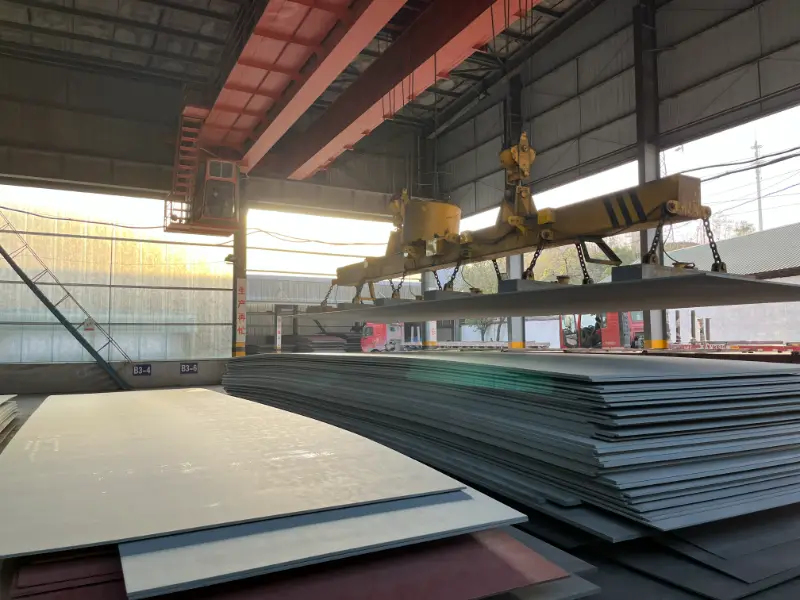
NK Grade A70 Quenched & Tempered Shipbuilding Steel
NK Grade A70 Quenched & Tempered Shipbuilding Steel - High Strength 690 MPa Yield Plate
NK Grade A70 is a high-strength quenched and tempered steel plate certified by Nippon Kaiji Kyokai (ClassNK) for ship and offshore structures. With minimum yield strength of 690 MPa and excellent toughness, it is ideal for critical components subjected to high stress and low-temperature conditions.
Hot rolling followed by quenching and tempering; subsequent cold forming, machining, welding (with preheating and low-hydrogen procedures)
- Phone : +8618037372205
- Email : [email protected]
- WhatsApp: Contact via Whtsapp
- WeChat: +8618037372205
NK Grade A70 Quenched & Tempered Shipbuilding Steel Introduction
NK Grade A70 is a premium quenched and tempered high-strength shipbuilding steel plate governed by the Nippon Kaiji Kyokai (ClassNK) Rules for the Survey and Construction of Steel Ships. It belongs to the ultra-high strength structural steel category with a minimum yield strength of 690 MPa (approximately 70 kgf/mm²), ensuring exceptional load-bearing capacity. The grade designation 'A' indicates impact toughness tested at 0°C, suitable for moderate service temperatures. The material combines high strength with good weldability and formability, achieved through careful alloying with micro-alloying elements like niobium, vanadium, and titanium. It is extensively applied in offshore platforms, crane booms, heavy-lift vessels, and military shipbuilding where weight reduction and reliability are critical. Typical delivery condition is quenched and tempered (Q&T).
NK Grade A70 Quenched & Tempered Shipbuilding Steel Chemical Composition
The chemical composition of NK Grade A70 steel is designed to achieve high strength, good weldability, and toughness. It is low-carbon alloy steel with additions of manganese, chromium, nickel, molybdenum, and micro-alloying elements. Strict control of phosphorus and sulfur ensures cleanliness and resistance to brittle fracture. The values below represent typical ranges observed in production and are compliant with ClassNK guidelines for 690 MPa grade steels. Actual ladle analysis may vary slightly within the limits allowed by the standard.
| Element | Standard Value (wt%) | Remarks |
|---|---|---|
| Carbon (C) | 0.15 – 0.21 | Max 0.21% for weldability; typical aim 0.18% |
| Silicon (Si) | 0.15 – 0.50 | Deoxidizer and strength contributor |
| Manganese (Mn) | 0.80 – 1.20 | Grain refiner and toughness enhancer |
| Phosphorus (P) | ≤ 0.025 | Maximum allowed; lower values improve ductility |
| Sulfur (S) | ≤ 0.010 | Extra low sulfur for improved through-thickness properties |
| Chromium (Cr) | 0.50 – 1.00 | Hardenability element |
| Nickel (Ni) | 0.20 – 1.00 | For toughness and low-temperature performance |
| Molybdenum (Mo) | 0.30 – 0.55 | Prevents temper embrittlement |
| Copper (Cu) | ≤ 0.35 | Often present for weathering resistance |
| Vanadium (V) | 0.02 – 0.08 | Micro-alloy for precipitation strengthening |
| Niobium (Nb) | 0.015 – 0.05 | Grain refinement |
| Titanium (Ti) | 0.005 – 0.02 | Nitrogen scavenger, improves weld heat-affected zone toughness |
| Aluminum (Al) | 0.020 – 0.060 | Deoxidation and grain size control |
| Nitrogen (N) | ≤ 0.012 | Controlled to avoid embrittlement |
| Boron (B) | ≤ 0.0005 | Optional for increased hardenability |
NK Grade A70 Quenched & Tempered Shipbuilding Steel Thermal and Electrical Physical Properties
Physical properties of NK Grade A70 are similar to other quenched and tempered low-alloy steels. These values are indicative at room temperature unless otherwise stated and are essential for design calculations involving thermal expansion, heat transfer, and electromagnetic effects. Density is constant, while thermal expansion coefficient is given for a typical operating range.
| Property | Standard Requirement Value | Unit | Test Condition |
|---|---|---|---|
| Density (ρ) | 7.85 | g/cm³ | At 20°C |
| Elastic Modulus (E) | 205 – 210 | GPa | Tensile modulus, longitudinal and transverse, at 20°C |
| Shear Modulus (G) | 80 – 82 | GPa | Calculated from E and Poisson's ratio, at 20°C |
| Poisson's Ratio (ν) | 0.28 – 0.30 | — | In elastic range, at 20°C |
| Thermal Expansion Coefficient (α) | 11.7 – 12.5 | 10⁻⁶/K | Between 20°C and 100°C |
| Thermal Conductivity (λ) | 28 – 35 | W/(m·K) | At 20°C; decreases with increasing temperature |
| Specific Heat Capacity (c) | 460 – 500 | J/(kg·K) | At 20°C |
| Electrical Resistivity (ρₑ) | 0.20 – 0.25 | µΩ·m | At 20°C, typical for low-alloy steel |
NK Grade A70 Quenched & Tempered Shipbuilding Steel Mechanical Properties
Mechanical properties are guaranteed by ClassNK rules for the specified grade. Tests are performed on transverse specimens in the quenched and tempered condition. The values below are typical minimums for plate thicknesses up to 50 mm. For thicker plates, properties may be slightly reduced, but still meet the minimum yield strength of 690 MPa. Impact energy is verified on Charpy V-notch specimens at 0°C for 'A' quality grade. The steel exhibits excellent strength-to-weight ratio and good ductility despite its high strength level.
| Property | Standard Requirement Value | Unit | Test Condition |
|---|---|---|---|
| Yield Strength (ReH) | ≥ 690 | MPa | Room temperature, transverse specimen, 0.2% offset |
| Tensile Strength (Rm) | 770 – 940 | MPa | Room temperature, transverse specimen |
| Elongation (A) | ≥ 14 | % | Gauge length L0=5.65√S0 (or 50 mm), transverse |
| Reduction of Area (Z) | ≥ 40 | % | Transverse specimen |
| Charpy Impact Energy (KV) | ≥ 27 | J | 0°C, transverse, V-notch, average of three specimens |
| Bend Test (Mandrel Diameter) | 3t (t = plate thickness) | 180° bend, no cracking; specimen width ≥ 50 mm, longitudinal | |
| Hardness | 235 – 320 | HBW | Brinell hardness; typical for Q&T condition |
| Thickness Reduction on Yield/Tensile | Negotiable for thickness >50 mm | For thick plates, min yield may be 650 MPa; refer to NK rules |
NK Grade A70 Quenched & Tempered Shipbuilding Steel Fully Equivalent Material Grades and Standards for Substitution
| Country/Region | Standard | Grade | Remarks |
|---|---|---|---|
| USA / International | ASTM A514/A517 | Grade A, B, E, H, P, Q, S (as applicable thickness) | Quenched and tempered alloy steel plates; yield ≥690 MPa. Specific grades may need NK certification. |
| Europe | EN 10025-6 | S690Q / S690QL / S690QL1 | Hot-rolled structural steel, quenched and tempered; close match in strength and toughness, with additional impact test options. |
| Japan | JIS G3128 | SHY685 / SHY70 | High yield strength steel plates for welded structures; yield ≥685 MPa, often recognized by ClassNK. |
| IACS Members | ABS Rules | AH70, DH70, EH70, FH70 | American Bureau of Shipping high-strength grades; 'A' denotes 0°C impact. EH70 corresponds closely. |
| IACS Members | Lloyd's Register | AH70, DH70, EH70, FH70 | LR grades identical in designation. EH70 is fully equivalent. |
| IACS Members | DNV | NV A690 / AH70 | DNV high-strength steel with yield ≥690 MPa. |
| China | GB/T 16270 | Q690D / Q690E | High strength structural steel plates, quenched and tempered; D or E for impact properties. |
NK Grade A70 Quenched & Tempered Shipbuilding Steel Application Introduction
NK Grade A70 steel is engineered for structures where high strength and weight savings are critical. It is widely adopted in shipbuilding and offshore engineering for components that endure heavy dynamic loads, low temperatures, and corrosive marine environments. Its quenched and tempered condition ensures a balanced combination of strength, toughness, and weldability, provided proper fabrication practices are followed. The material is well suited for the following applications:
Product Applications: Ship hull and superstructure plates in high-stress zones, Deck and bottom longitudinals, girders, and frames, Offshore platform legs and spudcans, Crane lattice members and tubular joints, Pressure hull sections for underwater vehicles
Processed into products: Welded box girders and built-up sections, Reinforcement plates for cargo holds and ballast tanks, Pinion plates, luffing racks, and slew rings, Connection nodes and transition rings for offshore wind monopiles, Thick-walled pipe and hollow sections for structural columns
Application industries: Shipbuilding (heavy-lift vessels, icebreakers, naval combatants), Offshore oil & gas (jack-up rig legs, permanent platform nodes, subsea templates), Marine heavy lifting (crane booms, A-frames, spreader bars), Renewable energy (offshore wind turbine substructures, transition pieces), Mining and construction equipment (excavator booms, dump truck frames)
NK Grade A70 Quenched & Tempered Shipbuilding Steel Similar or Near-Equivalent Material Recommendations
| Country/Region | Standard | Grade | Remarks |
|---|---|---|---|
| USA | MIL-S-16216 | HY-80 / HY-100 | Naval armor grades; HY-80 has yield ≥550 MPa, HY-100 has 690 MPa, similar toughness but different chemisty (Ni-Cr-Mo). |
| Europe | EN 10025-6 | S690MC | Thermomechanically rolled, minimum yield 690 MPa, suitable for cold forming, but may lack the same tempering level. |
| Germany | DIN EN 10083-3 | 42CrMo4 / AISI 4140 Q&T | Engineering steel with ~700-900 MPa tensile strength, but not typical in structural plate formats; for smaller components. |
| Japan | JIS G3106 | SM570 | Rolled steel for welded structure, yield ≥430 MPa, much lower strength but improved weldability; used where lower strength is acceptable with larger thickness. |
Notes:
Welding Considerations: Low-hydrogen welding processes (SMAW, SAW, GMAW, FCAW) must be employed. Preheating (typically 100-200°C) and interpass temperature control are essential to avoid hydrogen cracking. Post-weld heat treatment (PWHT) may be required depending on the thickness and service conditions, but caution is needed to avoid temper embrittlement. Certification: Material must be ClassNK inspected and stamped. Ultrasonic testing (UT) to ASTM A435/A577 or equivalent is usually required. Thickness Availability: Common thickness range is from 6 mm up to 150 mm, with maximum width of 3000-4000 mm. Heavier gauges require careful testing for through-thickness properties (Z-quality). Corrosion Protection: In marine service, cathodic protection and coatings are necessary to prevent corrosion despite the material's low alloy content.
- Share



