
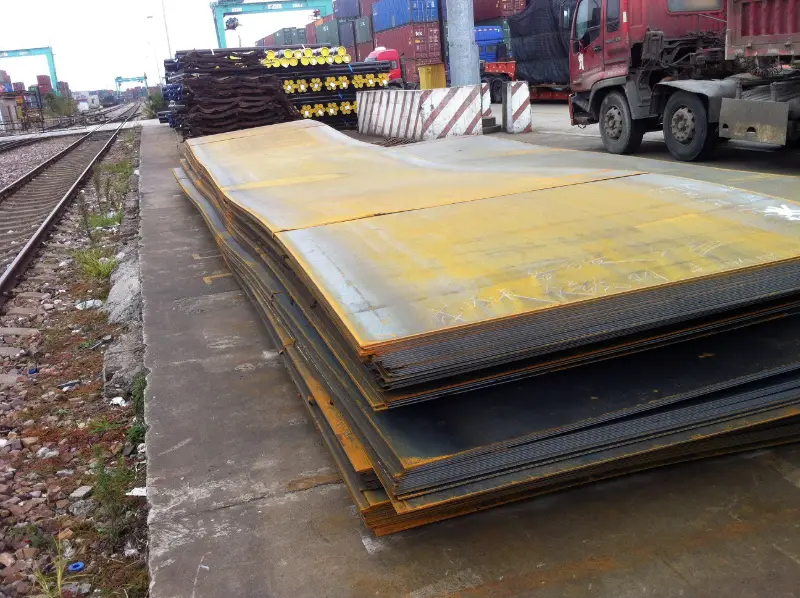
NK Grade F63 Shipbuilding Steel Plate - High-Strength Low-Temp Hull Steel
NK Grade F63 Shipbuilding Steel Plate - High-Strength Low-Temp Hull Steel (equivalent KF50 class) | by ClassNK
Detailed material data for NK Grade F63 shipbuilding steel plate, a high-strength grade designed for low-temperature service and commonly associated with ClassNK grade KF50. Includes chemical composition, mechanical properties, thermal and electrical data, equivalent standards, and application guidance.
Cutting, cold/hot forming, welding (all common arc welding processes), bending, machining
- Phone : +8618037372205
- Email : [email protected]
- WhatsApp: Contact via Whtsapp
- WeChat: +8618037372205
NK Grade F63 Shipbuilding Steel Plate - High-Strength Low-Temp Hull Steel Introduction
NK Grade F63 is a high-strength shipbuilding steel plate certified by Nippon Kaiji Kyokai (ClassNK). In commercial and shipyard terminology, 'F63' often refers to a grade with a minimum tensile strength of 63 kgf/mm² (approximately 620 MPa), which corresponds to the ClassNK designation KF50 (yield strength ≥ 500 MPa, tensile strength 610–770 MPa). The 'F' indicates excellent notch toughness at –60 °C, making it suitable for critical hull structures and offshore equipment operating in extreme environments. The steel is produced by controlled rolling or thermo-mechanical control process (TMCP) to achieve fine grain refinement, high strength, superior weldability, and excellent low-temperature impact properties. Typical applications include ice-class vessels, large container ships, naval structures, and demanding offshore components. This material is supplied in normalized, quenched and tempered, or TMCP condition according to ClassNK rules and project specifications.
NK Grade F63 Shipbuilding Steel Plate - High-Strength Low-Temp Hull Steel Chemical Composition
The chemical composition complies with ClassNK requirements for high-strength hull steels of 500 MPa yield class (KF50/KF460 series). Limits are established to ensure good weldability, strength, and low-temperature toughness. Microalloying elements such as niobium, vanadium, and titanium may be added singly or in combination. The carbon equivalent (CEV) is usually restricted to ≤0.43% depending on thickness to guarantee cold cracking resistance.
| Element | Standard Value (max, %) | Remarks |
|---|---|---|
| Carbon (C) | 0.18 | max |
| Silicon (Si) | 0.50 | max |
| Manganese (Mn) | 0.90 – 1.60 | range |
| Phosphorus (P) | 0.035 | max |
| Sulfur (S) | 0.035 | max |
| Aluminium (Al) acid soluble | ≥0.015 | min, for fine grain practice |
| Niobium (Nb) | ≤0.05 | optional microalloying |
| Vanadium (V) | ≤0.10 | optional microalloying |
| Titanium (Ti) | ≤0.02 | optional microalloying |
| Nitrogen (N) | 0.009 | max (if not bound by Al/Ti) |
NK Grade F63 Shipbuilding Steel Plate - High-Strength Low-Temp Hull Steel Thermal and Electrical Physical Properties
The following physical properties are typical values for high-strength low-alloy shipbuilding steel at room temperature unless otherwise noted. Actual values can vary slightly depending on exact chemical composition and heat treatment condition. These data are intended for design calculations and are not mandatory requirements of the ClassNK specification.
| Property | Typical Value | Unit | Condition / Remarks |
|---|---|---|---|
| Density (ρ) | 7.85 | g/cm³ | at 20 °C |
| Elastic modulus (E) | 205 | GPa | at 20 °C |
| Shear modulus (G) | 80 | GPa | approx. at 20 °C |
| Poisson's ratio (ν) | 0.3 | – | at 20 °C |
| Thermal expansion coefficient (α), 20–100 °C | 11.6 | 10⁻⁶/K | linear expansion |
| Thermal expansion coefficient (α), 20–200 °C | 12.2 | 10⁻⁶/K | |
| Thermal expansion coefficient (α), 20–400 °C | 13.2 | 10⁻⁶/K | |
| Thermal conductivity (λ) | 46 | W/(m·K) | at 20 °C |
| Specific heat capacity (cₚ) | 460 | J/(kg·K) | approx. 0–100 °C |
| Electrical resistivity (ρₑ) | 0.22 | μΩ·m | at 20 °C |
NK Grade F63 Shipbuilding Steel Plate - High-Strength Low-Temp Hull Steel Mechanical Properties – Typical Reference Values for KF50/F63 Plate
Minimum mechanical property requirements are according to ClassNK rules for yield strength 500 MPa grade (KF50). Properties are valid for plate thickness ≤50 mm; for thicker plates, slight reductions may apply. The impact test temperature is –60 °C (longitudinal Charpy V–notch average). Tensile test is performed in the transverse direction unless otherwise agreed.
| Property | Standard Requirement | Unit | Test Condition / Remarks |
|---|---|---|---|
| Yield strength (ReH) min. | 500 | MPa | t ≤ 50 mm, transverse |
| Tensile strength (Rm) | 610 – 770 | MPa | t ≤ 50 mm |
| Elongation after fracture (A) min. | 16 | % | Gauge length 5.65√S₀, t ≤ 50 mm |
| Impact energy (KV₂) min. (longitudinal) | 41 (average) / 28 (single) | J | –60 °C, Charpy V–notch |
| Impact energy (KV₂) min. (transverse) | 27 (average) / 19 (single) | J | –60 °C, Charpy V–notch |
| Bend test (180°) | D=3a (t ≤ 50 mm) | – | No cracks; D=mandrel diameter, a=thickness |
NK Grade F63 Shipbuilding Steel Plate - High-Strength Low-Temp Hull Steel Exact Equivalent Standards and Replaceable Grades
| Country / Region | Standard | Grade | Remarks |
|---|---|---|---|
| International (IACS) | IACS UR W11 | FH50 | FH50 – identical –60 °C impact requirement |
| Japan (ClassNK) | ClassNK Rules Part K | KF50 / KA50–KF50 | KF50 is the official ClassNK designation for –60 °C, YS 500 MPa |
| Norway (DNV) | DNV GL Rules | NV F50 | Corresponds to FH50 |
| U.S.A. (ABS) | ABS Rules | ABS FH50 | FH50 grade with –60 °C impact |
| U.K. (LR) | Lloyd's Register Rules | LR FH50 | Same toughness and strength level |
| France (BV) | Bureau Veritas Rules | BV FH50 | Equivalent FH50 |
| China (CCS) | CCS Rules | FH500 | Chinese notation for FH50 |
NK Grade F63 Shipbuilding Steel Plate - High-Strength Low-Temp Hull Steel Application Introduction
NK Grade F63 / KF50 steel plates are mainly used in shipbuilding and offshore structures where a combination of high strength, excellent low-temperature notch toughness, and good weldability is required. They are tailored for the most critical hull members subjected to high stress and low environmental temperatures.
Typical application areas include:
Product Applications: Hull shell plates, inner bottom plates, bilge strakes, strength deck plating for polar-class vessels, Structural modules for offshore platforms (legs, braces, deck structures), Ice belt reinforcements and frames, Heavy-lift crane pedestals and boom sections for marine applications
Processed into products: Longitudinal stiffeners, transverse frames, web frames, brackets, Rudder horns, shaft brackets, engine bearers, Mounting plates for azimuth thrusters, tunnel plates, Offshore node joints, pad-eyes, padeye reinforcements
Application industries: Shipbuilding (ice-class vessels, Arctic tankers, heavy-lift ships), Offshore oil & gas (jack-up rigs, semi-submersibles, platform structural components), Naval and defence (navy vessels, special craft), Marine renewable energy (offshore wind turbine foundations, tidal energy structures)
NK Grade F63 Shipbuilding Steel Plate - High-Strength Low-Temp Hull Steel Similar or Close Alternative Materials
| Country / Region | Standard | Grade | Remarks |
|---|---|---|---|
| International (IACS) | IACS UR W11 | EH50 | EH50 has –40 °C impact, may replace when slightly less stringent toughness needed |
| Japan (JIS) | JIS G 3106 | SM570 | Similar tensile strength (570–720 MPa), but impact test not specified as ship standard; requires additional agreement |
| Japan (ClassNK) | ClassNK Rules | KF46 (KF460) | KF46 with YS ≥460 MPa, slightly lower strength but comparable weldability |
| Europe (EN) | EN 10025-6 | S500QL / S500QL1 | Quenched and tempered structural steel, YS 500 MPa, impact –40/–60 °C available |
Notes:
Note: The designation 'F63' is often used in commercial trading to indicate a shipbuilding plate with a tensile strength class of 63 kgf/mm². The formal ClassNK grade that matches this requirement is KF50 (or KF50 for -60 °C impact toughness). It must be stressed that any material supplied as 'NK Grade F63' should be accompanied by a valid ClassNK certificate indicating the exact grade and its compliance with the applicable rules. For thicknesses above 50 mm, tensile and impact requirements may be slightly adjusted as per ClassNK Part K. Welding consumables and procedures must be approved for the high strength level, and post-weld heat treatment is generally not required if proper preheat and interpass temperatures are maintained.
- Share



