
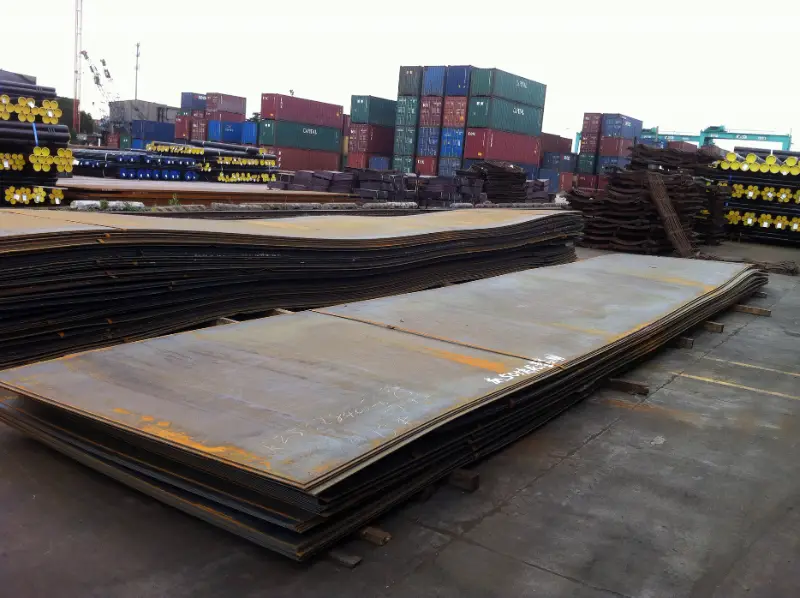
NK Grade E63 Shipbuilding Steel Plate
NK Grade E63 Shipbuilding Steel Plate - High-Strength Structural Steel for Ship and Offshore Applications
Explore the detailed material data of NK Grade E63 shipbuilding steel plate, including chemical composition, mechanical properties, thermal and electrical physical properties, international equivalents, and application guidance.
Welding, thermal cutting, cold/hot forming, bending, machining
- Phone : +8618037372205
- Email : [email protected]
- WhatsApp: Contact via Whtsapp
- WeChat: +8618037372205
NK Grade E63 Shipbuilding Steel Plate Introduction
NK Grade E63 is a high-strength structural steel plate certified by Nippon Kaiji Kyokai (NK, ClassNK) for marine and offshore construction. With a minimum yield strength of 620 MPa, it belongs to the normalized or quenched-and-tempered high-strength hull steel category. The 'E' designation indicates guaranteed impact toughness at -40°C. Typical delivery conditions include TMCP, QT, or normalizing. This grade offers excellent weldability, low-temperature toughness, and high strength-to-weight ratio, making it ideal for critical structural components in large container ships, icebreakers, and offshore platforms.
- Yield strength ≥ 620 MPa
- Tensile strength 720–890 MPa
- Charpy impact at -40°C
- Good weldability with low carbon equivalent
NK Grade E63 Shipbuilding Steel Plate Chemical Composition
Typical chemical composition according to NK Rules for Materials. The steel is fully killed and aluminium treated. Microalloying elements (Nb, V, Ti) may be added singly or in combination to achieve the required mechanical properties. Note: The carbon equivalent (CEV) is controlled to ensure good weldability; typical CEV ≤ 0.52%.
| Element | Standard Value (max or range) | Remarks |
|---|---|---|
| Carbon (C) | ≤ 0.20 | |
| Silicon (Si) | 0.10 – 0.55 | Killed steel |
| Manganese (Mn) | 1.00 – 1.70 | Higher Mn for strength |
| Phosphorus (P) | ≤ 0.025 | |
| Sulfur (S) | ≤ 0.025 | |
| Aluminium (Al) | ≥ 0.015 | Acid soluble; grain refinement |
| Niobium (Nb) | ≤ 0.05 | Optional microalloy |
| Vanadium (V) | ≤ 0.10 | Optional microalloy |
| Titanium (Ti) | ≤ 0.02 | Optional microalloy |
| Copper (Cu) | ≤ 0.35 | Residual element |
| Chromium (Cr) | ≤ 0.20 | Residual element |
| Nickel (Ni) | ≤ 0.40 | Residual element |
| Molybdenum (Mo) | ≤ 0.08 | Residual element |
| Nitrogen (N) | ≤ 0.012 | For aluminium killed steel |
| Boron (B) | ≤ 0.0005 | If intentionally added |
NK Grade E63 Shipbuilding Steel Plate Thermal and Electrical Physical Properties
These properties are typical for high-strength low-alloy quenched and tempered steels of this strength level. They are not mandatory per NK Rules but serve as engineering references for design and processing. Values may vary slightly depending on exact chemical composition and heat treatment.
| Property | Typical Value | Unit | Test Condition / Remarks |
|---|---|---|---|
| Density (ρ) | 7.85 | g/cm³ | at 20°C |
| Modulus of Elasticity (E) | 205 | GPa | at 20°C |
| Shear Modulus (G) | 80 | GPa | at 20°C, approximate |
| Poisson's Ratio (ν) | 0.3 | — | at 20°C |
| Thermal Expansion Coefficient (α) | 11.5 | 10⁻⁶/K | 20 – 100°C |
| Thermal Expansion Coefficient (α) | 12.5 | 10⁻⁶/K | 20 – 200°C |
| Thermal Conductivity (λ) | 45 | W/(m·K) | at 20°C |
| Specific Heat Capacity (Cp) | 460 | J/(kg·K) | at 20°C |
| Electrical Resistivity (ρₑ) | 0.20 | 10⁻⁶ Ω·m | at 20°C |
NK Grade E63 Shipbuilding Steel Plate Mechanical Properties
Mechanical properties as per NK Rules for thickness ≤ 100 mm. Transverse properties may be specified for certain applications. Impact test specimens are taken in the longitudinal direction (KV2 at -40°C). Note: For thickness >50 mm, elongation requirements may be reduced by 1% for each additional 25 mm up to a maximum of 3% reduction.
| Property | Required Value | Unit | Test Condition | |
|---|---|---|---|---|
| Yield Strength (ReH) | ≥ 620 | MPa | t ≤ 100 mm; transverse or longitudinal | |
| Tensile Strength (Rm) | 720 – 890 | MPa | t ≤ 100 mm | |
| Elongation after fracture (A5) | ≥ 16 | % | t ≤ 50 mm, gauge length 5.65√So | |
| Elongation after fracture (A5) | ≥ 15 | % | 50 < t ≤ 75 mm | |
| Elongation after fracture (A5) | ≥ 14 | % | 75 < t ≤ 100 mm | |
| Charpy Impact (KV2) at -40°C | ≥ 41 (average), ≥ 28 (single) | J | Longitudinal, V-notch, 10x10 mm | |
| Bend Test (180°) | d = 3a | — | t ≤ 30 mm; no cracks | d = 4a for t > 30 mm but often specified |
NK Grade E63 Shipbuilding Steel Plate Fully Equivalent Grades and Replacement Recommendations
| Country/Region | Standard/Classification Society | Grade | Remarks |
|---|---|---|---|
| USA / International | American Bureau of Shipping | ABS EH63 | Equivalent strength and toughness class |
| Norway / International | DNV | DNV E630 | Yield strength 620 MPa, -40°C |
| France / International | Bureau Veritas | BV EH63 | Same requirements |
| UK / International | Lloyd's Register | LR EH63 | Directly equivalent |
| South Korea / International | Korean Register | KR EH63 | Directly equivalent |
| Italy / International | RINA | RINA EH63 | Directly equivalent |
| Russia / International | Russian Maritime Register of Shipping | RS E63 | May have similar composition |
| China / International | China Classification Society | CCS E63 | Identical classification |
NK Grade E63 Shipbuilding Steel Plate Application Introduction
NK Grade E63 is employed where high strength, superior low-temperature toughness, and good weldability are required. It is extensively used in the shipbuilding and offshore industries for structural components subjected to high static and dynamic loads. Typical application areas include:
Product Applications: Hull plates and stiffeners of large container ships and bulk carriers, Decks, bottom shells, and longitudinal frames of ice-strengthened vessels, Main structural members of jack-up rig legs and spudcans, Heavy-lift crane booms and pedestals, Arctic-class marine structures
Processed into products: Bottom plate of double bottom tanks (high bending stress areas), Sheer strakes and deck stringer plates, Bilge keels and hull frames, Connection nodes and brackets in offshore structures, Support rings and flanges for heavy marine equipment
Application industries: Shipbuilding (commercial and naval vessels), Offshore oil & gas platforms (jackets, topsides, modules), Heavy engineering, Port and harbour construction equipment, Wind turbine support structures (offshore)
NK Grade E63 Shipbuilding Steel Plate Similar or Approximate Substitute Materials
| Country/Region | Standard/Specification | Grade | Remarks |
|---|---|---|---|
| European Union | EN 10025-6 | S690QL (1.8928) | Higher yield (≥690 MPa), QT condition, similar applications; adjust welding procedures |
| USA | ASTM A514 / A514M | Grade E | Quenched & tempered alloy steel plate, yield 690 MPa, requires careful weld heat input control |
| Japan | JIS G 3140 | SP700 or equivalent high-tensile steel | Not identical, but used in heavy-duty structures; mechanical properties close |
| International | API 2Y / 2W | Various (e.g., API 2Y-60) | Designed for offshore structures, similar tensile class; check toughness requirements |
Notes:
Welding: Pre-heat may be required depending on thickness and carbon equivalent. Low-hydrogen welding consumables are recommended. Post-weld heat treatment is generally not required for thicknesses up to 50 mm, but should be evaluated based on service conditions. Forming: Cold forming radii should consider the high strength level; hot forming may affect mechanical properties if temperatures exceed tempering temperature. Testing: All plates are ultrasonically tested according to NK Rules unless otherwise specified. Supplementary testing (Z-direction properties, CTOD) can be agreed upon.
- Share



