
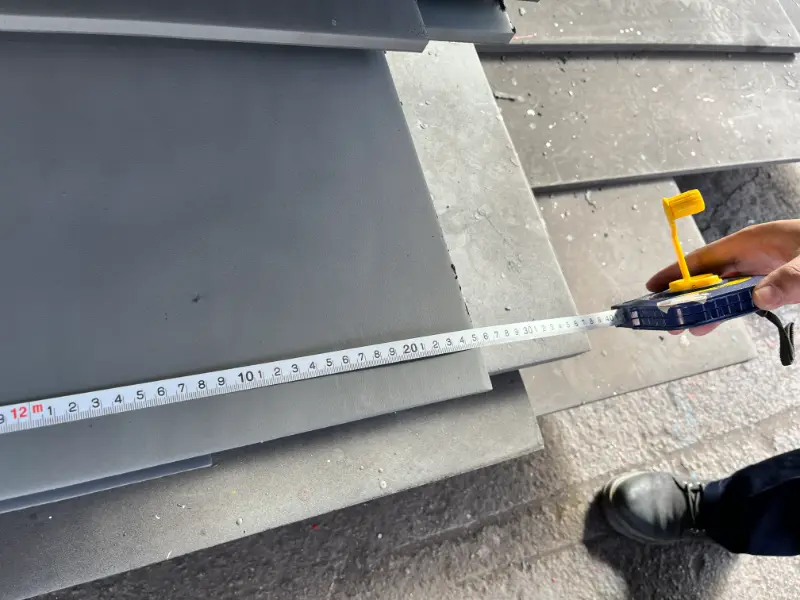
NK Grade D63 Shipbuilding Steel Plate
NK Grade D63 Shipbuilding Steel Plate – High Yield Strength 620MPa Cryogenic Toughness
Complete material data for NK Grade D63 shipbuilding steel plate per ClassNK Rules. Includes chemical composition, mechanical and physical properties, equivalent international grades, typical applications, and delivery conditions.
Hot rolling followed by TMCP (Thermo-Mechanical Controlled Process) or Quenching & Tempering (QT); cold forming, welding, cutting
- Phone : +8618037372205
- Email : [email protected]
- WhatsApp: Contact via Whtsapp
- WeChat: +8618037372205
NK Grade D63 Shipbuilding Steel Plate Introduction
NK Grade D63 is a high-strength, weldable structural steel plate certified by Nippon Kaiji Kyokai (ClassNK) for ship and offshore construction. It belongs to the ultra-high strength category with a minimum specified yield strength of 620 MPa and excellent low-temperature toughness guaranteed by the "D" designation (impact tested at -20°C). The grade meets the requirements of IACS UR W11 for 63 kg/mm² class high-strength hull structural steel.
Key features include:
- High strength-to-weight ratio enabling lighter structures
- Good weldability with controlled carbon equivalent (CEV)
- Fine-grained microstructure achieved through thermomechanical controlled processing (TMCP) or quenching and tempering (QT)
- Reliable ductility and fatigue resistance under dynamic loading
The plate is produced in thicknesses typically up to 50 mm, with tighter control of alloying elements such as Nb, V, and Ti for grain refinement and precipitation strengthening. It is extensively used in critical parts of large container ships, bulk carriers, and offshore platforms where high stress levels and weight savings are essential.
NK Grade D63 Shipbuilding Steel Plate Chemical Composition
Chemical composition according to IACS UR W11 for Grade D63/63 kg class. All values are maximum unless a range or minimum is specified. The steel is micro-alloyed with Nb, V, Ti for grain refinement and precipitation hardening. Carbon equivalent (CEV) is controlled to ensure good weldability and is typically ≤0.41% for thicknesses ≤50 mm. Fine grain practice requires a minimum total aluminum or other nitrogen-binding element content.
| Element | Value (%) | Remarks |
|---|---|---|
| Carbon (C) | ≤ 0.20 | Ladle analysis |
| Silicon (Si) | ≤ 0.55 | Optional; often 0.10–0.50 |
| Manganese (Mn) | 1.00 – 1.65 | For strength and hardenability |
| Phosphorus (P) | ≤ 0.025 | Controlled for toughness |
| Sulfur (S) | ≤ 0.025 | Ensures clean steel |
| Aluminum (Al) acid soluble | ≥ 0.015 | Grain refinement (fine grain practice) |
| Niobium (Nb) | ≤ 0.06 | Micro-alloy for grain refinement |
| Vanadium (V) | ≤ 0.10 | Precipitation strengthener |
| Titanium (Ti) | ≤ 0.02 | Nitride former, optional |
| Copper (Cu) | ≤ 0.30 | Residual; may be added for corrosion resistance |
| Chromium (Cr) | ≤ 0.25 | May increase hardenability |
| Nickel (Ni) | ≤ 0.80 | Improves low-temperature toughness |
| Molybdenum (Mo) | ≤ 0.30 | Enhances hardenability |
| Nitrogen (N) | ≤ 0.012 | Controlled for toughness; nitrogen binders used |
| Sum Nb+V+Ti | ≤ 0.12 | For t ≤ 50 mm (typical) |
| CEV (typical) | ≤ 0.41 | Carbon Equivalent = C+Mn/6+(Cr+Mo+V)/5+(Ni+Cu)/15 |
NK Grade D63 Shipbuilding Steel Plate Physical Properties
These are typical physical properties for low-alloy structural steel of this strength class. Values are not part of the compulsory acceptance criteria but are useful for design and processing. Density, thermal expansion, thermal conductivity, and electrical resistivity are comparable to other quenched and tempered or TMCP high-strength steels.
| Property | Typical Value | Unit | Remarks / Test Condition |
|---|---|---|---|
| Density (ρ) | 7.85 | g/cm³ | Room temperature |
| Elastic Modulus (E) | 205 – 210 | GPa | Dynamic; static may be slightly lower |
| Shear Modulus (G) | ~80 | GPa | Calculated from E and ν |
| Poisson's Ratio (ν) | 0.3 | – | Elastic range |
| Thermal Expansion Coefficient (α) | 11.5 | ×10⁻⁶/K | 20–100°C |
| Thermal Expansion Coefficient (α) | 12.3 | ×10⁻⁶/K | 20–200°C |
| Thermal Expansion Coefficient (α) | 13.2 | ×10⁻⁶/K | 20–400°C |
| Specific Heat Capacity (c) | ~460 | J/(kg·K) | Room temperature |
| Thermal Conductivity (λ) | 45 – 50 | W/(m·K) | Room temperature |
| Electrical Resistivity (ρe) | ~0.20 | µΩ·m | Room temperature |
NK Grade D63 Shipbuilding Steel Plate Mechanical Properties
Tensile properties according to IACS UR W11 for thicknesses ≤50 mm. Yield strength is the upper yield strength (ReH) for steels exhibiting a yield phenomenon, otherwise 0.2% proof strength (Rp0.2). Impact test is Charpy V-notch conducted at -20°C for grade D. All values are minimum unless a range is given. Bending test uses a 180° bend with the specified mandrel diameter.
| Property | Value | Unit | Test Condition |
|---|---|---|---|
| Yield Strength (ReH) | ≥ 620 | MPa | Transverse, t ≤ 50 mm |
| Tensile Strength (Rm) | 720 – 890 | MPa | Transverse, t ≤ 50 mm |
| Elongation (A) | ≥ 17 | % | Gauge length 5.65√S0 (L0=200 mm for plate), t≤50 mm |
| Charpy Impact Energy (KV) | ≥ 41 | J | Longitudinal, -20°C, 10×10 mm V-notch |
| Bend Test (180°) - t ≤ 25 mm | d = 3t (no cracks) | – | Mandrel diameter = 3× thickness |
| Bend Test (180°) - 25 < t ≤ 50 mm | d = 4t (no cracks) | – | Mandrel diameter = 4× thickness |
NK Grade D63 Shipbuilding Steel Plate Fully Equivalent International Designations for NK Grade D63
| Country / Region | Standard / Society | Grade | Remarks |
|---|---|---|---|
| International | IACS UR W11 | DH63 (or D63) | Common base standard for all members |
| France | Bureau Veritas (BV) | DH63 | Identical requirements |
| UK | Lloyd's Register (LR) | DH63 | Identical requirements |
| Germany / Norway | DNV (DNV GL) | DH63 | Identical requirements (DNV-OS-B101) |
| USA | American Bureau of Shipping (ABS) | DH63 | Identical requirements |
| China | China Classification Society (CCS) | DH63 | Identical requirements |
| Italy | RINA | DH63 | Identical requirements |
| Korea | Korean Register (KR) | DH63 | Identical requirements |
| Russia | Russian Maritime Register (RS) | DH63 | Identical; may have additional Arctic specifications |
NK Grade D63 Shipbuilding Steel Plate Application Introduction
NK Grade D63 plates are designed for the most heavily stressed regions of modern merchant ships and offshore structures, where high strength allows reduction of plate thickness and weight while still maintaining structural integrity and fatigue resistance. The guaranteed toughness at -20°C makes the steel suitable for low-temperature service conditions encountered in cold waters. It is weldable with low-hydrogen procedures and preheating/interpass control as prescribed by ClassNK guidelines.
Product Applications: Large container ships (ultra-large, post-Panamax), Bulk carriers and ore carriers, Arctic vessel hulls, Semi-submersible drilling rigs, Jack-up rig legs and spudcans, Ship superstructure of heavy-lift vessels
Processed into products: Upper deck plating and sheer strake, Hatch coamings and coaming top plates, Longitudinal stiffeners and box girders, Bottom shell in high-strength zones, Oiltight bulkheads in deep tanks, Foundation plates for heavy machinery
Application industries: Shipbuilding (commercial and naval), Offshore oil and gas (fixed and floating platforms), Heavy lifting equipment (crane booms, gantries), Wind turbine substructures (jacket foundations, transition pieces)
NK Grade D63 Shipbuilding Steel Plate Alternative Materials with Similar Properties
| Country / Region | Standard / Society | Grade | Remarks |
|---|---|---|---|
| International | IACS UR W11 | E63 / F63 | Lower service temperature (-40°C / -60°C); same strength |
| International | IACS UR W11 | D55 / D69 | Yield 550 MPa / 690 MPa; close strength levels |
| European | EN 10025-6 | S620Q / S620QL1 | Quenched and tempered structural steel; not specifically for ship class but comparable tensile properties |
| European | EN 10025-6 | S690Q | Higher yield (690 MPa); heavier sections |
| USA | ASTM A514/A517 | Grade B / H / Q | High yield quenched & tempered plate, similar strength but different weldability and toughness guarantee |
Notes:
Delivery must be accompanied by a ClassNK certificate confirming conformance to the specified grade, including ladle analysis, tensile test results, and Charpy V-notch impact values.
Welding: Low-hydrogen consumables must be used; typical preheat temperature depends on thickness and CEV (often 50–100°C). For thicknesses above 30 mm, post-weld heat treatment may be required depending on the fabrication standard but is generally avoided for TMCP grades.
The material is normally supplied in the as-TMCP or QT condition; if hot forming is necessary, the fabrication yard must consult ClassNK for re‑qualification of properties.
- Share



