
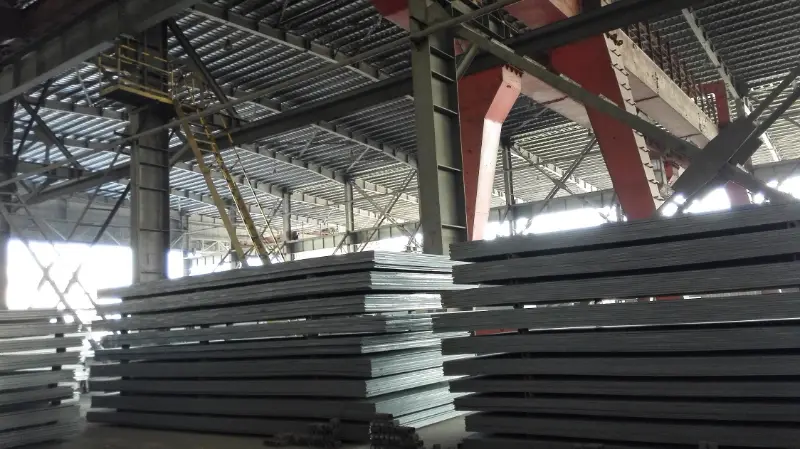
NK Grade A63 Shipbuilding Steel Plate
NK Grade A63 Shipbuilding Steel Plate - Ultra-High Strength, Tough, Weldable
NK Grade A63 is a high-performance shipbuilding steel with a minimum yield strength of 618 MPa, excellent low-temperature toughness, and good weldability. It is used in critical hull structures requiring weight reduction and high load capacity.
Hot rolling followed by quenching and tempering; suitable for cold forming, gas cutting, submerged arc welding, and other standard shipyard processes.
- Phone : +8618037372205
- Email : [email protected]
- WhatsApp: Contact via Whtsapp
- WeChat: +8618037372205
NK Grade A63 Shipbuilding Steel Plate Introduction
NK Grade A63, designated KA63 under Nippon Kaiji Kyokai (ClassNK) rules, is a quenched and tempered extra-high-strength structural steel plate for shipbuilding. It delivers a minimum yield strength of 63 kgf/mm² (approximately 618 MPa) and an ultimate tensile strength between 706 and 834 MPa. The material is engineered for extreme service conditions, combining superior strength with reliable toughness at 0 °C (impact test temperature). Its controlled chemical composition, including microalloying elements and low carbon equivalent, ensures good weldability for fabrication of large, safety-critical marine structures. Key benefits:
- Ultra-high strength allows down-gauging and weight savings
- Excellent notch toughness at low ambient temperatures
- Good through-thickness properties when specified
- Proven performance in harsh offshore environments
NK Grade A63 Shipbuilding Steel Plate Chemical Composition
Typical ladle analysis according to ClassNK specifications for KA63. Microalloying elements (Nb, V, Ti) may be added singly or in combination. The carbon equivalent value (CEV) is controlled to ensure welding performance. Note: Values are for plates ≤50 mm; slightly relaxed limits may apply for thicker products.
- CEV = C + Mn/6 + (Cr+Mo+V)/5 + (Ni+Cu)/15 ≤ 0.41% for t ≤ 50 mm (typical).
- Phosphorus and sulphur are kept very low to maintain toughness.
| Element | Specification | Remarks |
|---|---|---|
| C | ≤ 0.20 | Ladle analysis, lower carbon improves weldability |
| Si | 0.10 – 0.55 | Deoxidiser; upper limit ensures toughness |
| Mn | 0.70 – 1.70 | Contributes to strength; excess may harm weldability |
| P | ≤ 0.030 | Low phosphorus to avoid temper embrittlement |
| S | ≤ 0.030 | Low sulphur for improved through-thickness properties |
| Cu | ≤ 0.35 | Residual element; beneficial for corrosion resistance |
| Cr | ≤ 0.20 | Enhances hardenability; kept low for weldability |
| Ni | ≤ 0.40 | Improves toughness; limited to control cost |
| Mo | ≤ 0.08 | Small addition for strength/hardenability |
| V | ≤ 0.10 | Microalloying to refine grain and increase yield |
| Ti | ≤ 0.02 | Grain refiner; can fix nitrogen |
| Nb | ≤ 0.05 | Grain refinement and precipitation strengthening |
| Al (total) | ≥ 0.020 | Required as grain refiner |
| Ceq | ≤ 0.41* | *Typical max for t ≤ 50 mm; subject to approval |
NK Grade A63 Shipbuilding Steel Plate Physical & Thermal Properties
The following physical properties are representative of quenched and tempered low-alloy steel plates with a structure similar to KA63. Actual values may vary slightly depending on heat treatment and exact composition. These data are based on published engineering handbooks and are suitable for design calculations.
- Thermal conductivity tends to decrease with increasing temperature.
- Specific heat capacity rises with temperature; value shown is for room temperature.
| Property | Typical Value | Unit | Conditions |
|---|---|---|---|
| Density (ρ) | 7850 | kg/m³ | At 20 °C |
| Young's Modulus (E) | 205 | GPa | At 20 °C, for design |
| Shear Modulus (G) | 80 | GPa | At 20 °C, derived from E and ν |
| Poisson's ratio (ν) | 0.3 | - | Elastic range, 20 °C |
| Coefficient of thermal expansion (α) | 11.7 × 10⁻⁶ | 1/K | 20 – 100 °C |
| Thermal conductivity (λ) | 50 | W/(m·K) | At 20 °C |
| Specific heat capacity (c) | 460 | J/(kg·K) | At 20 °C |
| Electrical resistivity (ρ_e) | 0.20 × 10⁻⁶ | Ω·m | At 20 °C |
NK Grade A63 Shipbuilding Steel Plate Mechanical Properties
Properties are based on ClassNK Rules for KA63. Tensile and impact tests are performed in the longitudinal direction unless otherwise specified. Bending test uses a mandrel diameter of 3 × thickness. Note: Values vary with plate thickness; listed are the most common ranges. For thicknesses exceeding 100 mm, mechanical properties shall be individually agreed.
- Impact test temperature: 0 °C (A-class).
- A_min: elongation on 5.65√S gauge length (ISO 6892) or proportional to plate thickness as per standard.
| Property | Specified Value | Unit | Test Conditions |
|---|---|---|---|
| ReH (Yield strength) | ≥ 618 | MPa | Plate thickness ≤ 50 mm, transverse |
| ReH (Yield strength) | ≥ 598 | MPa | Plate thickness > 50 to ≤ 70 mm, transverse |
| ReH (Yield strength) | ≥ 578 | MPa | Plate thickness > 70 to ≤ 100 mm, transverse |
| Rm (Tensile strength) | 706 – 834 | MPa | All thicknesses ≤ 100 mm, longitudinal |
| A (Elongation after fracture) | ≥ 19 | % | Gauge length: L₀ = 5.65√S₀, thickness ≤ 50 mm |
| A (Elongation after fracture) | ≥ 18 | % | Gauge length: L₀ = 5.65√S₀, thickness > 50 to ≤ 70 mm |
| A (Elongation after fracture) | ≥ 17 | % | Gauge length: L₀ = 5.65√S₀, thickness > 70 to ≤ 100 mm |
| Bending test (180°) | No cracks | - | Mandrel diameter = 3 × thickness; all thicknesses |
| KV (Charpy V-notch) | ≥ 47 | J | Longitudinal, at 0 °C, specimen 10×10 mm |
| KV (Charpy V-notch) | ≥ 31 | J | Transverse, at 0 °C, specimen 10×10 mm |
NK Grade A63 Shipbuilding Steel Plate Complete Equivalent Materials and Substitute Grades
Exact equivalents are specific to ClassNK rules. The table lists NK-internal variants with the same strength level but different impact testing temperatures, as well as analogous grades from other classification societies that, with appropriate documentation, may be considered interchangeable subject to approval.
| Country/Region | Standard | Grade | Remarks |
|---|---|---|---|
| Japan (NK) | NK Rules Part K | NK KD63 | Same yield/tensile strength, impact test at -20 °C |
| Japan (NK) | NK Rules Part K | NK KE63 | Same strength, impact test at -40 °C |
| Japan (NK) | NK Rules Part K | NK KF63 | Same strength, impact test at -60 °C (thickness ≤ 70 mm) |
| International (IACS) | UR W31 (if adopted) | – | IACS does not yet define a 63 kgf class; EH47 is the highest common grade |
| Various | Class rules (LR, DNV, BV, etc.) | E620 / E690* | *Strength level analogue; approval by the respective society needed |
NK Grade A63 Shipbuilding Steel Plate Application Introduction
NK Grade A63 is tailored for weight-critical, high-stress structural members in marine and offshore environments. Its combination of strength and toughness allows designers to reduce section thickness, lowering vessel weight and increasing cargo capacity. Proper welding procedures, including preheat and interpass temperature control, are essential to avoid hydrogen cracking in the heat-affected zone.
Product Applications: Main decks, sheer strakes, and bottom shell plating of ultra-large container ships, Longitudinal stiffeners, girders, and transverse web frames, Jack-up leg chords and lattice structures, Semisubmersible column and pontoon shell plates, Lifting eyes, pad-eyes, and crane bases, Deck hatches and reinforcement inserts
Processed into products: Welded plate panels up to 100 mm thick, Built-up box and T-section beams, Flame-cut structural shapes and notches, Through-hull penetrations and winch foundations, High-fatigue nodes in deck/bulkhead intersections, Machined bearing supports for heavy equipment
Application industries: Shipbuilding (commercial and naval), Offshore oil and gas exploration/ production, Renewable offshore energy (wind turbine foundations, substations), Heavy-lift marine cranes and machinery, Offshore support/ construction vessels
NK Grade A63 Shipbuilding Steel Plate Similar / Alternative Materials for Reference
The following materials offer comparable minimum yield strength (≥ 600 MPa) and are used in marine, offshore, or structural applications. They are NOT direct substitutes without case-by-case verification of chemical, mechanical, and welding requirements according to the applicable construction code.
| Country/Region | Standard | Grade | Remarks |
|---|---|---|---|
| USA | ASTM A514/A514M | Grade H | Q&T plate; min YS 690 MPa; additional toughness tests may be needed |
| EU | EN 10025-6 | S690Q / S690QL | Hot-rolled Q&T steel; delivery condition Q, min YS 690 MPa |
| Japan | JIS G 3128 | SHY 685 / SHY 685N | High strength steel for welded structures; min YS 685 MPa, different CEV limits |
| International | API 2Y / API 2W | Grade 60 / Grade 65 | Offshore structural steel; closest strength is Grade 65 (YS 450 MPa), so lower |
| China | GB/T 16270 | Q690D / Q690E | High-strength structural steel; min YS 690 MPa |
Notes:
Welding: Use low-hydrogen consumables and proper preheat (typically 100–150 °C, depending on thickness) to prevent cold cracking. PWHT is usually not required for thicknesses under 50 mm, but stress relief may be considered for critical welded joints. Corrosion: As with other structural steels, KA63 requires protective coatings or cathodic protection in seawater immersion. Certification: Plates are delivered with ClassNK certificates showing chemical analysis, mechanical properties, and non-destructive test results. Thickness tolerances: Comply with NK and applicable ISO standards. Special requirements for through-thickness properties (Z35) can be ordered against standard NK supplementary specifications.
- Share



