
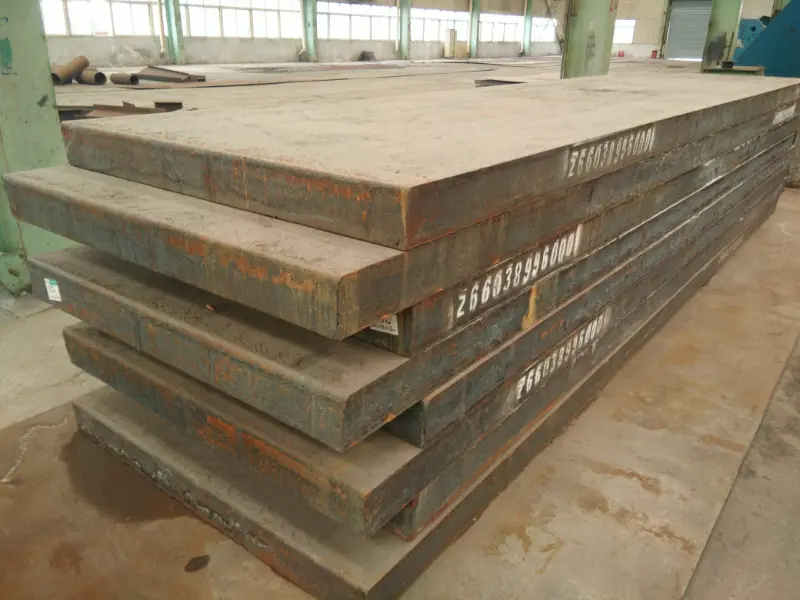
NK Grade F56 Shipbuilding Steel Plate
NK Grade F56 Shipbuilding Steel Plate: High-Strength for Deep-Sea & Arctic Hull Structures
In-depth data sheet for NK Grade F56 shipbuilding steel plate, covering chemical composition, mechanical properties at sub-zero temperatures, physical constants, and equivalent grades.
Thermo-Mechanical Controlled Rolling (TMCP), Normalizing, Quenching and Tempering (upon agreement), Cutting, Cold forming, Welding (FCAW, SAW, GMAW)
- Phone : +8618037372205
- Email : [email protected]
- WhatsApp: Contact via Whtsapp
- WeChat: +8618037372205
NK Grade F56 Shipbuilding Steel Plate Introduction
NK Grade F56 steel is a premium high-strength hull structural steel plate certified by ClassNK (Nippon Kaiji Kyokai). It is classified as an ultra-high strength grade within the thermo-mechanically rolled (TMCP) group, designated for extreme service conditions. With a specified minimum yield strength of 550 MPa, it is engineered for weight reduction in large container ships and structural reinforcement in ice-going vessels. This grade exhibits exceptional weldability owing to its low carbon equivalent (Ceq) and fine-grained microstructure, while maintaining guaranteed low-temperature toughness down to -60°C.
NK Grade F56 Shipbuilding Steel Plate Chemical Composition
The chemical composition is tightly controlled to achieve the F56 high-strength designation while limiting the carbon equivalent (Ceq). Stricter specifications apply to the product analysis compared to heat analysis. Typical micro-alloying additions of Ni, Nb, V, and Ti are employed to ensure fine grain size and properties through TMCP.
| Element | Standard Value (Max, %) | Remarks |
|---|---|---|
| Carbon (C) | 0.18 | Dependent on delivery condition and thickness |
| Silicon (Si) | 0.10 - 0.55 | Deoxidation agent; controls strength |
| Manganese (Mn) | 0.90 - 1.70 | Key strengthening element; ensures toughness |
| Phosphorus (P) | 0.020 | Strictly limited for low-temperature toughness |
| Sulfur (S) | 0.020 | Strictly limited to prevent hot cracking |
| Chromium (Cr) | 0.20 | Residual element unless specified for QT |
| Nickel (Ni) | 1.00 - 2.00 | Essential for -60°C charpy impact guarantee |
| Molybdenum (Mo) | 0.12 | Enhances hardenability if treated |
| Copper (Cu) | 0.40 | Minor atmospheric corrosion resistance |
| Niobium (Nb) | 0.06 | Grain refinement; precipitation strengthening |
| Vanadium (V) | 0.08 | Precipitation strengthening |
| Titanium (Ti) | 0.02 | Grain refinement; nitrogen fixation |
| Aluminum (Al) acid sol. | 0.015 - 0.060 | Fine grain melting practice required |
| Nitrogen (N) | 0.012 | Limited binding with Al/Ti |
| Carbon Equivalent (Ceq) | Typically 0.42 - 0.46 | Calculated as C+Mn/6+(Cr+Mo+V)/5+(Ni+Cu)/15 |
NK Grade F56 Shipbuilding Steel Plate Thermal & Electrical Physical Properties
These physical properties are typical for high-strength low-alloy (HSLA) 550 MPa grade structural steels. Small variations may occur based on exact product thickness and final heat treatment state. Values are provided at ambient temperature unless otherwise specified.
| Property | Standard Requirement Value | Unit | Test Condition |
|---|---|---|---|
| Density (ρ) | 7.85 | g/cm³ | Ambient (20°C) |
| Elastic Modulus (E) | 205 | GPa | Ambient (20°C) |
| Shear Modulus (G) | 80 | GPa | Ambient (20°C) estimated |
| Poisson's Ratio (ν) | 0.30 | - | Ambient (20°C) |
| Thermal Expansion Coefficient (α) | 12.0 | 10⁻&sup6;/K | Range 20 - 100°C |
| Thermal Expansion Coefficient (α) | 12.8 | 10⁻&sup6;/K | Range 20 - 300°C |
| Thermal Conductivity (λ) | 36 | W/(m·K) | Ambient (20°C) |
| Thermal Conductivity (λ) | 34 | W/(m·K) | Temperature 300°C |
| Specific Heat Capacity | 460 | J/(kg·K) | Ambient (20°C) |
| Specific Heat Capacity | 530 | J/(kg·K) | Temperature 300°C |
| Electrical Resistivity (ρe) | 0.25 | Ω·mm²/m | Ambient (20°C) |
NK Grade F56 Shipbuilding Steel Plate Mechanical Properties
The following mechanical properties are verified through transverse tensile and Charpy V-notch impact testing. Due to the high strength and TMCP process, the yield-to-tensile ratio is carefully managed. Impact properties are guaranteed at -60°C.
| Property | Standard Requirement | Unit | Test Condition |
|---|---|---|---|
| Yield Strength (ReH) | 550 min | MPa | Ambient (Transverse) |
| Tensile Strength (Rm) | 620 - 790 | MPa | Ambient (Transverse) |
| Elongation (A) | 17 min | % | Gauge length L0=5.65√S0 (Transverse) |
| Charpy Impact Energy (KV) | 62 (Avg) / 41 (Indiv) min | J | Temperature -60°C (Longitudinal) |
| Charpy Impact Energy (KV) | 41 (Avg) / 30 (Indiv) min | J | Temperature -60°C (Transverse) |
| Yield Strength at Elevated Temp. | ~450 | MPa | Temperature 200°C (Typical estimate) |
| Yield Strength at Elevated Temp. | ~410 | MPa | Temperature 300°C (Typical estimate) |
NK Grade F56 Shipbuilding Steel Plate Fully Equivalent Material Standards & Substitutable Grades
| Country / Region | Standard | Grade Designation | Remarks |
|---|---|---|---|
| International | IACS (International Association of Classification Societies) | UR W31 F56 | Unified Requirement for high-strength TMCP steel; matches NK F56 |
| USA | ASTM / ABS | ABS Grade FQ56 | Quench and Temper treatment also acceptable; nominal -60°C impact toughness |
| UK/Global | LR (Lloyd's Register) | LR Grade FH56 | Equivalent TMCP grade for maritime construction |
| Norway/Germany | DNV (Det Norske Veritas) | NV F560 (or VL F55) | Modified designation; F indicates -60°C impact requirements |
| France | BV (Bureau Veritas) | BV Grade FH560 | Equivalent high-strength cryogenic hull steel |
NK Grade F56 Shipbuilding Steel Plate Application Introduction
NK Grade F56 steel is uniquely positioned for extreme marine environments where high strength and superior sub-zero toughness are non-negotiable. Its design prioritizes fatigue life under cyclic wave loading and resistance to brittle fracture in ice belt regions. The steel is readily weldable with low hydrogen practices, though heat input must be controlled to preserve the TMCP heat-affected zone (HAZ) properties.
Product Applications: Upper hull and longitudinal stiffeners of container ships exceeding 18,000 TEU, Icebreaker bow and side shell plating, Offshore crane pedestals and heavy lift barge structures, Deck modules and blast walls on offshore platforms
Processed into products: Main deck stringer plates (highly stressed deck panels), Hatch coaming stays (corner reinforcements), Bridle reinforcement inserts for mooring winches, Longitudinal hatch girders (load-bearing box girders), Shear plates in structural nodes (fatigue-critical welded joints)
Application industries: Commercial Shipbuilding (Ultra-Large Container Ships, VLCC, VLOC), Arctic & Ice-Class Shipping (LNG Carriers, Research Vessels), Offshore Oil & Gas (Jack-up Rig Legs, Floating Production Storage and Offloading Units), Heavy Civil Marine Engineering (Movable Bridges, Flood Gates)
NK Grade F56 Shipbuilding Steel Plate Similar / Close Substitute Material Recommendations
| Country / Region | Standard | Grade Designation | Remarks / Analysis |
|---|---|---|---|
| International | IACS UR W31 | IACS Grade E56 | Similar 550 MPa yield strength but limited to -40°C impact test temperature (higher min. service temp). |
| China | GB/T 712-2022 | GB Grade F550 | Chinese classification society standard (CCS) equivalent. Matches strength but exhibits marginally lower Ni content typically. |
| Russia | GOST R 52927-2015 | F500W (F50W) | Slightly lower yield strength (500 MPa vs 550 MPa) but comparable low-temperature toughness for Arctic service. |
| Europe | EN 10025-6 | S690QL (Quenched & Tempered) | Significantly higher strength grade (690 MPa) requiring strict pre-heat/post-heat treatment during welding, used where weight savings override F56 cost considerations. |
Notes:
Welding Considerations: Preheating is generally not required for limited thicknesses during tack welding, but strictly controlled low-hydrogen procedures with matching E76Y or T76Z type consumables (AWS/ASME SFA standard) are mandatory. Interpass temperature must not exceed 200°C to protect TMCP properties. Forming: Cold bending relies on sufficient press capacity due to high yield strength; hot forming above 650°C will annul the TMCP condition and mechanical guarantees, requiring re-normalizing. Testing: Independent inspections for each batch must include through-thickness (Z-direction) tensile testing if structural contraction is critical (Z35 usually achievable).
- Share



