
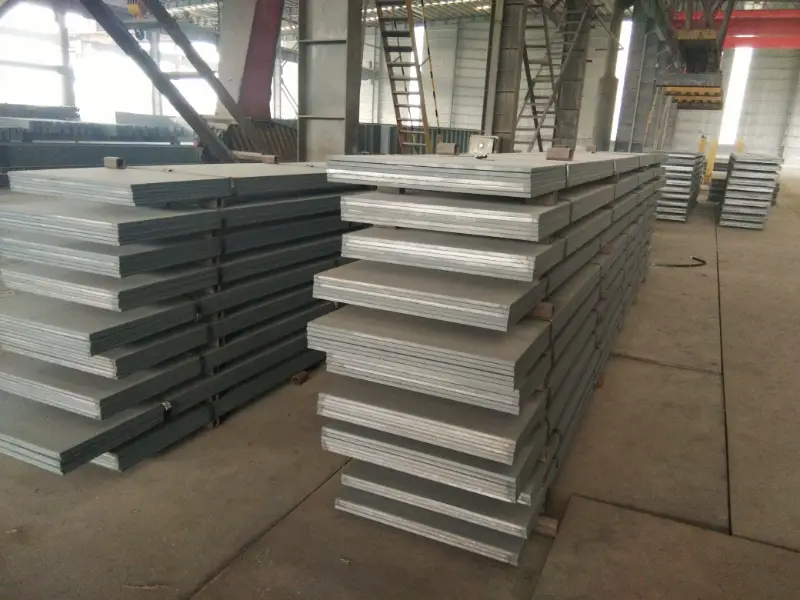
NK Grade E47 Shipbuilding Steel Plate
NK Grade E47 Shipbuilding Steel Plate - High Strength Marine Structural Steel with 460 MPa Yield
Comprehensive data sheet for NK Grade E47 / EH47 shipbuilding steel plate, including chemical composition, mechanical and physical properties per ClassNK rules. Ideal for Arctic and heavy-duty marine structures.
Welding, cold forming, hot forming, flame cutting, machining
- Phone : +8618037372205
- Email : [email protected]
- WhatsApp: Contact via Whtsapp
- WeChat: +8618037372205
NK Grade E47 Shipbuilding Steel Plate Introduction
NK Grade E47, also designated EH47, is a high-strength shipbuilding steel plate classified by Nippon Kaiji Kyokai (ClassNK). With a minimum yield strength of 460 MPa, it belongs to the higher strength hull structural steel family, surpassing the common FH40 (390 MPa) grades. The "E" indicates excellent low-temperature toughness with impact testing at -40°C, making it suitable for applications in cold climates and Arctic conditions.
This grade is microalloyed and typically delivered in thermomechanically controlled rolled (TMCP) or normalized condition, ensuring a fine-grained microstructure that combines high strength with good weldability and ductility. It is widely used in critical structural members of large container ships, offshore platforms, icebreakers, and naval vessels where weight savings and safety are paramount.
NK Grade E47 Shipbuilding Steel Plate Chemical Composition
Typical ladle analysis for NK Grade E47 plates according to ClassNK rules. The steel is microalloyed with Nb, V, and Ti to achieve fine grain size and high strength. Carbon equivalent (CEV) is normally controlled below 0.43 to ensure good weldability.
Residual elements such as Cr, Ni, Cu, and Mo are often present in small quantities depending on thickness, contributing to hardenability and toughness.
| Element | Typical Value (wt%) | Remarks |
|---|---|---|
| C (Carbon) | 0.15 - 0.20 | Upper limit 0.20; lower values for better weldability |
| Si (Silicon) | 0.15 - 0.55 | Deoxidizer and strength contributor |
| Mn (Manganese) | 0.70 - 1.70 | Main strengthening element |
| P (Phosphorus) | ≤ 0.025 | Strict control for low-temperature toughness |
| S (Sulphur) | ≤ 0.025 | Strict control for low-temperature toughness |
| Al (Aluminium) | ≥ 0.015 total Al | Grain refinement by AlN precipitation |
| Nb (Niobium) | 0.02 - 0.05 | Microalloy for grain refinement and precipitation hardening |
| V (Vanadium) | 0.05 - 0.10 | Microalloy, optional combination with Nb |
| Ti (Titanium) | 0.01 - 0.03 | Grain size control and nitrogen fixation |
| Cr (Chromium) | ≤ 0.25 | May be added to increase strength for thick plates |
| Ni (Nickel) | ≤ 0.30 | Improves low-temperature impact toughness |
| Mo (Molybdenum) | ≤ 0.08 | Optional for thicker plates to improve hardenability |
| Cu (Copper) | ≤ 0.30 | May be present; minor element |
NK Grade E47 Shipbuilding Steel Plate Physical, Thermal and Electrical Properties
These physical properties are typical for structural steel with similar composition and microstructure. Values are valid at room temperature unless otherwise stated. They are not mandatory in ClassNK rules but are essential for design and engineering calculations.
| Property | Typical Value | Unit | Test Condition |
|---|---|---|---|
| Density (ρ) | 7.85 | g/cm³ | 20°C |
| Elastic Modulus (E) | 210 | GPa | 20°C, dynamic method |
| Shear Modulus (G) | 80 | GPa | 20°C, estimated |
| Poisson's Ratio (ν) | 0.3 | 20°C | |
| Thermal Expansion Coefficient (α) | 12.0 | 10⁻⁶/K | 20°C to 100°C |
| Thermal Expansion Coefficient (α) | 12.5 | 10⁻⁶/K | 20°C to 200°C |
| Thermal Expansion Coefficient (α) | 13.3 | 10⁻⁶/K | 20°C to 400°C |
| Thermal Conductivity (λ) | 50 | W/(m·K) | 20°C |
| Thermal Conductivity (λ) | 45 | W/(m·K) | 100°C |
| Specific Heat Capacity (cp) | 460 | J/(kg·K) | 20°C |
| Electrical Resistivity (ρₑ) | 0.20 | μΩ·m | 20°C |
NK Grade E47 Shipbuilding Steel Plate Mechanical Properties
Tensile and impact properties as required by ClassNK for Grade E47 plates. The yield strength (ReH) and tensile strength (Rm) depend on plate thickness. Impact energy (KV) is measured at -40°C using Charpy V-notch specimens (10x10 mm). These values represent transverse test data unless longitudinal is specified.
| Property | Specified Value | Unit | Test Condition |
|---|---|---|---|
| Yield Strength (ReH) | ≥ 460 | MPa | t ≤ 100 mm |
| Yield Strength (ReH) | ≥ 440 | MPa | 100 < t ≤ 150 mm |
| Tensile Strength (Rm) | 570 – 720 | MPa | All thicknesses |
| Elongation (A5), 5.65√S₀ | ≥ 17 | % | Longitudinal, t ≤ 50 mm; lower values for thicker plates per agreement |
| Charpy Impact (KV2) | ≥ 46 (average), 31 (individual) | J | Transverse, -40°C; for t > 50 mm, may use smaller specimens with proportional values |
| Bend Test (180°) | d = 3a (bend diameter = 3 times thickness) | No cracks on outer surface |
NK Grade E47 Shipbuilding Steel Plate Fully Equivalent Material Standards and Substitutable Grades
| Country / Region | Standard | Grade | Remarks |
|---|---|---|---|
| Europe | EN 10025-6 | S460ML | Thermomechanical rolled; -50°C impact option available |
| USA | ASTM A514 / A517 | Grade E | Quenched and tempered; 690 MPa tensile. Higher strength, but often accepted as equivalent for structural use with modifications |
| Norway / DNV | DNV-OS-B101 | DNV E460 | Yield 460 MPa; -40°C; hull structural steel |
| UK / LR | Lloyd's Register Rules | LR EH47 | Direct equivalent to NK E47 |
| USA / ABS | ABS Rules | ABS EH47 | Identical requirements per IACS UR W11 |
| France / BV | BV Rules | BV E460 | Also referred as EH460; same strength and toughness grade |
NK Grade E47 Shipbuilding Steel Plate Application Introduction
NK Grade E47 is engineered for severe marine environments where high strength-to-weight ratio and excellent low-temperature fracture resistance are critical. Its weldability, combined with a minimum yield of 460 MPa, allows for thinner plate design and reduced structural weight without compromising safety. The material is suitable for both welded and bolted connections and can be formed to complex shapes with proper practices.
Product Applications: Rolled steel plates from 6 mm to 150 mm thickness, Wide flats and profiles for stiffeners, Custom-cut components (waterjet, plasma, oxy-fuel), Prefabricated panels and sub-assemblies
Processed into products: Ship hull plates and shell plating, Longitudinal stiffeners and web frames, Deck stringer plates and sheer strakes, Offshore platform primary structural members (columns, braces), Heavy-lift crane pedestals and booms, Ice belt reinforcement on ice-class vessels, Transverse bulkheads and tank boundaries
Application industries: Marine and shipbuilding (hulls, superstructures, hatch covers), Offshore oil & gas (platforms, decks, modules), Port and harbour construction (heavy-duty berths, crane girders), Defence and naval (ice patrol ships, frigates), Arctic engineering (icebreakers, ice-resistant structures)
NK Grade E47 Shipbuilding Steel Plate Similar or Near-Equivalent Materials for Comparison
| Country / Region | Standard | Grade | Remarks |
|---|---|---|---|
| Europe | EN 10025-3 | S460N | Normalized, yield 460 MPa; impact -20°C (N) or -50°C (NL); lacks E47's specific shipbuilding certification but similar strength |
| Japan | JIS G 3106 | SM490B, SM490C, SM490YA, SM490YB | 490 MPa tensile strength class; SM490Y has yield ≥ 365 MPa. Lower shear than E47 but common for shipbuilding in a lower tier |
| USA | ASTM A572 | Grade 65 | 450 MPa yield (close to 460); structural steel, not normalized, not ship grade |
| China | GB/T 712 | EH460 | Equivalent to E47; this is the Chinese shipbuilding steel grade with 460 MPa yield, -40°C impact |
| International | IACS W11 | EH47 | Unified requirement; basis for all IACS class societies |
Notes:
Welding: Preheating and interpass temperature controls are required especially for thick sections to avoid hydrogen cracking. Suitable welding consumables matching the 460 MPa class should be used.
Thickness up to 150 mm is typical; for thicker plates, quenching and tempering or enhanced TMCP process may be applied, and supplementary testing is often required.
This material meets the IACS UR W11 and W28 unified requirements, which guarantees acceptance across all major classification societies.
For designs requiring Z-direction properties (through-thichness tensile ductility), Z35/Z25 options can be specified per NK rules.
- Share



