
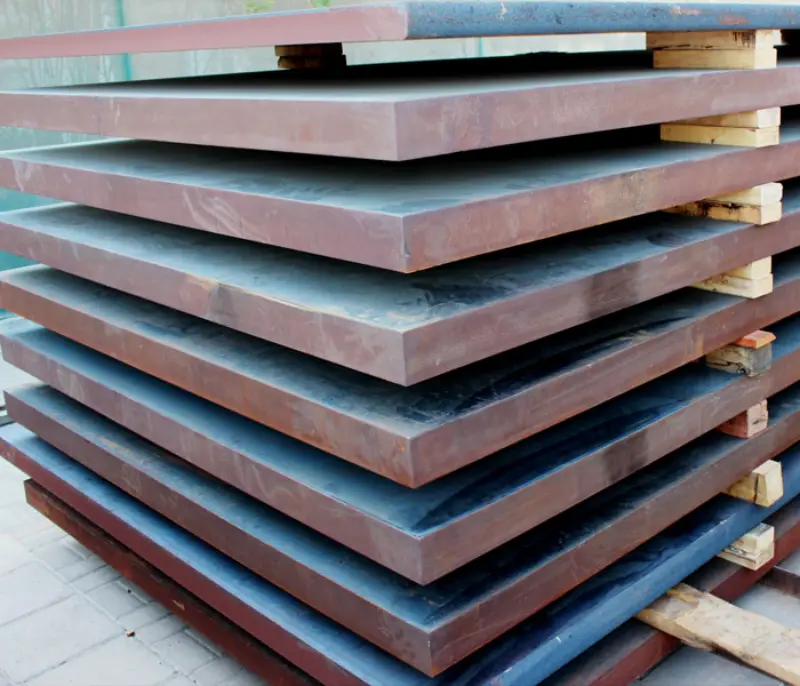
NK Grade F47 Shipbuilding Steel Plate
NK Grade F47 Shipbuilding Steel Plate - High Strength Quenched & Tempered Material for Extreme Marine Environments
Comprehensive material data for NK Grade F47 shipbuilding steel plate, including chemical composition, mechanical and physical properties, international equivalents, and application guidance. Conforms to ClassNK rules and IACS UR W31.
Hot rolling followed by quenching and tempering (Q+T). Can undergo cold forming, welding, and machining under appropriate conditions.
- Phone : +8618037372205
- Email : [email protected]
- WhatsApp: Contact via Whtsapp
- WeChat: +8618037372205
NK Grade F47 Shipbuilding Steel Plate Introduction
NK Grade F47 is a high-strength quenched and tempered shipbuilding steel plate with a minimum yield strength of 460 MPa. It is designed for critical structural components in shipbuilding and offshore engineering that demand excellent weldability, high toughness at low temperatures, and resistance to brittle fracture.
- Excellent strength-to-weight ratio, enabling lighter constructions with high load-bearing capacity.
- Outstanding low-temperature toughness, typically guaranteed down to -40 °C.
- Delivered in quenched and tempered (Q+T) condition, ensuring a uniform martensitic-bainitic microstructure.
- Fully complies with ClassNK rules and IACS UR W31, the international standard for high-strength quenched and tempered steels.
NK Grade F47 Shipbuilding Steel Plate Chemical Composition
The chemical composition of NK Grade F47 is tightly controlled to achieve the required strength and toughness after quenching and tempering. Microalloying elements such as Nb, V, and Ti are used for grain refinement, while low sulfur and phosphorus contents ensure excellent cleanliness and resistance to lamellar tearing. The values below are typical and comply with IACS UR W31.
| Chemical Element | Standard Value (%) | Remarks |
|---|---|---|
| Carbon (C) | ≤ 0.18 | Tighter limits for better weldability |
| Silicon (Si) | ≤ 0.55 | - |
| Manganese (Mn) | ≤ 1.60 | - |
| Phosphorus (P) | ≤ 0.025 | - |
| Sulfur (S) | ≤ 0.025 | - |
| Aluminium (Al) | ≥ 0.015 | Total aluminium, for grain refinement |
| Niobium (Nb) | ≤ 0.05 | - |
| Vanadium (V) | ≤ 0.10 | - |
| Titanium (Ti) | ≤ 0.05 | - |
| Copper (Cu) | ≤ 0.35 | - |
| Chromium (Cr) | ≤ 0.25 | - |
| Nickel (Ni) | ≤ 0.30 | For toughness improvement |
| Molybdenum (Mo) | ≤ 0.10 | - |
| Nitrogen (N) | ≤ 0.012 | - |
NK Grade F47 Shipbuilding Steel Plate Thermal and Electrical Physical Properties
The physical properties below are typical for quenched and tempered structural steels and are provided for design calculations. They are not mandatory requirements but are based on measurements on similar high-strength steels.
| Property | Typical Value | Unit | Test Condition / Remarks |
|---|---|---|---|
| Density (ρ) | 7850 | kg/m³ | At 20 °C |
| Modulus of Elasticity (E) | 210 | GPa | At 20 °C |
| Shear Modulus (G) | 81 | GPa | At 20 °C |
| Poisson's Ratio (ν) | 0.3 | - | At 20 °C |
| Thermal Expansion Coefficient (α) | 12.0 × 10⁻⁶ | 1/K | Between 20 °C and 100 °C |
| Thermal Conductivity (λ) | 42 | W/(m·K) | At 20 °C |
| Specific Heat Capacity | 460 | J/(kg·K) | At 20 °C |
| Electrical Resistivity (ρₑ) | 0.25 × 10⁻⁶ | Ω·m | At 20 °C |
NK Grade F47 Shipbuilding Steel Plate Mechanical Properties
The mechanical properties are determined on transverse test pieces taken from the delivered condition (quenched and tempered). Guaranteed values depend on plate thickness; typical data for thicknesses ≤ 50 mm are shown. The material offers high yield and tensile strength combined with good ductility and reliable low-temperature toughness.
| Property | Standard Required Value | Unit | Test Condition |
|---|---|---|---|
| Yield Strength (ReH) | ≥ 460 | MPa | Thickness ≤ 50 mm, transverse |
| Yield Strength (ReH) | ≥ 440 | MPa | Thickness 50-100 mm, transverse |
| Tensile Strength (Rm) | 570 - 720 | MPa | Thickness ≤ 100 mm, transverse |
| Elongation (A) | ≥ 17 | % | Gauge length 5.65√S₀, thickness ≤ 50 mm |
| Elongation (A) | ≥ 16 | % | Thickness 50-100 mm |
| Bend Test (Bend Diameter) | 3a (180°) | - | Thickness ≤ 50 mm, a = specimen thickness |
| Bend Test (Bend Diameter) | 4a (180°) | - | Thickness 50-100 mm |
| Impact Energy (KV₂) | ≥ 27 (average) | J | -40 °C, longitudinal, 10×10 mm specimen |
| Impact Energy (KV₂) | ≥ 19 (single minimum) | J | -40 °C, longitudinal, 10×10 mm specimen |
NK Grade F47 Shipbuilding Steel Plate Complete Equivalent Material Standards and Replaceable Grades
| Country / Region | Standard | Grade | Remarks |
|---|---|---|---|
| International | IACS UR W31 | F460 | Base standard for Q&T shipbuilding steels |
| USA | ABS | EQ47 | American Bureau of Shipping, identical requirements |
| France / International | BV | F460 | Bureau Veritas, directly equivalent |
| China | CCS | F460 | China Classification Society, identical grade |
| Norway / Germany | DNV | F460 | DNV GL (now DNV), standard high-strength grade |
| UK | LR | F460 | Lloyd's Register, fully interchangeable |
| South Korea | KR | F460 | Korean Register, equivalent designation |
| Italy | RINA | F460 | Registro Italiano Navale, same mechanical properties |
NK Grade F47 Shipbuilding Steel Plate Application Introduction
NK Grade F47 is specifically tailored for welded structures in the shipbuilding and offshore industry where high strength and resistance to brittle fracture at sub-zero temperatures are essential. Key processing notes:
- Preheating (typically 100-150 °C) is recommended before welding to avoid hydrogen-induced cracking.
- Post-weld heat treatment is generally not required for thicknesses up to 50 mm but may be specified for thicker sections.
- Hot forming must be followed by a new quenching and tempering treatment to restore mechanical properties.
- Z-quality (through-thickness properties) can be ordered for highly restrained joints.
Product Applications: Ship hulls and decks, Ice belts and ice-strengthened areas, Jack-up rig legs and spud cans, Offshore platform topsides, Pressure vessels (when additional codes are met)
Processed into products: Frames, longitudinals, and stiffeners, Bulkhead plates and web frames, Crane pedestal and turret structures, Heavy machinery support plates, Welded fabrications requiring guaranteed low-temperature toughness
Application industries: Shipbuilding, Offshore oil and gas platforms, Arctic and ice-class vessels, Heavy-lift crane structures, Bridge construction (with additional certification)
NK Grade F47 Shipbuilding Steel Plate Similar / Substitute Materials Recommendation
| Country / Region | Standard | Grade | Remarks |
|---|---|---|---|
| Europe | EN 10025-6 | S460Q / S460QL / S460QL1 | Structural steel quenched and tempered; requires verification of toughness and welding specifications for marine use. |
| Europe | EN 10025-4 | S460M / S460ML | Thermomechanically rolled; similar strength but less strict low-temperature toughness; may substitute for non-critical applications. |
| USA | ASTM A709 / A709M | Grade 50 (345 MPa) upgraded to 50W | Not a direct match; careful design review needed if used as shipbuilding plate. |
Notes:
Additional information:
- Through-thickness property (Z-quality) is available upon request according to IACS UR W13, with Z25 or Z35 grades.
- Material certificates 3.2 issued by ClassNK are the norm for delivered plates.
- Ultrasonic testing to class requirements (e.g., ClassNK KE 01) is mandatory for plates above a certain thickness.
- This data reflects typical, publicly available specifications; actual procurement should always reference the latest edition of the relevant ClassNK or IACS documents.
- Share



