
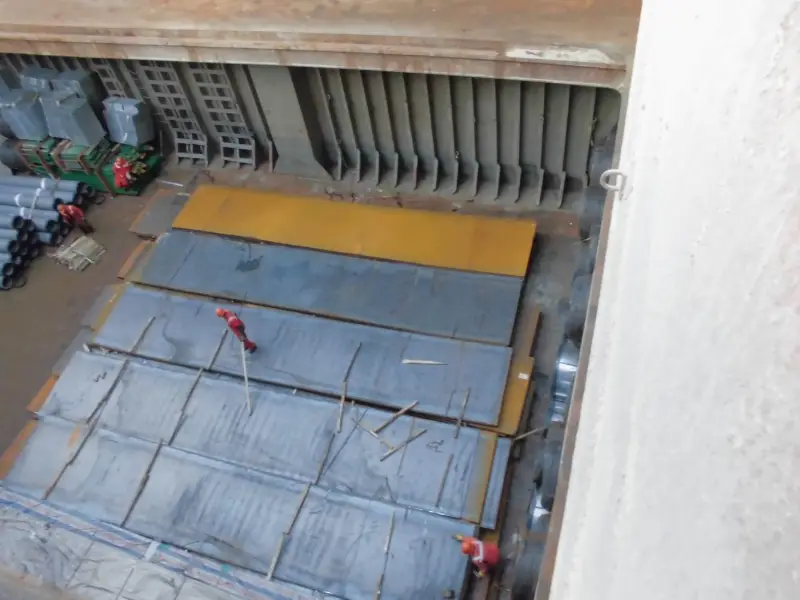
NK Grade A51 Shipbuilding Steel Plate
NK Grade A51 Shipbuilding Steel Plate - High Strength Hull Structural Steel
Comprehensive data sheet for NK Grade A51 (AH51) shipbuilding steel plate: chemical composition, mechanical and physical properties, equivalent grades, and applications in marine construction.
Thermomechanical rolling (TMCP), normalizing, quenching and tempering (optional); welding procedures in accordance with NK requirements
- Phone : +8618037372205
- Email : [email protected]
- WhatsApp: Contact via Whtsapp
- WeChat: +8618037372205
NK Grade A51 Shipbuilding Steel Plate Introduction
NK Grade A51 is a high-strength shipbuilding steel plate classified according to the rules of Nippon Kaiji Kyokai (ClassNK). It belongs to the AH51 designation, indicating a minimum yield strength of 510 MPa and impact testing at 0°C. This thermomechanically rolled or normalized steel exhibits excellent weldability, toughness, and strength-to-weight ratio, making it suitable for critical structural components in large vessels and offshore platforms. The material meets the requirements of IACS UR W11 and complies with strict maritime safety standards. Typical delivery condition is normalized or thermomechanical rolling (TMCP).
NK Grade A51 Shipbuilding Steel Plate Chemical Composition
The chemical composition is in accordance with NK Rules Part K and IACS UR W11 for grade AH51. Limits are given for the ladle analysis. Microalloying elements such as Nb, V, Ti may be added singly or in combination to achieve the required strength and toughness. Carbon equivalent (CEQ) is controlled to ensure weldability, typically CEQ ≤ 0.50% depending on thickness; precise values shall be agreed upon.
| Element | Standard Value (max, unless a range is shown) | Remarks |
|---|---|---|
| C | ≤ 0.18 | Ladle analysis |
| Si | ≤ 0.55 | Ladle analysis |
| Mn | 0.90 – 1.60 | Ladle analysis |
| P | ≤ 0.035 | Ladle analysis |
| S | ≤ 0.035 | Ladle analysis |
| Cr | ≤ 0.25 | Residual; may be specified lower upon agreement |
| Ni | ≤ 0.40 | Residual; may be specified lower upon agreement |
| Mo | ≤ 0.08 | Residual; may be specified lower upon agreement |
| Cu | ≤ 0.35 | Residual; may be specified lower upon agreement |
| Nb | ≤ 0.05 | Microalloying; if added |
| V | ≤ 0.10 | Microalloying; if added |
| Ti | ≤ 0.02 | Microalloying; if added |
| Al (total) | ≥ 0.015 | Fine grain practice mandatory |
| N | ≤ 0.012 | If not aluminum killed, nitrogen may be limited |
| Ceq (CE) | As agreed (typ. ≤0.50 for thickness ≤50mm) | Ceq = C + Mn/6 + (Cr+Mo+V)/5 + (Ni+Cu)/15 |
NK Grade A51 Shipbuilding Steel Plate Thermal and Electrical Physical Properties
The following physical properties are representative for high-strength structural steels similar to AH51. Exact values may slightly vary depending on heat treatment and composition. These data are not part of the NK specification but commonly used for engineering calculations. Density is assumed at room temperature. Elastic constants are for longitudinal deformation. Thermal expansion and conductivity are given for the range 20–100°C unless otherwise noted.
| Property | Typical Value | Unit | Test Condition / Temperature |
|---|---|---|---|
| Density (ρ) | 7850 | kg/m³ | 20°C |
| Elastic modulus (E) | 210 | GPa | 20°C, static |
| Shear modulus (G) | 80 | GPa | 20°C, calculated from E and ν |
| Poisson's ratio (ν) | 0.30 | dimensionless | 20°C |
| Thermal expansion coefficient (α) | 12.0 | 10⁻⁶ /K | 20 – 100°C |
| Thermal conductivity (λ) | 50 | W/(m·K) | 20°C |
| Specific heat capacity (cp) | 460 | J/(kg·K) | 20°C |
| Electrical resistivity (ρe) | 0.20 – 0.25 | μΩ·m | 20°C |
NK Grade A51 Shipbuilding Steel Plate Mechanical Properties
Mechanical properties are according to NK Rules and IACS UR W11, measured on transverse test pieces unless otherwise specified. Values depend on plate thickness (t). The yield strength is the upper yield point (ReH) or 0.2% proof strength (Rp0.2). Impact test temperature for A51 grade is 0°C. Charpy V-notch energy values are average of three specimens; single minimum is 70% of the specified average.
| Property | Required Value | Unit | Test Condition / Thickness |
|---|---|---|---|
| Yield Strength (ReH) | ≥ 510 | MPa | t ≤ 100 mm; specified for transverse direction |
| Tensile Strength (Rm) | 610 – 770 | MPa | t ≤ 100 mm |
| Elongation after fracture (A) | ≥ 16 | % | 5.65√So gauge, t ≤ 50 mm |
| Elongation after fracture (A) | ≥ 15 | % | 5.65√So gauge, 50 < t ≤ 70 mm |
| Elongation after fracture (A) | ≥ 14 | % | 5.65√So gauge, 70 < t ≤ 100 mm |
| Charpy V-notch impact energy (KV) at 0°C | ≥ 41 (longitudinal) | J | t ≤ 50 mm; average of 3 tests |
| Charpy V-notch impact energy (KV) at 0°C | ≥ 34 (longitudinal) | J | 50 < t ≤ 70 mm |
| Charpy V-notch impact energy (KV) at 0°C | ≥ 27 (longitudinal) | J | 70 < t ≤ 100 mm |
| Cold bend test (180°) | d = 3a (t ≤ 20 mm) | Bend diameter d; a = specimen thickness; no cracks | |
| Cold bend test (180°) | d = 4a (t > 20 mm) | Bend diameter d; a = specimen thickness; no cracks |
NK Grade A51 Shipbuilding Steel Plate Full Equivalent Standards and Replaceable Grades
| Country / Society | Standard | Grade | Remarks |
|---|---|---|---|
| International (IACS) | IACS UR W11 | AH51 | Directly equivalent: A51 impact tested at 0°C |
| American Bureau of Shipping | ABS Rules | AH51 | Identical mechanical and chemical requirements |
| DNV (Norway/Germany) | DNV Rules | AH51 | DNV AH51 interchangeable with NK A51 |
| Bureau Veritas | BV Rules | AH51 | Equivalent under IACS Unified Requirements |
| Lloyd's Register | LR Rules | AH51 | Same designation and properties |
| China Classification Society | CCS Rules | AH51 | CCS AH51 matched to NK AH51 |
| Korean Register | KR Rules | AH51 | KR AH51 fully equivalent |
| Registro Italiano Navale | RINA Rules | AH51 | RINA AH51 meets same criteria |
| Russian Maritime Register | RS Rules | AH51 | Equivalent high-strength hull steel |
NK Grade A51 Shipbuilding Steel Plate Application Introduction
NK Grade A51 steel plates are specifically designed for high-stress structural components in shipbuilding and marine engineering where weight reduction and high strength are critical. Due to its controlled carbon equivalent and fine grain structure, it offers good weldability with preheating and low-hydrogen processes. Common applications include highly stressed regions of hull girders, deck plating, and offshore modules. The material is normally supplied with NK certification stamped on each plate.
Product Applications: Main hull plates, Deck plates and sheer strakes, Bottom shell plating, Longitudinal bulkheads, Transverse web frames, Hatch coaming and corner pieces, Offshore module structural members
Processed into products: Ship hull sections subjected to high stress, Stiffeners and girders in deck and bottom structures, Connection plates at stress concentrations, Reinforcement pads and doubler plates, Brackets and foundations for heavy machinery, Leg components of self-elevating platforms (with additional toughness requirements), Welded built-up sections for heavy load-bearing members
Application industries: Shipbuilding (container ships, bulk carriers, tankers, LNG carriers), Offshore oil and gas (jack-up rigs, floating production units, platform structures), Marine engineering (dockside cranes, heavy-lift vessel components), Bridge and heavy civil construction (when marine approval accepted)
NK Grade A51 Shipbuilding Steel Plate Similar or Closely Related Alternative Materials
| Country / Society | Standard | Grade | Comparison / Remarks |
|---|---|---|---|
| NK (ClassNK) | NK Rules | AH50 | Minimum yield 500 MPa instead of 510 MPa; otherwise very similar, may be acceptable with design adjustment |
| NK (ClassNK) | NK Rules | AH55 | Minimum yield 550 MPa, slightly higher strength; requires careful welding procedure |
| NK (ClassNK) | NK Rules | DH51 | Same strength but impact test at -20°C (D grade); used where lower service temperature required |
| NK (ClassNK) | NK Rules | EH51 | Same strength but impact test at -40°C (E grade) |
| ASTM (USA) | ASTM A514 / A517 | Grade H / Grade Q | Quenched and tempered steel with yield ~690 MPa; not a direct shipbuilding grade but used in offshore structures with special approval |
| EN (Europe) | EN 10025-6 | S500Q / S500QL | Similar yield 500 MPa, but for general structural applications; requires verification for marine use |
Notes:
Additional Information: All data conforms to NK Rules Part K (current edition) and IACS UR W11. Actual supply conditions (normalized vs TMCP) must be specified in the purchase order. Thickness tolerances and surface conditions are as per NK standards. Ultrasonic testing may be required by the classification society for certain critical applications. Welding consumables must match the strength level and be approved by NK. For thicknesses above 50 mm, special attention to through-thickness properties (Z-quality) may be needed. The carbon equivalent values should be reported on the mill certificate. This grade is not intended for service temperatures below 0°C without impact testing at lower temperatures (upgrade to DH51 or EH51).
- Share



