
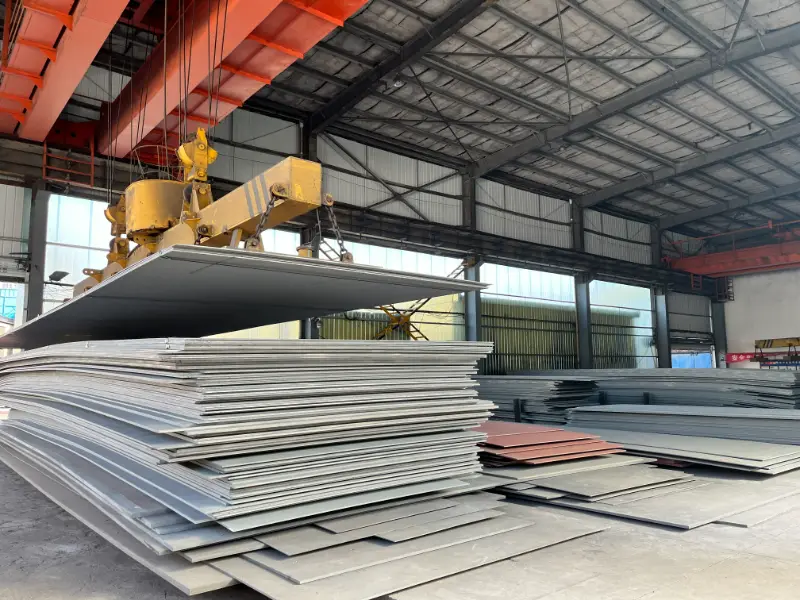
NK Grade D51 Shipbuilding Steel Plate
NK Grade D51 Shipbuilding Steel Plate - High-Strength Quenched and Tempered Marine Steel (500 MPa Yield)
In-depth technical data for NK Grade D51 shipbuilding steel plate including chemical composition, mechanical properties, thermal and electrical physical properties, international equivalents, and application guidance.
Cutting (flame, plasma, laser), cold and hot forming, welding (SMAW, GMAW, SAW, FCAW), machining, preheat and post-weld heat treatment as required
- Phone : +8618037372205
- Email : [email protected]
- WhatsApp: Contact via Whtsapp
- WeChat: +8618037372205
NK Grade D51 Shipbuilding Steel Plate Introduction
NK Grade D51 is a high-strength quenched and tempered shipbuilding steel plate classified by Nippon Kaiji Kyokai (ClassNK). The designation 'D' indicates a minimum impact toughness guarantee at -20 °C, and '51' refers to a minimum yield strength of 51 kgf/mm² (500 N/mm²). This steel is mainly used for critical structural components in ships and offshore installations where high strength, good weldability, and reliable low-temperature toughness are required. It is typically supplied in the quenched and tempered (Q&T) condition, though thermo-mechanically controlled processing (TMCP) variants may also be available. The material meets the requirements of IACS UR W11 for HT500 grades and is fully traceable to international equivalents such as DH500 in LR, ABS, and DNV rules.
NK Grade D51 Shipbuilding Steel Plate Chemical Composition
The chemical composition of NK D51 conforms to the requirements of IACS UR W11 for HT500 grade (quenched and tempered). Grain-refining elements such as Al, Nb, V, and Ti are added to ensure fine grain size and improve toughness. Carbon equivalent (Ceq) is restricted to guarantee weldability. The typical values given are guideline maximum limits unless a range is specified.
| Element | Standard Requirement (mass %) | Remarks |
|---|---|---|
| Carbon (C) | ≤ 0.18 | |
| Silicon (Si) | 0.10 – 0.55 | |
| Manganese (Mn) | 0.90 – 1.70 | |
| Phosphorus (P) | ≤ 0.030 | |
| Sulfur (S) | ≤ 0.030 | |
| Chromium (Cr) | ≤ 1.50 | |
| Nickel (Ni) | ≤ 2.00 | |
| Molybdenum (Mo) | ≤ 0.60 | |
| Copper (Cu) | ≤ 0.50 | |
| Vanadium (V) | ≤ 0.10 | Sum Nb+V+Ti ≤ 0.12% |
| Niobium (Nb) | ≤ 0.05 | Sum Nb+V+Ti ≤ 0.12% |
| Titanium (Ti) | ≤ 0.05 | Sum Nb+V+Ti ≤ 0.12% |
| Aluminium (Al, acid soluble) | ≥ 0.015 | |
| Nitrogen (N) | ≤ 0.012 | If sufficient Al or Ti is present to bind N, higher N may be permitted |
| Boron (B) | ≤ 0.0010 | If used, may affect hardenability; not typically required |
NK Grade D51 Shipbuilding Steel Plate Thermal and Electrical Physical Properties
The physical properties listed below are typical for quenched and tempered high-strength carbon-manganese steels and are not specifically defined in the NK rule. They are provided for engineering design calculations. Values may vary slightly depending on the exact tempering temperature and microalloying content.
| Property | Typical Value | Unit | Test Condition |
|---|---|---|---|
| Density (ρ) | 7850 | kg/m³ | 20 °C |
| Modulus of Elasticity (E) | 205 | GPa | Room temperature |
| Shear Modulus (G) | 79 | GPa | Room temperature |
| Poisson's Ratio (ν) | 0.30 | – | |
| Thermal Expansion Coefficient (α) | 11.5 | 10⁻⁶/K | 20 – 100 °C |
| Thermal Expansion Coefficient (α) | 12.5 | 10⁻⁶/K | 20 – 200 °C |
| Thermal Expansion Coefficient (α) | 13.5 | 10⁻⁶/K | 20 – 400 °C |
| Thermal Conductivity (λ) | 42 | W/(m·K) | 20 °C |
| Thermal Conductivity (λ) | 40 | W/(m·K) | 200 °C |
| Thermal Conductivity (λ) | 36 | W/(m·K) | 400 °C |
| Specific Heat Capacity (c) | 460 | J/(kg·K) | 20 °C |
| Specific Heat Capacity (c) | 520 | J/(kg·K) | 200 °C |
| Specific Heat Capacity (c) | 590 | J/(kg·K) | 400 °C |
| Electrical Resistivity (ρ_e) | 0.22 | 10⁻⁶ Ω·m | 20 °C |
NK Grade D51 Shipbuilding Steel Plate Mechanical Properties
Mechanical properties are verified by tensile and impact testing on transverse specimens according to the NK Rules and IACS UR W11. The values apply to plate thickness t ≤ 50 mm. For thicker plates, slight reductions in yield strength may be permitted; refer to the full standard. The bending test is performed with the specified mandrel diameter, and the welded bend test may have different requirements.
| Property | Standard Requirement | Unit | Test Condition |
|---|---|---|---|
| Yield Strength (ReH) | ≥ 500 | N/mm² (MPa) | t ≤ 50 mm, transverse |
| Tensile Strength (Rm) | 610 – 770 | N/mm² (MPa) | t ≤ 50 mm, transverse |
| Elongation (A) | ≥ 14 | % | Gauge length 5.65√So, transverse, t ≤ 50 mm |
| Impact Energy (KV) | ≥ 34 (average) / ≥ 24 (single) | J | D-grade: –20 °C, Charpy V-notch, longitudinal |
| Bend Test (through thickness) | 180° bending, d=4a | a = plate thickness, no cracks or defects |
NK Grade D51 Shipbuilding Steel Plate Fully Equivalent Material Standards and Substitutes
| Country / Region | Standard | Grade | Remarks |
|---|---|---|---|
| International (IACS) | UR W11 | HT500 (DH500) | Identical technical requirements |
| USA (ABS) | ABS Rules | DH51 | D-grade (–20 °C), 51 kgf/mm² |
| Norway/Germany (DNV) | DNV Rules | D500 | D-grade, 500 N/mm² yield |
| UK (LR) | LR Rules | DH500 | Identical to NK D51 |
| France (BV) | BV Rules | DH500 | Identical to NK D51 |
| China (CCS) | CCS Rules | DH500 | Identical to NK D51 |
| South Korea (KR) | KR Rules | DH500 | Identical to NK D51 |
| Italy (RINA) | RINA Rules | DH500 | Identical to NK D51 |
| Russia (RS) | RS Rules | D500 | Also designated as 5D, D-500 |
NK Grade D51 Shipbuilding Steel Plate Application Introduction
NK D51 steel plates are designed for highly loaded welded structures where weight saving, high strength, and reliable notch toughness at low temperatures are critical. They are commonly used in the following areas, but final suitability must be confirmed against the specific design codes, service temperature, and fabrication procedures. The material is readily weldable with low-hydrogen processes, but preheating and interpass temperature control are recommended based on plate thickness and carbon equivalent.
Product Applications: Ship hull plates (shell plating, bilge strakes, bottom plates), Deck plating and longitudinal stiffeners, Watertight and oiltight bulkheads, Offshore platform decks and module support structures, Jack-up rig leg chords and spudcans, Offshore crane pedestals and slewing rings
Processed into products: Shell plate panels and insert plates, Longitudinal and transverse frames, Web frames and girders, Hatch coamings and covers, Rudders and rudder horns, Mooring and towing brackets, Support stools for equipment, Keel blocks and bottom reinforcement
Application industries: Shipbuilding – commercial ships (container vessels, bulk carriers, tankers, LNG/LPG carriers), Naval and defence – warship hulls and structural parts, Offshore oil and gas – fixed and floating platforms (jacket legs, deck boxes, flare booms), Offshore renewable energy – wind turbine foundation transition pieces, substation topsides, Marine heavy engineering – heavy-lift crane barges, dredger hulls, salvage equipment
NK Grade D51 Shipbuilding Steel Plate Closely Related or Similar Alternative Materials
| Country / Region | Standard | Grade | Remarks |
|---|---|---|---|
| Japan | NK Rules | A51 | Higher impact test temperature (0 °C), same strength; suitable for less demanding service |
| Japan | NK Rules | E51 | Lower impact test temperature (–40 °C), same strength; for arctic applications |
| Japan | NK Rules | F51 | Lowest impact test temperature (–60 °C), same strength; for extreme cold environments |
| Europe | EN 10025-6 | S500Q | Quenched and tempered structural steel, ReH ≥500 MPa, delivery condition Q or QL; may need additional toughness qualification for marine use |
| Europe | EN 10025-6 | S500QL | Same as S500Q but with guaranteed low-temperature impact properties (–40 °C), equivalent to E51 |
| USA | ASTM A514 / A517 | Grade Q | Yield strength ≥620 MPa, higher strength but different toughness and welding requirements; not a direct substitute for thickness > 50 mm |
| China | GB/T 16270 | Q500D | Similar strength and –20 °C toughness, often used in heavy machinery; may be accepted subject to Classification Society approval |
Notes:
Carbon equivalent (Ceq) is usually limited to 0.50% for quenched and tempered condition to ensure good weldability; additional requirements for through-thickness reduction of area (Z35 quality) may be specified if plate is subjected to significant through-thickness loading. Ultrasonic testing in accordance with NK rules is normally required. Contact the mill or class society for exact Certificates of Approval and full traceability.
- Share



