
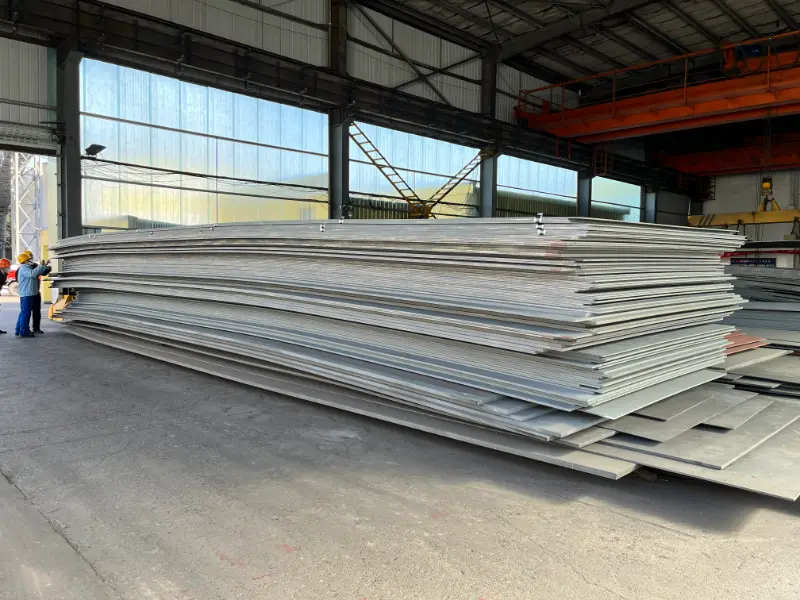
NK Grade E51 Shipbuilding Steel Plate
NK Grade E51 Shipbuilding Steel Plate: High-Strength Hull Structural Material for Arctic-Class Vessels
Comprehensive material data sheet for NK Grade E51 shipbuilding steel plate compliant with Nippon Kaiji Kyokai (ClassNK) rules. Covers chemical composition, mechanical properties, thermal and electrical characteristics, international equivalents, and application guidance for marine and offshore engineering.
Hot rolling, controlled rolling, normalizing, thermo-mechanical control process (TMCP), welding, cold forming (limited), bending, edge preparation
- Phone : +8618037372205
- Email : [email protected]
- WhatsApp: Contact via Whtsapp
- WeChat: +8618037372205
NK Grade E51 Shipbuilding Steel Plate Introduction
NK Grade E51 is a high-strength shipbuilding steel plate classified by Nippon Kaiji Kyokai (ClassNK) with a minimum yield strength of 51 ksi (355 MPa) and guaranteed impact toughness at -40°C. It belongs to the E-grade series of high-tensile hull structural steels, designed for critical structural components in ships and offshore platforms operating in low-temperature environments. Key features include excellent weldability, good notch toughness, and resistance to brittle fracture, making it suitable for Arctic-class vessels, icebreakers, and deep-sea structures. The material is supplied in normalized or thermo-mechanically controlled processed (TMCP) condition, meeting the requirements of IACS UR W11 for ordinary and high-strength hull structural steels.
NK Grade E51 Shipbuilding Steel Plate Chemical Composition
The chemical composition adheres to ClassNK requirements for high-strength hull structural steel grade E51 (equivalent to IACS UR W11 for EH36). Ladle analysis limits are given. Carbon equivalent (CEV) is typically controlled for weldability: CEV ≤ 0.38% for thickness ≤ 50 mm. Additional microalloying elements (Nb, V, Ti) may be added at the manufacturer's discretion to achieve the required mechanical properties.
| Element | Standard Value (%) | Remarks |
|---|---|---|
| Carbon (C) | ≤ 0.18 | Ladle analysis; lower for TMCP delivery to improve toughness |
| Silicon (Si) | ≤ 0.50 | May be adjusted for deoxidation |
| Manganese (Mn) | 0.90 – 1.60 | For thickness ≤ 25 mm; for thickness > 25 mm, range may be 1.00–1.65 |
| Phosphorus (P) | ≤ 0.035 | Strict control for low-temperature toughness |
| Sulfur (S) | ≤ 0.035 | Low sulfur for improved ductility |
| Aluminum (Al) (total) | ≥ 0.015 | For fine grain practice and deoxidation |
| Niobium (Nb) | 0.02 – 0.05 | Optional microalloying; typical range for strength and toughness |
| Vanadium (V) | 0.05 – 0.10 | Optional microalloying |
| Titanium (Ti) | ≤ 0.02 | Optional; may be used for grain refinement |
| Carbon Equivalent (CEV) | ≤ 0.38 (for ≤50 mm); ≤ 0.40 (for >50–100 mm) | Based on IIW formula: CEV = C + Mn/6 + (Cr+Mo+V)/5 + (Ni+Cu)/15 |
NK Grade E51 Shipbuilding Steel Plate Thermal and Electrical Physical Properties
Physical properties are typical for normalized or TMCP EH36-type steel. Thermal expansion, conductivity, and specific heat values vary with temperature. Electrical resistivity is given for DC measurement at 20°C. These values are suitable for design calculations in marine and structural engineering.
| Property | Typical Value | Unit | Test Condition / Remarks |
|---|---|---|---|
| Density (ρ) | 7.85 | g/cm³ | At 20°C |
| Elastic Modulus (E) | 205 | GPa | At 20°C; tension |
| Shear Modulus (G) | 80 | GPa | Calculated from E and ν |
| Poisson's Ratio (ν) | 0.29 | – | At 20°C |
| Thermal Expansion Coefficient (α) | 11.7 × 10⁻⁶ | K⁻¹ | 20–100°C |
| Thermal Expansion Coefficient (α) | 12.5 × 10⁻⁶ | K⁻¹ | 20–200°C |
| Thermal Expansion Coefficient (α) | 13.3 × 10⁻⁶ | K⁻¹ | 20–300°C |
| Thermal Conductivity (λ) | 45 – 50 | W/(m·K) | At 20°C |
| Specific Heat Capacity (cp) | 460 – 480 | J/(kg·K) | At 20°C |
| Electrical Resistivity (ρₑ) | 0.20 – 0.25 | µΩ·m | At 20°C, DC |
NK Grade E51 Shipbuilding Steel Plate Mechanical Properties
Mechanical properties are determined on transverse test pieces taken from the plate in accordance with ClassNK requirements. Yield strength (ReH), tensile strength (Rm), and elongation (A) depend on plate thickness. Impact test (Charpy V-notch) is performed at -40°C. Bending test is normally required for certification. All values meet or exceed IACS UR W11 for EH36.
| Property | Required Value | Unit | Test Condition / Remarks |
|---|---|---|---|
| Yield Strength (ReH) | ≥ 355 | MPa | Thickness ≤ 50 mm |
| Yield Strength (ReH) | ≥ 345 | MPa | 50 < thickness ≤ 70 mm |
| Yield Strength (ReH) | ≥ 325 | MPa | 70 < thickness ≤ 100 mm |
| Tensile Strength (Rm) | 490 – 620 | MPa | All thicknesses |
| Elongation (A, 5.65√S₀) | ≥ 21 | % | Thickness ≤ 50 mm |
| Elongation (A) | ≥ 20 | % | 50 < thickness ≤ 70 mm |
| Elongation (A) | ≥ 19 | % | 70 < thickness ≤ 100 mm |
| Charpy Impact Energy (KV, -40°C) | ≥ 34 (longitudinal); ≥ 24 (transverse) | J | Average of 3 tests, min. single value 70% of average |
| Bend Test (Mandrel Diameter) | 3t (t = plate thickness) | – | 180° bending; no cracks |
NK Grade E51 Shipbuilding Steel Plate Exact Equivalent Material Standards and Substitutable Grades
| Country / Region | Standard | Grade / Designation | Remarks |
|---|---|---|---|
| International (IACS) | IACS UR W11 | EH36 | Unified requirement for high-strength hull structural steel with -40°C impact test, minimum yield 355 MPa; fully equivalent |
| USA / International | ABS Rules for Steel Vessels | ABS Grade EH36 | Same strength and toughness level; chemical limits identical |
| UK / International | Lloyd's Register Rules | LR Grade EH36 | Direct equivalent; interchangeable for marine construction |
| Norway / International | DNV Rules for Ships | DNV Grade VL E36 (formerly NV E36) | Original DNV designation; current DNV GL (now DNV) uses VL E36; identical requirements |
| France / International | Bureau Veritas Rules | BV Grade EH36 | Equivalent high-strength shipbuilding grade |
| China | CCS Rules for Steel Ships | CCS Grade EH36 | China Classification Society equivalent |
| South Korea | KR Rules for Steel Ships | KR Grade EH36 | Korean Register equivalent |
| Italy | RINA Rules | RINA Grade EH36 | Registro Italiano Navale equivalent |
| Russia | RS Rules for the Classification and Construction of Sea-Going Ships | RS Grade E36 | Russian Maritime Register of Shipping equivalent |
| Europe (non-marine) | EN 10025-4 | S355ML (thermomechanical rolled) | Comparable structural steel for low-temperature toughness; CEV and impact requirements may differ slightly; often accepted for offshore structures |
| USA (non-marine) | ASTM A131 / A131M | Grade EH36 | Standard specification for structural steel for ships |
NK Grade E51 Shipbuilding Steel Plate Application Introduction
NK Grade E51 steel is designed for primary structural members in ships and offshore units that require high strength and reliable low-temperature toughness. Its balanced chemistry and controlled rolling/TMCP deliver good weldability and service performance. Typical applications include:
Product Applications: Hull plates for container ships, bulk carriers, tankers, and LNG carriers, Longitudinal stiffeners, stringers, and web frames, Ice-strengthened belts and bow structures for icebreakers, Deck plates for naval auxiliary vessels, Jack-up rig legs, spudcans, and platform modules, Transition pieces and node cans for offshore wind monopiles
Processed into products: Ship hull shell plating (side, bottom, sheer strake), Strength deck plating and hatch coamings, Bulkhead plates and corrugated bulkheads, Rudder stock parts and stern frames, Bracket plates and tripping brackets, Lifting padeyes and heavy-duty pad plates
Application industries: Marine & Shipbuilding, Offshore Oil & Gas, Arctic Engineering / Ice-Class Vessels, Port & Harbor Infrastructure, Renewable Energy (Offshore Wind Jacket Foundations)
NK Grade E51 Shipbuilding Steel Plate Similar/Comparable Alternative Material Recommendations
| Country / Region | Standard | Grade / Designation | Remarks |
|---|---|---|---|
| Europe | EN 10025-3 | S355N / S355NL | Normalized structural steel with yield 355 MPa; S355NL offers -50°C impact toughness, making it a close alternative for non-marine applications |
| Japan | JIS G 3106 | SM490YB / SM490C | SM490YB is a high-strength steel with yield 365 MPa for thickness ≤16 mm; SM490C offers 0°C impact; not exact for -40°C but similar strength with additional processing |
| USA | ASTM A572 / A572M | Grade 50 [345] | Yield strength 345 MPa; not classed for low-temperature marine use but can be considered if impact requirements are adjusted |
| International (offshore) | API 2Y / 2W | Grade 50 (345 MPa) | Offshore structural steel with 345 MPa yield; typically TMCP; may substitute with additional Charpy verification at -40°C |
| China | GB/T 712 | EH36 | Chinese national standard for shipbuilding steel, directly comparable |
Notes:
- NK Grade E51 is usually certified by Nippon Kaiji Kyokai and stamped with the ClassNK mark and grade on the plate.
- Supplementary requirements such as Z-direction tensile testing (Z25/Z35) for lamellar tearing resistance, through-thickness hardness, and extra-wide plate dimensions can be agreed upon in the contract.
- Welding consumables should match the base metal strength and toughness (e.g., AWS E7018 or equivalent low-hydrogen electrodes). Preheating and interpass temperature control are recommended based on plate thickness and carbon equivalent.
- For critical applications, ultrasonic testing (UT) according to ClassNK standard (e.g., NK-NDT-UT) or EN 10160 Class S2/E2 is often specified.
- Maximum carbon equivalent may be further restricted for Arctic service (e.g., CEV ≤ 0.36) to ensure ductile fracture resistance at very low temperatures.
- This data sheet is compiled from publicly available ClassNK rules and IACS UR W11. For final design, the latest version of the respective society's rules and material certificate must be consulted.
- Share



