
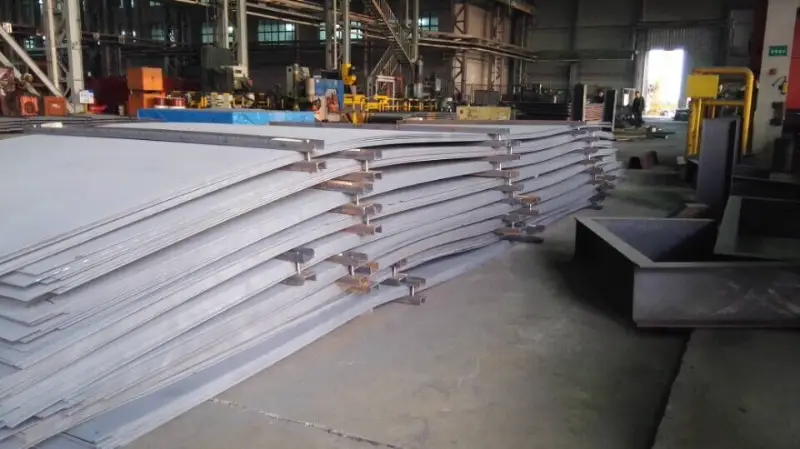
NK Grade F51 High Strength Quenched & Tempered Shipbuilding Steel Plate
NK Grade F51 High Strength Quenched & Tempered Shipbuilding Steel Plate | ClassNK F51
Comprehensive material data for NK Grade F51 quenched and tempered shipbuilding steel plate as per ClassNK rules, including chemical, mechanical and physical properties, equivalent grades and application guidance.
Thermal cutting, shielded metal arc welding (SMAW), submerged arc welding (SAW), gas metal arc welding (GMAW), forming (with appropriate preheating), machining
- Phone : +8618037372205
- Email : [email protected]
- WhatsApp: Contact via Whtsapp
- WeChat: +8618037372205
NK Grade F51 High Strength Quenched & Tempered Shipbuilding Steel Plate Introduction
NK Grade F51 is a high-strength, quenched and tempered (QT) steel plate classified under the ClassNK (Nippon Kaiji Kyokai) Rules for the Survey and Construction of Steel Ships. It is designed for welded hull structures that demand a minimum yield strength of 51 kgf/mm² (approximately 500 MPa) coupled with excellent low-temperature notch toughness. The steel exhibits a fine-grained microstructure achieved through controlled rolling and heat treatment, ensuring superior resistance to brittle fracture at temperatures down to -60°C. Its balanced chemistry, which includes microalloying elements such as niobium, vanadium, and titanium, provides good weldability and formability, making it a preferred choice for critical load-bearing components in modern shipbuilding and offshore engineering. The grade is typically supplied in the quenched and tempered condition, guaranteeing uniform mechanical properties through-thickness.
NK Grade F51 High Strength Quenched & Tempered Shipbuilding Steel Plate Chemical Composition
The material is fully killed and fine-grain treated. The chemical composition is carefully balanced to achieve the required mechanical properties after quenching and tempering, while maintaining good weldability. Limits are in accordance with ClassNK rules for high-strength QT hull structural steel of the 500 MPa yield strength class. Microalloying with Nb, V, and Ti is permitted. Aluminium is added for grain refinement. The carbon equivalent (CEV) is controlled to minimise hardening in the heat-affected zone.
| Chemical Element | Standard Value (wt%) | Remarks |
|---|---|---|
| Carbon (C) | ≤ 0.18 | |
| Silicon (Si) | 0.10 - 0.55 | |
| Manganese (Mn) | 0.90 - 1.60 | |
| Phosphorus (P) | ≤ 0.025 | |
| Sulfur (S) | ≤ 0.015 | |
| Chromium (Cr) | ≤ 0.25 | |
| Nickel (Ni) | ≤ 0.80 | |
| Molybdenum (Mo) | ≤ 0.30 | |
| Copper (Cu) | ≤ 0.35 | |
| Aluminium (Al) | ≥ 0.015 (total) | Required for grain refinement |
| Niobium (Nb) | ≤ 0.05 | |
| Vanadium (V) | ≤ 0.10 | |
| Titanium (Ti) | ≤ 0.02 | |
| Nitrogen (N) | ≤ 0.015 | Sufficient Al, Ti or Nb present to bind N |
| Carbon Equivalent (CEV) | ≤ 0.47 (typical) | CEV = C + Mn/6 + (Cr+Mo+V)/5 + (Ni+Cu)/15; limit depends on thickness |
NK Grade F51 High Strength Quenched & Tempered Shipbuilding Steel Plate Thermal and Electrical Physical Properties
The following physical properties are typical for low-alloy quenched and tempered steels of this strength class. They are not part of the mandatory certification but provide useful guidance for design calculations, thermal analysis, and welding procedure development. Values are approximate and may vary slightly with exact chemical composition and heat treatment condition.
| Property | Typical Value | Unit | Test Condition |
|---|---|---|---|
| Density (ρ) | 7850 | kg/m³ | Ambient |
| Modulus of Elasticity (E) | 210 | GPa | Ambient |
| Shear Modulus (G) | 80 | GPa | Ambient |
| Poisson's Ratio (ν) | 0.3 | - | Ambient |
| Thermal Expansion (α, 20-100°C) | 12.0 | 10⁻⁶/K | Mean coefficient |
| Thermal Conductivity (λ) | ~50 | W/(m·K) | At 20°C |
| Specific Heat Capacity (c) | ~460 | J/(kg·K) | At 20°C |
| Electrical Resistivity (ρₑ) | ~0.20 | 10⁻⁶ Ω·m | At 20°C |
NK Grade F51 High Strength Quenched & Tempered Shipbuilding Steel Plate Mechanical Properties
The mechanical properties specified below represent the minimum acceptance criteria as per ClassNK rules for F51 grade (QT condition). Tensile testing is performed on transverse test pieces. Impact tests are carried out on longitudinal Charpy V-notch specimens at the designated temperature for the F-quality level (-60°C). Bend tests are conducted with the internal radius and angle shown, without cracks or defects. Values are dependent on plate thickness.
| Property | Required Value | Unit | Test Condition |
|---|---|---|---|
| Yield Strength (ReH), min | 500 | MPa | t ≤ 50 mm |
| Yield Strength (ReH), min | 490 | MPa | 50 mm < t ≤ 70 mm |
| Yield Strength (ReH), min | 480 | MPa | 70 mm < t ≤ 100 mm |
| Tensile Strength (Rm) | 610 - 770 | MPa | All thicknesses |
| Elongation (A), min | 16 | % | t ≤ 50 mm, gauge length 5.65√S0 |
| Elongation (A), min | 14 | % | 50 mm < t ≤ 70 mm |
| Elongation (A), min | 12 | % | 70 mm < t ≤ 100 mm |
| Charpy V-Notch Impact (KV2), min | 27 | J | Longitudinal, -60°C |
| Bend Test (180°) | d = 3t | t ≤ 50 mm, no cracks | |
| Bend Test (180°) | d = 4t | 50 mm < t ≤ 70 mm | |
| Bend Test (180°) | d = 5t | 70 mm < t ≤ 100 mm |
NK Grade F51 High Strength Quenched & Tempered Shipbuilding Steel Plate Fully Equivalent Material Standards & Grade Substitutions
| Country/Region | Standard | Grade/Designation | Remarks |
|---|---|---|---|
| Japan / ClassNK | ClassNK Rules for Steel Ships | F51 / FH500 | Original grade |
| DNV (Norway) | DNV-OS-B101 | NV F500 | Identical specification, quenched and tempered hull steel |
| ABS (USA) | ABS Rules for Building and Classing Steel Vessels | FQ50 | Equivalent high-strength Q&T steel |
| LR (UK) | Lloyd's Register Rules | F500 | Hull structural steel, equivalent properties |
| BV (France) | Bureau Veritas Rules for Steel Ships | F500 | Matching toughness and strength |
| CCS (China) | China Classification Society Rules | F500 | Same technical requirements |
| KR (Korea) | Korean Register Rules | F51 | Same designation, full equivalence |
NK Grade F51 High Strength Quenched & Tempered Shipbuilding Steel Plate Application Introduction
NK Grade F51 steel plate is extensively used in shipbuilding and offshore engineering where high strength, low weight, and resistance to brittle fracture are decisive. Its high yield-to-tensile ratio permits significant structural weight savings. Typical applications include:
Product Applications: Hull shell plates (bottom, side, deck), Offshore platform substructures and modules, Deck plates of large container ships and bulk carriers, Crane pedestals and booms for floating cranes, Legs of jack-up rigs, Pressure hulls for submarines
Processed into products: Longitudinal and transverse stiffeners, Web frames and stringers, Bulkhead plates and stiffened panels, Hatch coaming and coaming stiffeners, Bracket plates and transition joints, Floor plates and inner bottom plating, Ice belt and sheer strake on ice-strengthened ships
Application industries: Shipbuilding (naval and commercial vessels), Offshore oil & gas platforms, Marine renewable energy structures (wind turbine foundations), Heavy-lift crane manufacturing, Ice-going and polar-class vessels
NK Grade F51 High Strength Quenched & Tempered Shipbuilding Steel Plate Similar / Near-Equivalent Materials for Reference
| Country/Region | Standard | Grade/Designation | Remarks |
|---|---|---|---|
| Europe | EN 10225 | S500QL | Offshore structural steel, comparable yield strength, good low-temperature toughness, slightly different composition range |
| Europe | EN 10225 | S500G1 | Weldable fine-grain structural steel for offshore structures, similar strength |
| DNV | DNV-OS-B101 | NV F460 | Lower yield strength (460 MPa) but same F-quality toughness; a possible cost-reduced alternative where 500 MPa strength is not fully utilised |
| ABS | ABS Rules | FQ47 | Slightly lower strength (min YS 460 MPa), similar low-temperature impact properties |
| ClassNK | ClassNK Rules | FH460 | NK equivalent of F460, may be considered for less demanding structural designs |
| All major IACS members | IACS UR W11 | F500 type | Most International Association of Classification Societies members have a harmonised standard for high-strength QT steel, ensuring consistent performance of equivalent grades |
Notes:
Welding of NK Grade F51 requires low-hydrogen processes. Preheating to 75–150°C is recommended depending on plate thickness and restraint. Interpass temperature should be controlled typically in the range of 150–200°C. A post-weld heat treatment (stress relief) is not mandatory for thicknesses up to approximately 50 mm, but may be necessary for heavier sections or highly restrained joints to prevent hydrogen-induced cracking. The steel is delivered with a mill test certificate conforming to ClassNK rules, including chemical composition, tensile, impact, and bend test results. For applications requiring through-thickness properties (Z-quality), the grade can be ordered with additional Z-tests according to ClassNK procedures.
- Share



