
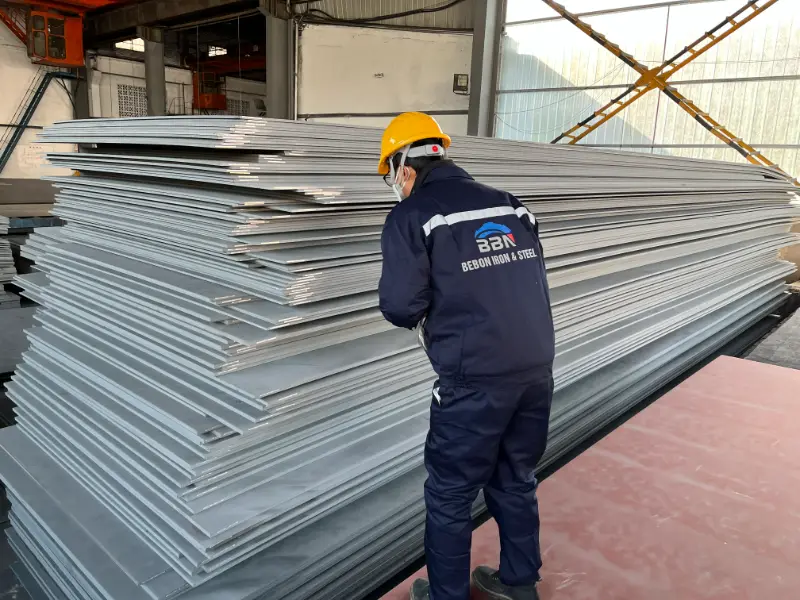
NK Grade A56 Shipbuilding Steel Plate
NK Grade A56 Shipbuilding Steel Plate - High-Strength Hull Structural Steel for Marine Applications
Detailed material data for NK Grade A56 shipbuilding steel plate, a high-tensile hull structural steel certified by Nippon Kaiji Kyokai (ClassNK) with specified minimum yield strength of approximately 56 ksi (390 MPa). Includes chemical composition, mechanical properties, and physical data compliant with NK Rules Part K.
Hot rolling, normalizing, thermo-mechanical controlled processing (TMCP), welding, cold forming
- Phone : +8618037372205
- Email : [email protected]
- WhatsApp: Contact via Whtsapp
- WeChat: +8618037372205
NK Grade A56 Shipbuilding Steel Plate Introduction
NK Grade A56 is a high-strength hull structural steel plate certified by Nippon Kaiji Kyokai (ClassNK), designed for critical shipbuilding applications. This grade belongs to the higher-strength category and corresponds to the metric designation NK AH40 (minimum yield strength 390 N/mm², equivalent to 56 ksi). The 'A' indicates impact testing at 0°C, ensuring reliable notch toughness. The steel is supplied in normalized or thermo-mechanical controlled processed (TMCP) condition, offering excellent weldability, high strength-to-weight ratio, and good corrosion resistance in marine environments. It fully complies with the chemical composition, tensile property, and impact toughness requirements of NK Rules for the Survey and Construction of Steel Ships, Part K, Chapter 2, for rolled steels with specified minimum yield point of 390 N/mm². Typical thickness ranges from 6 mm to 100 mm, making it suitable for primary hull structures such as decks, bottom shells, and longitudinal bulkheads. The material is widely accepted in global shipbuilding due to its strict quality control and traceability.
NK Grade A56 Shipbuilding Steel Plate Chemical Composition as per NK Rules for AH40 / A56 Grade
Typical ladle analysis limits for higher-strength hull structural steel grade with min. yield strength of 390 N/mm² (56 ksi) and impact test temperature 0°C. Values meet the requirements of ClassNK Rules Part K, Table K2.1.3-3. Actual values may vary with thickness and manufacturer's practices, but all elements are strictly controlled for weldability and toughness.
| Element | Standard Value (max unless range) | Remarks | |
|---|---|---|---|
| Carbon (C) | ≤0.18% | Depending on thickness; TMCP grades often lower | |
| Silicon (Si) | 0.10–0.50% | Common range | |
| Manganese (Mn) | 0.90–1.60% | Higher Mn for strength and toughness | |
| Phosphorus (P) | ≤0.030% | Sulfur (S) | ≤0.030% |
| Copper (Cu) | ≤0.35% | Residual element | |
| Chromium (Cr) | ≤0.20% | Nickel (Ni) | ≤0.40% |
| Molybdenum (Mo) | ≤0.08% | Optional | |
| Aluminum (Al) | ≥0.015% (total Al) | Grain refining; acid-soluble Al ≥0.010% | |
| Niobium (Nb) | 0.02–0.05% | Microalloying – typical for TMCP | |
| Vanadium (V) | 0.05–0.10% | Optional microalloying | |
| Titanium (Ti) | ≤0.02% | Optional for grain refinement | |
| Nitrogen (N) | ≤0.012% | If not fixed by Al/Ti | |
| Carbon Equivalent (CEV) | ≤0.40% (typically ≤0.38%) | Based on IIW formula; critical for weldability |
NK Grade A56 Shipbuilding Steel Plate Thermal and Electrical Physical Properties for AH40 / A56 Grade
Physical properties at room temperature and atmospheric pressure. Values are typical for low-alloy carbon-manganese steel of similar composition and may vary slightly depending on exact chemistry and heat treatment. Data provided for engineering calculations such as weight estimation, thermal stress analysis, and electrical insulation requirements.
| Property | Typical Value | Unit | Conditions / Remarks |
|---|---|---|---|
| Density (ρ) | 7.85 | g/cm³ | At 20°C |
| Modulus of Elasticity (E) | 205–210 | GPa | Room temperature, tension |
| Shear Modulus (G) | 79–81 | GPa | Calculated from E and Poisson's ratio |
| Poisson's Ratio (ν) | 0.29–0.30 | – | Elastic range |
| Thermal Expansion Coefficient (α) | 12.0 × 10⁻⁶ (20–100°C) | 1/K | Linear expansion; increases to ~14.0 × 10⁻⁶ at 300°C |
| Thermal Conductivity (λ) | 45–50 | W/(m·K) | At 20°C; decreases with alloy content and temperature rise |
| Specific Heat Capacity (cp) | 460–500 | J/(kg·K) | At 20°C |
| Electrical Resistivity (ρ_e) | 0.20–0.25 | µΩ·m | At 20°C, depending on composition |
NK Grade A56 Shipbuilding Steel Plate Mechanical Properties as per NK Rules for AH40 / A56 Grade
Transverse tensile and impact properties at ambient temperature, for plates not exceeding 100 mm thickness. Testing conditions and specimen preparation comply with NK Rules Part K, Chapter 2. Yield strength and tensile strength values are minimum requirements; elongation depends on specimen gauge length (proportional). Impact test at 0°C using standard Charpy V-notch specimens.
| Property | Required Value | Unit | Test Condition / Remarks |
|---|---|---|---|
| Yield Strength (ReH) | ≥390 | MPa (N/mm²) | Transverse tensile, for thickness ≤100 mm |
| Tensile Strength (Rm) | 510–650 | MPa | Transverse tensile, for thickness ≤100 mm |
| Elongation (A) | ≥20 | % | Gauge length 5.65√S₀; for plates ≤50 mm |
| Elongation (A) | ≥19 | % | Gauge length 5.65√S₀; for plates >50 to 70 mm |
| Elongation (A) | ≥18 | % | Gauge length 5.65√S₀; for plates >70 to 100 mm |
| Charpy V-notch Impact Energy (KV) | ≥34 (longitudinal) | J | Test temperature 0°C, average of 3 specimens, min single value 24 J |
| Charpy V-notch Impact Energy (KV) | ≥24 (transverse) | J | Test temperature 0°C, average of 3 specimens, min single value 17 J |
| Bend Test (180°) | No cracks | – | Bend diameter 3t (t = thickness) for thickness ≤25 mm; 4t for >25 mm |
NK Grade A56 Shipbuilding Steel Plate Fully Equivalent Material Standards and Grade Designations
| Country / Region | Standard | Grade / Designation | Remarks |
|---|---|---|---|
| International (IACS) | NK Rules Part K | NK Grade A56 / AH40 | Original specification; impact test at 0°C |
| USA / ABS | ABS Rules Part 2 | ABS Grade AH40 | Identical chemistry and mechanical properties |
| France / BV | BV Rules Part 2 | BV AH40 | Same yield and tensile requirements |
| Norway / DNV | DNV Rules Part 2 | DNV NV A40 | Corresponds to AH40 (0°C impact) |
| Germany / DNV GL | GL Rules II-1-2 | GL-AH40 | Now unified under DNV GL regime |
| UK / LR | LR Rules Chapter 3 | LR AH40 | Equivalent per IACS UR W11 |
| Italy / RINA | RINA Rules Part E | RINA AH40 | Full equivalency recognized |
| China / CCS | CCS Rules Part 1 | CCS AH40 | Same grade, test temperature 0°C |
| Korea / KR | KR Rules Part 2 | KR AH40 | Equivalent per IACS harmonization |
| Japan / JIS | JIS G 3106 | SM490YA / SM520C (approximate) | JIS does not have a direct AH40 equivalent but SM490/SM520 with impact class may be used if agreed by NK |
NK Grade A56 Shipbuilding Steel Plate Application Introduction
NK Grade A56 (AH40) is extensively used in commercial and naval ship construction as well as offshore structures. Its combination of high strength, excellent weldability, and guaranteed low-temperature toughness makes it suitable for primary load-bearing members. Typical processing includes cutting, forming, welding (with appropriate preheat and low-hydrogen consumables), and painting. Components are often galvanized or coated for extended marine service.
Product Applications: Hull plate for sides, decks, and bottom shells, Longitudinal and transverse bulkheads, Stringers and web frames, Keel and bilge strakes, Stiffeners, brackets, and beam knees, Deckhouses and superstructure elements, Offshore module structural components, Hatch coamings and covers
Processed into products: Main deck and strength deck plating, Bottom shell plate including bilge keel, Sheer strakes, sheerstringers, Gunwale bars and face plates, Longitudinal girders (floor, deck, side), Rudder horns and pintles, Engine room casing and deck plating, Crane pedestals and winch foundations, Rigid pipe supports and structural braces
Application industries: Shipbuilding (tankers, bulk carriers, container ships, LNG carriers), Naval & defense (hull and deck structures), Offshore oil & gas (platforms, FPSO modules, wind turbine foundations), Heavy marine engineering (jack-up rigs, dredgers), Port & harbor equipment (crane booms, loading arms)
NK Grade A56 Shipbuilding Steel Plate Similar or Alternative Materials with Comparable Performance
| Country / Region | Standard | Grade / Designation | Remarks |
|---|---|---|---|
| USA / ASTM | ASTM A131/A131M | Grade AH36 | Lower yield (≥355 MPa); may be used with reduced stresses |
| USA / ASTM | ASTM A945/A945M | Grade AH490 | HSLA ship steel with min YS 490 MPa; higher strength alternative |
| Europe / EN | EN 10025-4 | S420ML | Thermo-mechanical rolled steel for offshore structures; min YS 420 MPa |
| Japan / JIS | JIS G 3106 | SM570 | High tensile strength steel for welded structures; min YS 460 MPa, comparable toughness |
| Common practice | IACS UR W11 | AH40 (various Class) | Nearly identical; A56 refers to all IACS members' AH40, class A |
Notes:
Ordering information: Specify NK Grade A56 (or AH40) with plate dimensions, quantity, delivery condition (N or TMCP), and any supplementary requirements (e.g., through-thickness testing per Z35). Welding: Low-hydrogen processes (SMAW, SAW, FCAW) recommended; preheat typically not required for thicknesses below 30 mm (consult NK welding guidelines). Traceability: Each plate shall be marked with NK stamp, heat number, and grade as per ClassNK regulations. Approvals: The material is accepted by all major IACS classification societies when certified by NK, facilitating international shipbuilding projects. Testing: Mechanical tests must be witnessed by an NK surveyor and include tensile, impact, and bend tests unless otherwise agreed.
- Share



