
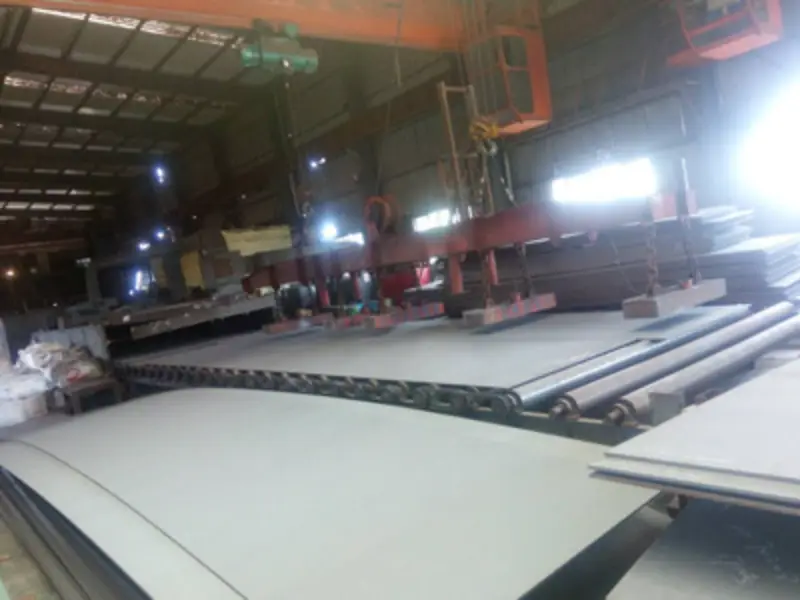
NK Grade D56 Shipbuilding Steel Plate
NK Grade D56 Shipbuilding Steel Plate: High Strength for Marine Structures
In-depth analysis of NK Grade D56 shipbuilding steel plate covering chemical composition, mechanical properties, physical data, equivalent grades, and application guidance.
Cutting, cold and hot forming, welding (all common shipbuilding procedures), suitable for TMCP rolling, normalizing, or QT treatments
- Phone : +8618037372205
- Email : [email protected]
- WhatsApp: Contact via Whtsapp
- WeChat: +8618037372205
NK Grade D56 Shipbuilding Steel Plate Introduction
NK Grade D56 is a high-strength shipbuilding steel plate certified by Nippon Kaiji Kyokai (ClassNK). It is designed for structural applications in ship hulls and offshore platforms where high yield strength (minimum 560 MPa) is required. The material offers an optimal combination of strength, weldability, and low-temperature toughness. Key features include:
- Controlled alloying with grain-refining elements for fine microstructure
- Guaranteed impact properties down to -20°C (Grade D designation)
- Available in various thicknesses with strict flatness and surface quality
- Supplied in normalized, thermomechanically controlled processed (TMCP), or quenched and tempered conditions
NK Grade D56 Shipbuilding Steel Plate Chemical Composition
The chemical composition is defined in the NK Rules for shipbuilding steels. For Grade D56, the standard specifies maximum limits for major elements and allows the addition of grain-refining elements (Nb, V, Ti, Al, etc.) to achieve the required mechanical properties. The full composition is reported by the steelmaker and must meet the following typical limits:
- Carbon (C): limited to maintain weldability
- Manganese (Mn): provides solid-solution strengthening
- Phosphorus (P) and Sulfur (S): kept low for toughness and cleanliness
Carbon equivalent (CEV) is often controlled to ensure cold cracking resistance.
| Element | Standard Value (max, %) | Remarks |
|---|---|---|
| C | 0.20 | Typical for high-strength plates, lower in thicker sections |
| Si | 0.55 | Deoxidizer and strength contributor |
| Mn | 0.90 – 1.60 | Required for strength and toughness balance |
| P | 0.035 | Detrimental to toughness; strictly controlled |
| S | 0.035 | Improves machinability but limited for ductility |
| Nb, V, Ti, Al, etc. | Residual or microalloyed | Grain refinement, not specified individually in standard; sufficient amount to meet mechanical properties |
NK Grade D56 Shipbuilding Steel Plate Thermal and Electrical Physical Properties
The following physical properties are typical for high-strength low-alloy steels similar to NK Grade D56. Actual values may slightly vary depending on exact chemical composition, heat treatment, and temperature. These reference numbers are useful for engineering calculations involving thermal expansion, heat transfer, and electromagnetic applications.
- Density (ρ) is similar to all structural steels (~7.85 g/cm³)
- Thermal conductivity (λ) decreases with increasing temperature
| Property | Typical Value | Unit | Test Condition / Temperature |
|---|---|---|---|
| Density (ρ) | 7.85 | g/cm³ | At room temperature (20°C) |
| Elastic Modulus (E) | 205 – 210 | GPa | Room temperature, tension/compression |
| Shear Modulus (G) | 80 – 82 | GPa | Calculated from E and Poisson's ratio |
| Poisson's Ratio (ν) | 0.28 – 0.30 | - | Elastic, room temperature |
| Thermal Expansion Coefficient (α) | 11.5 – 12.5 | 10⁻⁶/K | 20–100°C; increases to ~13.5 at 20–400°C |
| Thermal Conductivity (λ) | 42 – 48 | W/(m·K) | At 20°C; decreases to ~36 at 500°C |
| Specific Heat Capacity (cₚ) | 460 – 500 | J/(kg·K) | 20–100°C; rises with temperature |
| Electrical Resistivity (ρₑ) | 0.20 – 0.25 | µΩ·m | At room temperature |
NK Grade D56 Shipbuilding Steel Plate Mechanical Properties
The mechanical properties are tested in accordance with NK regulations. Tensile testing is performed on transverse specimens, and Charpy V-notch impact tests are conducted at -20°C (Grade D). Bend tests confirm formability without cracking. All values are guaranteed for standard thicknesses up to 50 mm; for thicker plates, properties may vary slightly.
- Yield strength (ReH) – minimum 560 MPa
- Tensile strength (Rm) – between 670 and 830 MPa
- Elongation (A) – gauge length 50 mm, minimum 18%
| Property | Required Value | Unit | Test Condition |
|---|---|---|---|
| Yield Strength (ReH) | ≥ 560 | MPa | Transverse, thickness ≤ 50 mm; for thicker plates, min. 550 MPa (refer to Rules) |
| Tensile Strength (Rm) | 670 – 830 | MPa | Transverse, all thicknesses |
| Elongation (A5) | ≥ 18 | % | Gauge length 50 mm, thickness ≤ 50 mm |
| Elongation (A5) | ≥ 16 | % | Gauge length 50 mm, thickness 50–100 mm (substitute requirement) |
| Bend Test (180°) | No cracks | - | Bend diameter = 4 × thickness (for ReH ≥ 460 MPa); specimen thickness as per standard |
| Charpy Impact Energy (KV₂) | ≥ 27 (average) | J | Longitudinal, at -20°C, thickness ≤ 50 mm (three specimen average, single minimum 70% of average) |
| Charpy Impact Temperature | -20 | °C | Grade D requirement; for thinner plates, sub-size specimens with adjusted energy values |
NK Grade D56 Shipbuilding Steel Plate Fully Equivalent Material Standards and Designations
| Country / Region | Standard | Designation | Remarks |
|---|---|---|---|
| International (IACS) | IACS UR W11 | Grade DH56 | Unified Requirements for high strength hull structural steel |
| USA (ABS) | ABS Rules | ABS Grade DH56 | Similar to NK D56, -20°C impact |
| Norway (DNV) | DNV Rules | DNV DH56 | Designation follows NF (Normalised) or TM designation |
| UK (LR) | LR Rules | LR Grade DH56 | Lloyd's Register equivalent |
| France (BV) | BV Rules | BV DH56 | Bureau Veritas equivalent |
| China (CCS) | CCS Rules | CCS DH56 | China Classification Society equivalent |
| Italy (RINA) | RINA Rules | RINA DH56 | Equivalent to ship plate with ReH ≥ 560 MPa |
| Japan (JIS) | JIS G 3106 (previously) | SM570 | SM570 has min. ReH 490 MPa; not directly equivalent but sometimes referenced for similar application. D56 strictly requires 560 MPa. |
NK Grade D56 Shipbuilding Steel Plate Application Introduction
NK Grade D56 shipbuilding steel plate is primarily used in marine and offshore construction where a combination of high strength, excellent weldability, and guaranteed low-temperature toughness is essential. It is ideally suited for structures that experience high static and dynamic loads and require lightweight design through reduced plate thickness. Typical processing includes cutting, forming, and welding using common shipyard practices.
- Welding: Preheating and interpass temperature control may be necessary depending on plate thickness; low-hydrogen welding processes are recommended.
- Forming: Cold and hot forming possible; hot forming temperatures should be compatible with the original heat treatment condition to preserve properties.
Product Applications: Hulls and decks of container ships, bulk carriers, tankers, Legs and spudcans of jack-up rigs, Crane pedestals and heavy-lift crane booms, Structural columns and beams for offshore platforms, Ice-strengthened ship structures, Piled foundations and monopile transition pieces for offshore wind
Processed into products: Hull shell plates, stiffeners, girders, Bulkhead webs and flanges, Rudder horn castings replacements (by welding), Plate girders for heavy crane runways, Load-bearing brackets and joints in harsh environments, Wind turbine tower flange-to-shell connection plates (when applicable)
Application industries: Shipbuilding (commercial and naval vessels), Offshore engineering (platforms, jackets, modules), Marine heavy lifting and transportation equipment, Pressure vessel manufacturing (when class-approved), Heavy civil construction (bridge components, pylon bases)
NK Grade D56 Shipbuilding Steel Plate Similar or Alternative Materials Recommendations
| Country / Region | Standard | Designation | Comparison Notes |
|---|---|---|---|
| Europe | EN 10025-6 | S550QL / S550QL1 | Quenched and tempered steel plate with min. ReH 550 MPa; similar strength level, but impact test condition and approval for shipbuilding may differ. |
| Germany | DIN/EN | S550GD (or S550) | Structural steel; not specifically for marine use; requires class approval for ship construction. |
| USA | ASTM A514 / A517 | Grade B, H, etc. | Quenched and tempered alloy steel plate with min. ReH 690 MPa; higher strength, may be used as alternative for heavier-duty structures after class approval. |
| Japan | JIS G 3128 | SHY685 | High yield strength steel for welded structures with min. ReH 685 MPa; higher strength, need to verify toughness requirements. |
| General | EN 10025-3 | S460N/NL | Normalised fine grain steel with min. ReH 460 MPa; lower strength but widely used in marine structures; can be considered if design allows reduced yield. |
Notes:
Additional Information:
- Certification: All plates must be stamped with the NK mark and accompanied by mill test certificates (3.1 or 3.2 as per EN 10204).
- Surface condition: As-rolled, blast-cleaned, or primer-painted according to buyer's requirements.
- Weldability: Carbon equivalent value (CEV) is usually ≤0.42%-0.45% for TMCP products; for thicker plates, CEV may be restricted to ≤0.47% to avoid cold cracking.
- Strain aging: After cold forming, a strain aging test may be required if specified in the contract.
- Ultrasonic testing: All plates can be supplied with UT per SA578 or EN 10160, class to be agreed upon.
- Share



