
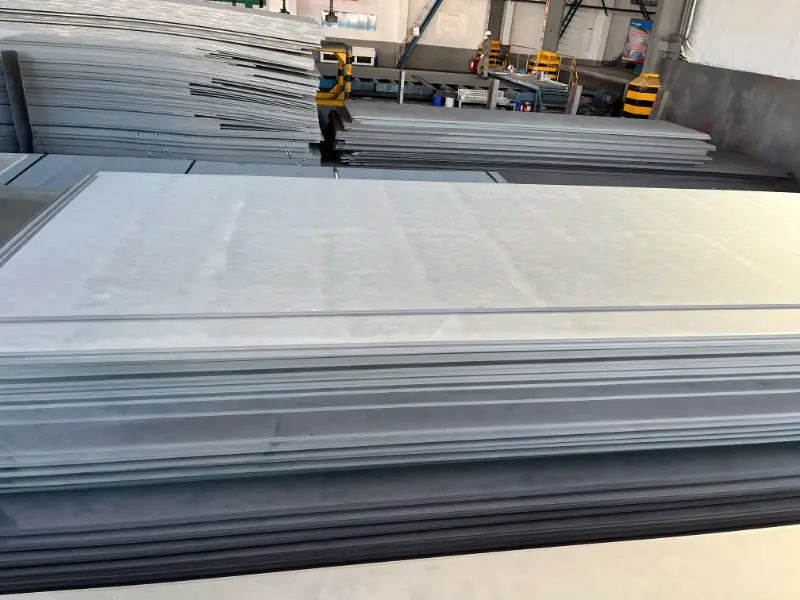
EN 10225 S355G7+N Offshore Structural Steel Plate
EN 10225 S355G7+N Offshore Structural Steel Plate - High-Strength & Low-Temperature Toughness
Comprehensive technical data for EN 10225 Grade S355G7+N offshore platform steel plate, including chemical composition, mechanical properties, thermal conductivity, and equivalent grades.
Hot rolling followed by normalizing; suitable for welding, cutting, bending, cold forming
- Phone : +8618037372205
- Email : [email protected]
- WhatsApp: Contact via Whtsapp
- WeChat: +8618037372205
EN 10225 S355G7+N Offshore Structural Steel Plate Introduction
EN 10225 Grade S355G7+N is a weldable normalized structural steel primarily used in offshore platforms and marine structures. It belongs to Group 7 (G7) of the EN 10225 series, ensuring minimum yield strength of 355 MPa and guaranteed impact toughness at -40°C. This steel is supplied in the normalized (+N) condition, which refines grain structure and provides balanced strength, ductility, and resistance to brittle fracture.
- Good weldability with low carbon equivalent (typically ≤0.43)
- Excellent low-temperature toughness (minimum 50 J at -40°C, longitudinal)
- Suitable for thick plates and welded components in harsh marine environments
EN 10225 S355G7+N Offshore Structural Steel Plate Chemical Composition
Ladle analysis limits according to EN 10225-1 for S355G7+N. All values are maximum unless a range is specified. Carbon equivalent (CEV) typically ≤0.43 to ensure good weldability. Aluminum is added as a grain refiner and for nitrogen binding.
| Element | Typical or Max. Value (%) | Remarks |
|---|---|---|
| C | ≤ 0.22 | CEV control |
| Mn | 1.00 – 1.65 | Higher end improves strength |
| Si | ≤ 0.55 | Deoxidiser |
| P | ≤ 0.030 | Phosphorus |
| S | ≤ 0.025 | Sulfur |
| Cr | ≤ 0.25 | Creep resistance |
| Ni | ≤ 0.30 | Toughness enhancement |
| Mo | ≤ 0.08 | Carbide former |
| Cu | ≤ 0.35 | Weathering resistance |
| V | ≤ 0.08 | Grain refinement |
| Al (total) | ≥ 0.015 | Grain refinement / deoxidation |
| Nb | ≤ 0.05 | Microalloying |
| Ti | ≤ 0.025 | Nitride former |
| N | ≤ 0.012 | |
| CEV | ≤ 0.43 (typical range 0.38–0.43) | Calculated per IIW formula |
EN 10225 S355G7+N Offshore Structural Steel Plate Physical Properties
Physical constants for normalised carbon-manganese structural steel grade S355G7. Values are typical and may vary slightly with composition. Density, modulus of elasticity, and thermal expansion are critical for offshore structural design.
| Property | Typical Value | Unit | Test Condition |
|---|---|---|---|
| Density (ρ) | 7850 | kg/m³ | at 20°C |
| Elastic modulus (E) | 210 | GPa | at 20°C |
| Shear modulus (G) | 81 | GPa | calculated from E and ν |
| Poisson's ratio (ν) | 0.3 | — | at 20°C |
| Thermal expansion coefficient (α) | 12 × 10⁻⁶ | /K | 20–100°C |
| Thermal conductivity (λ) | 50 | W/(m·K) | at 20°C |
| Specific heat capacity (cp) | 460 | J/(kg·K) | at 20°C |
| Electrical resistivity (ρₑ) | 0.21 | Ω·mm²/m | at 20°C |
EN 10225 S355G7+N Offshore Structural Steel Plate Mechanical Properties
Requirements according to EN 10225-1. Tensile testing transverse to rolling direction. Charpy V-notch impact energy tested at -40°C. Bending test with 180° bend over mandrel diameter (d=a) for thickness ≤ 12 mm; for thicker plates, mandrel diameter increases. Delivery condition: normalized (+N).
| Property | Minimum Required Value | Unit | Test Condition / Thickness Range |
|---|---|---|---|
| Yield strength (ReH) | ≥ 355 | MPa | t ≤ 40 mm |
| Yield strength (ReH) | ≥ 345 | MPa | 40 < t ≤ 63 mm |
| Yield strength (ReH) | ≥ 335 | MPa | 63 < t ≤ 80 mm |
| Yield strength (ReH) | ≥ 325 | MPa | 80 < t ≤ 100 mm |
| Tensile strength (Rm) | 470 – 630 | MPa | t ≤ 100 mm |
| Elongation (A5) | ≥ 22 | % | t ≤ 40 mm (transverse) |
| Elongation (A5) | ≥ 21 | % | 40 < t ≤ 63 mm |
| Elongation (A5) | ≥ 20 | % | 63 < t ≤ 80 mm |
| Elongation (A5) | ≥ 19 | % | 80 < t ≤ 100 mm |
| Charpy impact energy (KV) | ≥ 50 (longitudinal) | J | -40°C; thickness ≥ 6 mm |
| Charpy impact energy (KV) | ≥ 35 (transverse) | J | -40°C; thickness ≥ 6 mm |
| Bend test (180°) | d = 2a (t ≤ 16 mm) | — | Mandrel diameter = 2 × plate thickness |
| Bend test (180°) | d = 3a (16 < t ≤ 40 mm) | — | Mandrel diameter = 3 × plate thickness |
EN 10225 S355G7+N Offshore Structural Steel Plate Fully Equivalent Material Standards and Substitute Grades
Grades that match the technical delivery conditions of EN 10225 S355G7+N, including chemical composition, mechanical properties, and -40°C impact toughness.
| Country/Region | Standard | Grade | Remarks |
|---|---|---|---|
| EU (UK) | BS 7191 | Grade 355EM | Same yield class and -40°C impact; for offshore structures |
| Norway | NORSOK M-120 | Y35 | Offshore structural steel; Y35 grade with Z35 through-thickness available |
| International | API 2W | Grade 50 (toughness class T) | For offshore platform components; -40°C impact option |
| EU | EN 10225-3 | S355G7+N | Identical designation from later revision if applicable |
EN 10225 S355G7+N Offshore Structural Steel Plate Application Introduction
S355G7+N plates are specifically designed for heavy-duty offshore structures operating in cold climates. The normalized condition provides a fine grain size that ensures high resistance to brittle fracture and lamellar tearing. Typical applications include
- Fixed offshore platform decks and substructures
- Wind turbine monopiles, transition pieces, and jackets
- Flare booms and crane pedestals
- Ship unloader structures and heavy civil engineering bridges
Product Applications: Offshore platform topsides and jackets, Wind turbine foundations (monopiles, transition pieces), Subsea manifolds and templates, Flare towers and drilling substructures
Processed into products: Stiffened plate panels (bulkheads, decks), Tubular joints and braces, Transition pieces (wind turbine to monopile), Bolted or welded splice plates, Crane pedestal base rings, Main beams and columns in module frames
Application industries: Oil & Gas (offshore exploration and production), Renewable Energy (offshore wind farms), Shipbuilding & Marine Engineering, Heavy Civil Construction (bridges, port cranes)
EN 10225 S355G7+N Offshore Structural Steel Plate Similar or Closely Related Substitute Materials
Steels with similar strength level but different toughness classes or delivery conditions. These may be used as alternatives where the exact EN 10225 S355G7 specification is not mandatory. Weldability and toughness must be verified.
| Country/Region | Standard | Grade | Remarks |
|---|---|---|---|
| EU | EN 10025-3 | S355NL | Normalized fine-grain steel; -50°C impact, yield 355 MPa |
| EU | EN 10025-2 | S355J2+N | Non-alloy structural steel; -20°C impact, same strength, not for offshore |
| EU | EN 10225-1 | S355G10+N | Higher toughness group G10 (-40°C, 100 J min), yield 355 MPa |
| USA | ASTM A572 | Grade 50 | General structural steel; lacks guaranteed low-temperature impact |
| USA | ASTM A131 | Grade EH36 | Shipbuilding steel with -40°C impact, yield 355 MPa, similar but not identical |
Notes:
Z-quality (through-thickness ductility) may be specified in addition, e.g., S355G7+Z35, for critical joints to resist lamellar tearing. Plates are usually delivered with EN 10204 type 3.1 certification. Dimensional tolerances according to EN 10029. Ultrasonic testing per EN 10160 is mandatory for offshore grades. Weldability: preheat may be required for thick sections (>40 mm) to avoid cold cracking; use low-hydrogen welding processes. The material can be galvanised without liquid metal embrittlement provided the composition meets the Si+Mn limits.
- Share



