
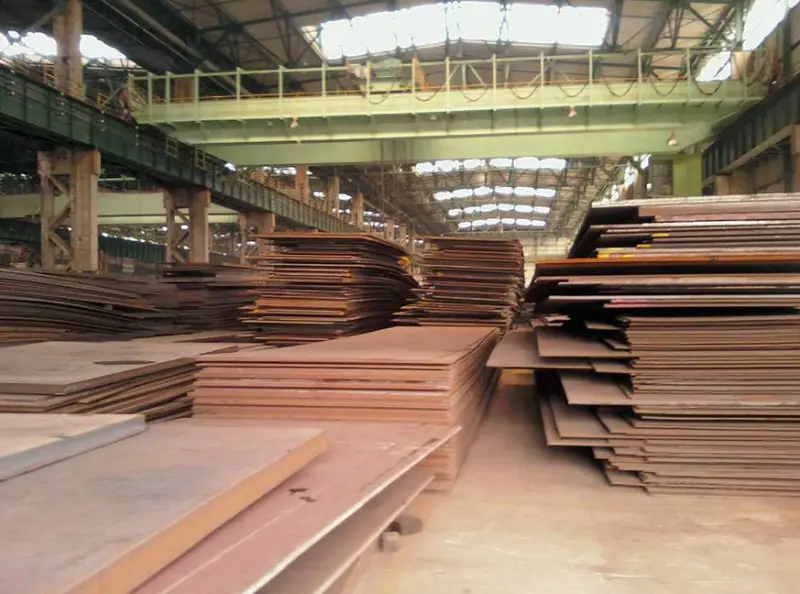
EN10225 S355G9+M Offshore Steel Plate
EN10225 S355G9+M Offshore Steel Plate: Premium TMCP Steel for Arctic & Deepwater Structures
Detailed material data for EN10225 Grade S355G9+M offshore platform steel plate: chemical composition, mechanical properties, thermal and electrical properties, global equivalents, and application guidelines.
Welding, cold forming, machining; suitable for cutting (thermal, shear), bending, rolling; TMCP condition minimizes subsequent normalizing stress relief.
- Phone : +8618037372205
- Email : [email protected]
- WhatsApp: Contact via Whtsapp
- WeChat: +8618037372205
EN10225 S355G9+M Offshore Steel Plate Introduction
EN10225 S355G9+M is a weldable structural steel produced by thermomechanical controlled processing (TMCP), deliverable in the +M condition. Standardized under EN 10225:2009 for offshore structures, it belongs to the high-strength low-alloy (HSLA) category with a minimum yield strength of 355 MPa. The G9 suffix indicates guaranteed impact toughness down to -40°C, making it suitable for Arctic and cold-climate marine applications. It exhibits fine grain structure, excellent weldability, and resistance to lamellar tearing, often specified with through-thickness (Z-quality) properties. Typical plate thickness up to 150 mm is available. Key applications include primary members of fixed and floating offshore platforms, wind turbine foundations, and subsea structures where high strength, toughness, and fatigue resistance are critical.
EN10225 S355G9+M Offshore Steel Plate Chemical Composition
The chemical composition is designed for excellent weldability and low carbon equivalent (CEV). Maximum limits are specified unless a range is given. Values comply with EN 10225:2009, Table 1 for S355G9+M. Grain-refining elements (Nb, V, Ti, Al) ensure fine grain size for high toughness at low temperatures.
| Element | Standard Value (max, %) | Remarks |
|---|---|---|
| C | 0.14 | Carbon; lower improves weldability |
| Si | 0.55 | Silicon; deoxidizer |
| Mn | 1.65 | Manganese; strength and toughness |
| P | 0.020 | Phosphorus; strict control for low-temperature toughness |
| S | 0.010 | Sulfur; crucial for through-thickness properties (Z-quality) |
| Al (total) | 0.015 – 0.055 | Aluminum; fine grain practice |
| Nb | 0.05 | Niobium; microalloying for strength |
| V | 0.10 | Vanadium; microalloying |
| Ti | 0.025 | Titanium; grain refinement |
| Cr | 0.30 | Chromium; residual limit |
| Ni | 0.50 | Nickel; optional for toughness |
| Mo | 0.20 | Molybdenum; optional |
| Cu | 0.30 | Copper; weather resistance |
| N | 0.015 | Nitrogen; controlled to avoid aging |
| CEV (max) | 0.43 (t ≤ 40mm) 0.45 (t > 40mm) | Carbon equivalent value based on ladle analysis; CEV = C + Mn/6 + (Cr+Mo+V)/5 + (Ni+Cu)/15 |
EN10225 S355G9+M Offshore Steel Plate Physical Properties
Physical properties are indicative for structural steel of this grade. Exact values may vary slightly with composition and thickness. Data based on typical behavior of S355 TMCP steel.
| Property | Typical Value | Unit | Conditions / Remarks |
|---|---|---|---|
| Density (ρ) | 7.85 | g/cm³ (kg/dm³) | 20°C |
| Elastic modulus (E) | 205 – 215 | GPa | 20°C, static tensile |
| Shear modulus (G) | 80 – 85 | GPa | 20°C, calculated from E and ν |
| Poisson's ratio (ν) | 0.29 – 0.31 | – | Elastic range |
| Thermal expansion coefficient (α) | 11.6 (20-100°C) 12.4 (20-200°C) 12.8 (20-300°C) | ×10⁻⁶/K | Linear coefficient, typical range |
| Thermal conductivity (λ) | 48 – 52 (at 20°C) ~45 (at 200°C) | W/(m·K) | Indicative for low-alloy steel |
| Specific heat capacity (cp) | 460 – 480 (at 20°C) ~550 (at 200°C) | J/(kg·K) | Typical HSLA steel |
| Electrical resistivity (ρe) | 0.15 – 0.25 | μΩ·m (Ω·mm²/m) | At 20°C |
EN10225 S355G9+M Offshore Steel Plate Mechanical Properties
Mechanical properties are valid for thicknesses up to 150 mm (for S355G9+M). Values depend on thickness range. Impact test temperature is -40°C (G9 requirement). Tensile and impact tests are performed on transverse specimens. Values per EN 10225:2009, Tables 2 and 4.
| Property | Value | Unit | Test Conditions / Thickness Range |
|---|---|---|---|
| Yield strength (ReH) | ≥ 355 | MPa | t ≤ 16 mm |
| Yield strength (ReH) | ≥ 350 | MPa | 16 mm < t ≤ 40 mm |
| Yield strength (ReH) | ≥ 340 | MPa | 40 mm < t ≤ 63 mm |
| Yield strength (ReH) | ≥ 330 | MPa | 63 mm < t ≤ 80 mm |
| Yield strength (ReH) | ≥ 320 | MPa | 80 mm < t ≤ 100 mm |
| Yield strength (ReH) | ≥ 310 | MPa | 100 mm < t ≤ 150 mm |
| Tensile strength (Rm) | 470 – 630 | MPa | t ≤ 16 mm |
| Tensile strength (Rm) | 470 – 630 | MPa | 16 mm < t ≤ 40 mm |
| Tensile strength (Rm) | 470 – 600 | MPa | 40 mm < t ≤ 63 mm |
| Tensile strength (Rm) | 460 – 600 | MPa | 63 mm < t ≤ 80 mm |
| Tensile strength (Rm) | 450 – 600 | MPa | 80 mm < t ≤ 100 mm |
| Tensile strength (Rm) | 440 – 600 | MPa | 100 mm < t ≤ 150 mm |
| Elongation (A) | ≥ 22 | % | 5.65√S₀ gauge, t ≤ 40 mm |
| Elongation (A) | ≥ 21 | % | 5.65√S₀ gauge, t > 40 mm |
| Impact toughness (KV₂) | ≥ 50 (mean) ≥ 38 (single) | J | -40°C, Charpy V-notch, transverse, t ≤ 150 mm |
| Through-thickness contraction (Z) | ≥ Z25 / Z35 (optional) | % | Per EN 10164, order-dependent |
EN10225 S355G9+M Offshore Steel Plate Full Equivalents / Replaceable Standards and Grades
| Country/Region | Standard | Grade | Remarks |
|---|---|---|---|
| United Kingdom | BS 7191:1989 | 355EMZ | Withdrawn but used historically; similar TMCP offshore steel with -40°C |
| Norway (NORSOK) | NORSOK M-120 (Ed. 5) | Y35 (with supplementary impact class -40°C) | Yield 350 MPa, plate for structures; requires Z-quality and testing |
| International (API) | API 2H, 9th Ed. | Grade 50 (modified) with Class C impact testing at -40°C | For offshore structural plates; similar strength but different CEV limits |
| International (ISO) | ISO 19902:2020 | 355 (non-identical) | Reference standard for offshore structures; material selection to EN 10225 recommended |
EN10225 S355G9+M Offshore Steel Plate Application Introduction
EN10225 S355G9+M is specifically tailored for offshore engineering where structural integrity under extreme cold, fatigue loads, and corrosive environments is essential. It is supplied in the as-rolled TMCP condition, eliminating the need for post-weld heat treatment (PWHT) in many cases. Key application areas:
- Fixed offshore platforms – jacket legs, bracings, pile guides, conductor supports
- Floating production systems – hull frames, deck modules, process skids
- Renewable energy – wind turbine monopiles, transition pieces, offshore substation structures
- Subsea equipment – templates, manifolds, protection structures
- Shipbuilding – ice-strengthened hulls, offshore support vessels
Typical processing includes sawing, plasma/oxy-fuel cutting, cold forming, and submerged arc welding (SAW). It can be fabricated into welded H-beams, box-section columns, and tubular joints. When specified with Z25 or Z35 quality, it resists lamellar tearing in highly restrained joints.
Product Applications: Jacket platforms (4-, 6-, 8-leg designs), Compliant towers and floating wind substructures, Topside modules (wellhead, process, utilities), Monopile foundations for wind turbines, Subsea protection covers, Crane pedestals and flare booms
Processed into products: Main chord and brace members of jacket structures, Pin piles and skirt piles, Transition piece flanges and shells, Deck plate girders and stiffeners, Stabbing guides and mudmats, Tubular nodes (Y, K, T joints) with through-thickness specification
Application industries: Offshore oil & gas exploration and production, Offshore wind energy, Shipbuilding and marine engineering, Civil engineering (bridges, coastal structures), Pressure vessels and storage spheres (with supplementary requirements)
EN10225 S355G9+M Offshore Steel Plate Similar / Alternative Material Recommendations
| Country/Region | Standard | Grade | Remarks |
|---|---|---|---|
| European Union | EN 10225 | S355G10+M | Same strength, guaranteed -50°C impact, lower P/S limits; suitable for colder climates |
| European Union | EN 10025-4 | S355ML | Thermomechanical rolled weather-resistant steel for general structural use; -50°C impact but not specifically offshore standard |
| USA | ASTM A572/A572M | Grade 65 (Type 1) with Supplementary Requirement S5 for Charpy at -40°C | Similar strength, but higher CEV; limited thickness range per ASTM; used in offshore bridges |
| USA | API 2H | Grade 50 (standard Class B or C) | Offshore structural plate; similar yield; Class C impact at -40°C closely matches S355G9 |
| China | GB/T 712 | DH36 (with additional Z-quality) | Shipbuilding and offshore steel; 355 MPa yield; impact at -20°C; may require TMCP + Z-quality upgrade |
Notes:
- For thicknesses above 150 mm, consult the producer; properties may be agreed separately.
- Supplementary requirements: Z-quality (through-thickness reduction of area) per EN 10164 shall be specified when applicable. Typical request: Z25 or Z35.
- Welding consumables should be selected to match the strength and low-temperature toughness of the base metal (e.g., AWS E7018-1 or E81T1-Ni2M for SMAW/FCAW).
- CEV limits ensure good weldability without preheat for moderate thicknesses, but preheat may be required for thick sections or high hydrogen risk (EN 1011-2).
- Third-party inspection certificates (EN 10204 type 3.2) are usual for offshore projects.
- Share



