
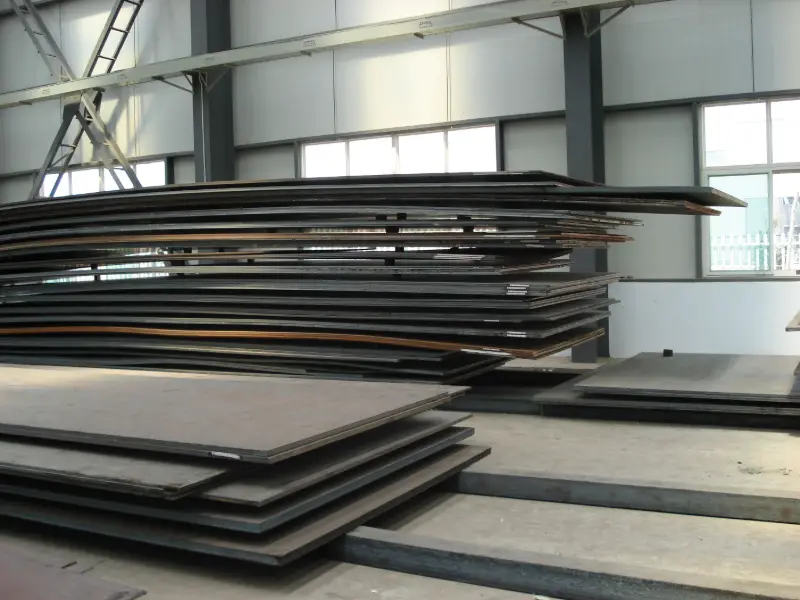
S235J0W Weather Resistant Steel Plate
S235J0W Weather Resistant Steel Plate: EN 10155 / EN 10025-5 Properties & Guide
Comprehensive technical data for EN 10155 S235J0W weather resistant steel plate, including chemical composition, mechanical and thermal properties, equivalent grades, and application recommendations for structural and architectural use.
Hot rolling, cold forming, welding (all common methods), flame cutting, machining, drilling
- Phone : +8618037372205
- Email : [email protected]
- WhatsApp: Contact via Whtsapp
- WeChat: +8618037372205
S235J0W Weather Resistant Steel Plate Introduction
S235J0W is a European standard weather‑resistant structural steel grade defined in EN 10025‑5 (superseding EN 10155). It is designed for use in the unprotected condition, where its alloying elements—especially copper, chromium and nickel—promote the formation of a dense, adherent oxide layer (patina) that retards atmospheric corrosion. This eliminates the need for painting in many outdoor applications and significantly reduces maintenance costs.
- Minimum yield strength of 235 MPa (for thickness ≤ 16 mm) with good ductility and weldability.
- Impact toughness guaranteed at 0 °C (J0 quality), making it suitable for structures in moderate climates.
- Similar fabrication behaviour to conventional carbon steel, allowing hot‑forming, cold‑forming, machining, and gas‑shielded welding.
- Available mainly as hot‑rolled plate, sheet, sections, and bar, delivered in the as‑rolled or normalized‑rolled condition.
- Frequently chosen for bridges, façades, containers, railway vehicles and architectural sculptures where the natural rust‑coloured appearance is desired.
S235J0W Weather Resistant Steel Plate Chemical Composition
The ladle analysis limits according to EN 10025‑5 guarantee the desired atmospheric corrosion resistance while maintaining good weldability. The phosphorous content is controlled (≤ 0.035 %) to avoid hot shortness, and carbon equivalent is typically ≤ 0.44 % for thickness ≤ 30 mm. Elements such as Cu, Cr and Ni are essential for the protective rust layer.
Note: Optional alloying elements (Nb, V, Ti) may be added singly or in combination, provided limits are not exceeded.
| Element | Standard Value (%) | Remarks |
|---|---|---|
| C | ≤ 0.13 | |
| Si | ≤ 0.40 | |
| Mn | 0.20 – 0.60 | |
| P | ≤ 0.035 | Maximum for all product forms |
| S | ≤ 0.035 | Maximum for all product forms |
| Cr | 0.40 – 0.80 | |
| Ni | ≤ 0.65 | |
| Cu | 0.25 – 0.55 | Key element for patina formation |
| Altotal | ≥ 0.020 | When used for grain refinement; otherwise optional |
| Nb | ≤ 0.06 | Optional; may be present as grain refiner |
| V | ≤ 0.15 | Optional; may be present for strength |
| Ti | ≤ 0.10 | Optional |
| N | ≤ 0.012 | Typical maximum; not always specified |
S235J0W Weather Resistant Steel Plate Thermal and Electrical Physical Properties
The following physical constants are representative of low‑alloy weathering steel and are suitable for design calculations. They are not part of the delivery standard but are derived from published data on similar structural steels.
Properties such as thermal conductivity and specific heat vary slightly with temperature; values given are for room temperature (20 °C) unless otherwise noted.
| Property | Typical Value | Unit | Condition |
|---|---|---|---|
| Density (ρ) | 7.85 | g/cm³ | At 20 °C |
| Modulus of Elasticity (E) | 210 | GPa | At 20 °C |
| Shear Modulus (G) | 81 | GPa | At 20 °C |
| Poisson's Ratio (ν) | 0.3 | — | At 20 °C |
| Thermal Expansion Coefficient (α) | 12.0 × 10⁻⁶ | /K | 20 – 100 °C |
| Thermal Conductivity (λ) | 50 | W/(m·K) | At 20 °C |
| Specific Heat Capacity (cₚ) | 460 | J/(kg·K) | At 20 °C |
| Electrical Resistivity (ρₑ) | 0.20 | μΩ·m | At 20 °C |
S235J0W Weather Resistant Steel Plate Mechanical Properties
The following properties are guaranteed by EN 10025‑5 for hot‑rolled products in the delivery condition. Values depend on nominal thickness. Tests are performed at room temperature except for impact energy. For products supplied in normalised or thermomechanically rolled condition, the producer may guarantee higher values.
Bend test: Specimens must withstand 180° bending around a mandrel of specified diameter without cracking on the tension side.
| Property | Typical Value | Unit | Test Condition |
|---|---|---|---|
| Minimum Yield Strength (ReH) | 235 | MPa | Nominal thickness ≤ 16 mm |
| Minimum Yield Strength (ReH) | 225 | MPa | Nominal thickness 16 mm < t ≤ 40 mm |
| Minimum Yield Strength (ReH) | 215 | MPa | Nominal thickness 40 mm < t ≤ 63 mm |
| Tensile Strength (Rm) | 360 – 510 | MPa | All thicknesses |
| Minimum Elongation (A) | 26 | % | Longitudinal, L₀ = 5.65√S₀, thickness ≤ 40 mm |
| Minimum Elongation (A) | 24 | % | Transverse, L₀ = 5.65√S₀, thickness ≤ 40 mm |
| Minimum Impact Energy (KV) | 27 | J | At 0 °C, Charpy V‑notch, longitudinal specimen |
| Bend Test (mandrel diameter) | 1t | — | 180° bend, thickness ≤ 16 mm |
| Bend Test (mandrel diameter) | 1.5t | — | 180° bend, thickness 16 mm < t ≤ 40 mm |
| Bend Test (mandrel diameter) | 2t | — | 180° bend, thickness 40 mm < t ≤ 63 mm |
S235J0W Weather Resistant Steel Plate Equivalent Material Standards and Substitute Grades
| Region | Standard | Grade | Remarks |
|---|---|---|---|
| Europe | EN 10025‑5 | S235J0W (1.8958) | Direct replacement; supersedes EN 10155 |
| International | ISO 5952 | S235W (impact quality J0) | Equivalent weathering structural steel; impact designation may be appended to grade |
| Germany | DIN EN 10025‑5 | S235J0W (1.8958) | Identical – German adoption of EN standard |
| United Kingdom | BS EN 10025‑5 | S235J0W | Identical – British adoption |
S235J0W Weather Resistant Steel Plate Application Introduction
S235J0W is intended for welded, bolted, and riveted structures where atmospheric corrosion resistance and an attractive appearance are important, and where painting is not desired. It can be processed using standard steel fabrication techniques. To maintain corrosion resistance at weldments, filler metals with matching weathering composition should be used. The formation of a uniform, protective patina requires alternating wet‑dry cycles; surface contamination should be avoided before exposure.
Product Applications: Hot‑rolled plates and sheets, Structural sections (I‑beams, channels, angles), Welded and seamless hollow sections, Cold‑formed profiles, Bridge girders and bridge components, Container bodies and frames, Facades and architectural mesh, Storage tanks (non‑aggressive contents), Sculptures and public artworks
Processed into products: Bridge main girders and cross‑frames, Crane booms and jibs, Railway wagon underframes and sidewalls, Intermodal container corner castings and panels, Transmission tower legs, bracings, and base plates, Architectural canopies, screens, and rainscreen panels, Highway noise barrier posts and cladding, Sheet piling and king piles, Welded fabrications for general engineering
Application industries: Bridge construction, Building and civil engineering, Railway vehicle manufacturing, Container and trailer production, Transmission towers and poles, Architectural cladding and sculptures, Industrial plant (structural frames, bins, tanks for non‑corrosive media)
S235J0W Weather Resistant Steel Plate Similar/Comparable Substitute Materials
| Region | Standard | Grade | Remarks |
|---|---|---|---|
| Europe | EN 10025‑5 | S235J2W (1.8961) | Same strength, better toughness at -20 °C; suitable for colder climates |
| Europe | EN 10025‑5 | S355J0W (1.8959) | Higher yield strength (355 MPa) weathering steel; similar corrosion resistance |
| USA | ASTM A588 / A588M | Grade A | Higher strength weathering steel (min 345 MPa); used for structural shapes and plates |
| Japan | JIS G3114 | SMA400AW | Hot‑rolled atmospheric corrosion resisting steel for welded structures; comparable to S235 level |
| International | ISO 4952 (withdrawn) | Fe 235W | Former ISO grade for weathering steel; replaced by ISO 5952 |
Notes:
For welding, choose consumables that match the atmospheric corrosion resistance of the base metal (e.g., AWS A5.5 E7018‑W or EN ISO 2560‑A E 38 Z W). Preheating is normally not required for thicknesses up to 30 mm under mild conditions. To obtain a uniform patina, the steel should be installed so that rainwater drains freely and runs over the surface; shadowed areas may show colour variations. Contact with de‑icing salts or industrial pollutants can affect patina stability; in such cases periodic washing is advised. The full technical delivery conditions, inspection, and testing requirements are specified in EN 10025‑5.
- Share



