
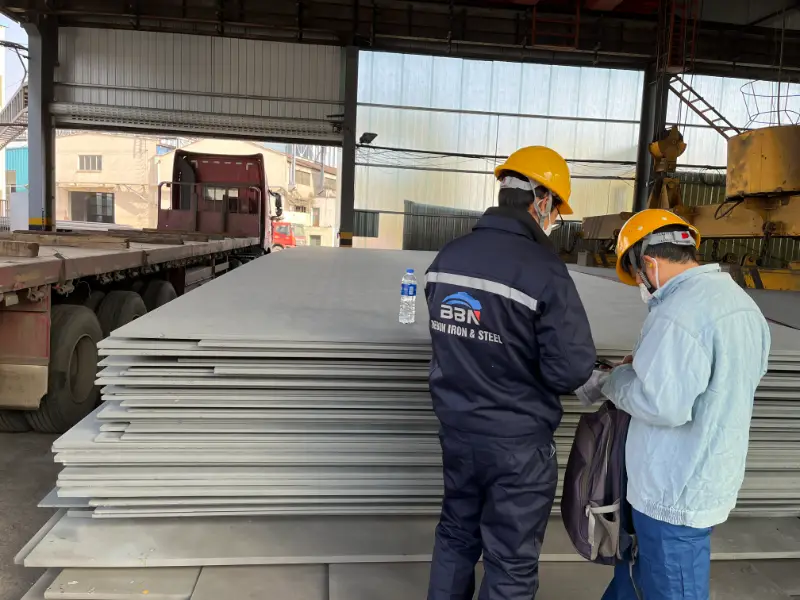
EN10225 S460G2+QT Offshore Steel Plate
EN10225 S460G2+QT Offshore Steel Plate - Quenched & Tempered 460MPa LE Structural Steel
Technical datasheet for EN10225 S460G2+QT offshore platform steel plate: chemical composition, mechanical properties, physical properties, international equivalents and applications in marine structures.
Welding, flame/plasma cutting, cold & hot bending, machining, drilling, shot blasting
- Phone : +8618037372205
- Email : [email protected]
- WhatsApp: Contact via Whtsapp
- WeChat: +8618037372205
EN10225 S460G2+QT Offshore Steel Plate Introduction
EN10225 Grade S460G2+QT is a quenched and tempered structural steel plate purpose-designed for offshore platforms, jackets, subsea structures and wind turbine foundations. It delivers a minimum yield strength of 460 MPa (up to 16 mm thickness) together with excellent notch toughness down to -40 °C (Charpy KV2 ≥ 50 J). The combination of low carbon content (≤ 0.14 %), controlled microalloying and advanced heat treatment provides good weldability, crack tip opening displacement (CTOD) performance and resistance to brittle fracture in thick sections.
- High yield-to-tensile ratio enables efficient structural design
- Suitable for severe marine environments and dynamic loading
- Fulfills the stringent requirements of EN 10225:2009+A1:2018
EN10225 S460G2+QT Offshore Steel Plate Chemical Composition
The chemical composition is tightly controlled to guarantee high strength, low‑temperature toughness and weldability. Maximum contents are given unless a range is specified. Carbon Equivalent (CEV) is limited to ≤0.47 for thickness ≤50 mm to avoid cold cracking.
| Chemical Element | Standard Value | Remarks |
|---|---|---|
| C | ≤ 0.14 | Low carbon for weldability |
| Si | ≤ 0.55 | |
| Mn | ≤ 1.65 | Contributes to strength |
| P | ≤ 0.020 | |
| S | ≤ 0.010 | Low sulfur for Z‑quality |
| Cr | ≤ 0.30 | |
| Ni | ≤ 0.50 | Enhances toughness |
| Mo | ≤ 0.25 | |
| Cu | ≤ 0.30 | |
| N | ≤ 0.015 | Total nitrogen |
| Nb | ≤ 0.05 | Grain refiner |
| V | ≤ 0.12 | Precipitation hardening |
| Ti | ≤ 0.05 | Grain size control |
| Al | ≥ 0.020 | Total aluminum (minimum) |
| Nb+V+Ti | ≤ 0.12 | Combined microalloy limit |
| CEV¹⁾ | ≤ 0.47 | For t ≤ 50 mm; higher thicknesses by agreement |
EN10225 S460G2+QT Offshore Steel Plate Thermal & Electrical Physical Properties
The following physical constants are indicative design values for quenched and tempered structural steels of this class. They are not part of EN 10225 but are derived from reliable engineering references for low‑alloy steels with similar composition and heat treatment.
| Performance Property | Standard Requirement Value | Unit | Test Condition |
|---|---|---|---|
| Density (ρ) | 7850 | kg/m³ | at 20 °C |
| Modulus of Elasticity (E) | 210 | GPa | at 20 °C |
| Shear Modulus (G) | 81 | GPa | at 20 °C |
| Poisson's Ratio (ν) | 0.30 | – | at 20 °C |
| Coefficient of Thermal Expansion (α) | 11.5 × 10⁻⁶ | K⁻¹ | 20 – 100 °C |
| Thermal Conductivity (λ) | 42 | W/(m·K) | at 20 °C |
| Specific Heat Capacity (cp) | 460 | J/(kg·K) | at 20 °C |
| Electrical Resistivity (ρe) | 0.22 | µΩ·m | at 20 °C |
EN10225 S460G2+QT Offshore Steel Plate Mechanical Properties
Properties are validated according to EN 10225. Yield strength and tensile strength depend on plate thickness. Charpy V‑notch impact energy is guaranteed at -40 °C (G2 class) for longitudinal specimens. Elongation is measured on a gauge length of L₀ = 5.65√S₀. Values represent minimum requirements.
| Performance Property | Standard Requirement Value | Unit | Test Condition |
|---|---|---|---|
| Yield Strength (ReH) | ≥ 460 | MPa | t ≤ 16 mm |
| Yield Strength (ReH) | ≥ 440 | MPa | 16 < t ≤ 40 mm |
| Yield Strength (ReH) | ≥ 420 | MPa | 40 < t ≤ 63 mm |
| Yield Strength (ReH) | ≥ 400 | MPa | 63 < t ≤ 100 mm |
| Tensile Strength (Rm) | 540 – 720 | MPa | t ≤ 16 mm |
| Tensile Strength (Rm) | 500 – 720 | MPa | 16 < t ≤ 40 mm |
| Tensile Strength (Rm) | 470 – 720 | MPa | 40 < t ≤ 63 mm |
| Tensile Strength (Rm) | 460 – 720 | MPa | 63 < t ≤ 100 mm |
| Elongation (A) | ≥ 17 | % | L₀=5.65√S₀, t ≤ 100 mm |
| Charpy V‑notch (KV₂) | ≥ 50 (mean) / ≥ 35 (single) | J | -40 °C, longitudinal, t ≤ 50 mm |
EN10225 S460G2+QT Offshore Steel Plate Completely Equivalent Material Standards & Replaceable Grades
| Country/Region | Standard(s) | Grade | Remarks |
|---|---|---|---|
| European Union | EN 10225:2009+A1:2018 | S460G2+QT | Original specification; +QT condition mandatory |
| Norway | NORSOK M-120:2008 (MDS Y46) | Y46 (S460G2+QT) | Equivalent offshore steel grade; references EN 10225 |
| Global | – | – | No direct equivalent in ASTM, JIS or other major national standards |
EN10225 S460G2+QT Offshore Steel Plate Application Introduction
S460G2+QT is engineered for primary load‑bearing members in offshore and marine structures where a combination of high strength, excellent weldability and resistance to low‑temperature brittle fracture is essential. Typical uses span from fixed jacket platforms to floating wind turbine foundations.
- Delivers high fatigue life and CTOD‑proven crack resistance
- Can be supplied with through‑thickness properties (Z25/Z35) for lamellar tearing resistance
- Compatible with standard offshore fabrication sequences (bevelling, panel assembly, node forming)
Product Applications: Fixed jacket platforms (legs, braces, conductor supports), Jack‑up rig chords and rack plates, Topsides primary beams and deck panels, Monopile and jacket foundations for wind turbines, Floating offshore substructures (semi‑submersible, spar), Subsea templates, manifolds and protection structures, Turret and mooring system components
Processed into products: Welded tubular joints (X, K, Y‑joints), Node cans / stubs with increased wall thickness, Bracing members and stiffeners, Bulkheads and diaphragm plates, Padeyes and trunnion connections, Lifting lugs and spreader bar plates, Transition pieces and grouted connections
Application industries: Offshore oil & gas exploration and production, Offshore wind energy (fixed & floating), Shipbuilding & conversion (heavy lift vessels, FPSO), Marine heavy lifting & subsea engineering, Bridge construction in aggressive marine environments
EN10225 S460G2+QT Offshore Steel Plate Similar / Alternative Material Grades
| Country/Region | Standard(s) | Grade | Remarks |
|---|---|---|---|
| European Union | EN 10025-6:2019 | S460Q / S460QL / S460QL1 | Quenched and tempered structural steel; not specifically for offshore; toughness classes differ |
| European Union | EN 10025-4:2019 | S460ML | Thermo-mechanically rolled offshore steel; yield strength curve differs; not heat treated |
| China | GB/T 712-2011 | FH460 | High‑strength offshore structural steel; quenched and tempered; similar yield but different composition limits |
| Japan | JIS G 3106:2015 | SM570 | Weldable structural steel with min 460 MPa yield; no offshore‑specific requirements; may require additional agreement |
| USA | ASTM A572/A572M | Grade 65 [450] | High‑strength low‑alloy structural steel; lower yield strength (450 MPa) and no offshore toughness guarantee |
| USA | API 2W / API 2Y | Grade 50 / 60 | Offshore structural steel plates; lower strength (345‑415 MPa) unless specially upgraded |
Notes:
The steel is delivered in the quenched and tempered condition (+QT). Welding must follow an approved procedure specification (WPS) using low‑hydrogen consumables, with preheat and interpass temperature typically between 100 °C and 200 °C depending on thickness and equivalent carbon content. Post‑weld heat treatment (PWHT) is generally not required for this grade when suitable welding parameters are used. The CEV maximum is 0.47 for thickness ≤ 50 mm; for thicker plates, CEV values are subject to agreement. Supplementary requirements such as through‑thickness tensile testing (Z35), CTOD testing at design temperature, ultrasonic examination (Class S2/E2) and improved surface finish can be specified at the time of enquiry and order. Mill certificates to EN 10204 Type 3.1 or 3.2 are standard.
- Share



