
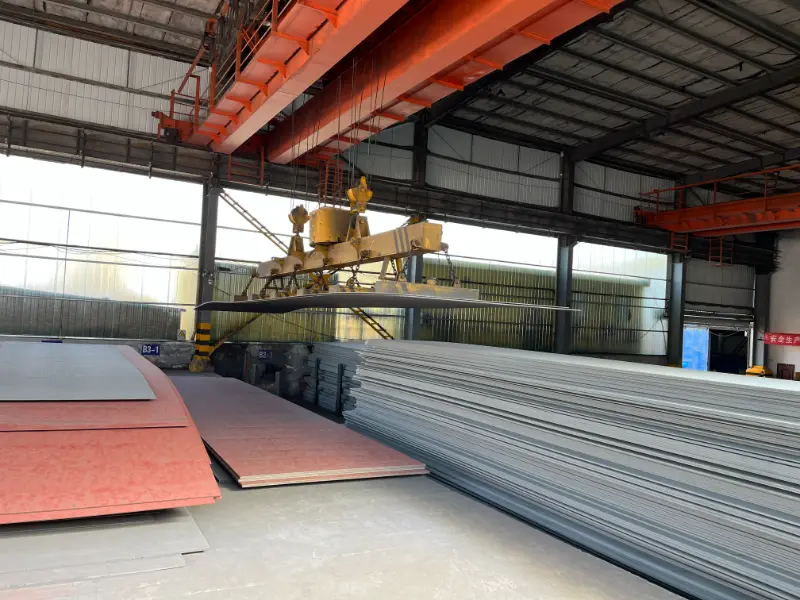
EN10225 S460G1+QT Offshore Platform Steel Plate
EN10225 S460G1+QT Offshore Platform Steel Plate Properties and Applications
Comprehensive data sheet for EN10225 S460G1+QT offshore structural steel, including chemical composition, mechanical and physical properties, equivalent grades, and application guidance.
Hot rolling, quenching and tempering (+QT), welding, cold forming with restrictions
- Phone : +8618037372205
- Email : [email protected]
- WhatsApp: Contact via Whtsapp
- WeChat: +8618037372205
EN10225 S460G1+QT Offshore Platform Steel Plate Introduction
EN10225 Grade S460G1+QT is a high-strength structural steel for fixed offshore structures in the quenched and tempered condition. S460G1+QT offers a minimum yield strength of 460 MPa, excellent toughness at sub-zero temperatures, and good weldability. It is designed for critical applications in harsh marine environments, combining high strength with ductility. The G1 designation indicates a specific delivery condition and impact test temperature of -40°C.
- High yield strength (460 MPa minimum) with good tensile properties
- Excellent low-temperature impact toughness (≥50 J at -40°C)
- Good through-thickness properties where specified
- Weldable with suitable procedures
- Supplied in quenched and tempered (+QT) condition
This steel is primarily used in the construction of offshore platforms, wind turbine foundations, and other marine structures where weight savings and reliability are essential.
EN10225 S460G1+QT Offshore Platform Steel Plate Chemical Composition
The chemical composition according to EN 10225-1 and EN 10225-3 for S460G1+QT. Maximum limits unless shown as a range. Carbon Equivalent (CEV) is controlled to ensure good weldability, typically ≤0.45% for ≤50 mm thickness, or ≤0.48% for thicker sections. Fine grain practice and microalloying elements like Nb, V, Ti provide the required strength and toughness.
| Chemical Element | Standard Value | Remarks |
|---|---|---|
| Carbon (C) | ≤ 0.14% | Heat analysis |
| Silicon (Si) | ≤ 0.55% | |
| Manganese (Mn) | ≤ 1.70% | |
| Phosphorus (P) | ≤ 0.020% | |
| Sulfur (S) | ≤ 0.010% | |
| Chromium (Cr) | ≤ 0.25% | |
| Nickel (Ni) | ≤ 0.75% | |
| Molybdenum (Mo) | ≤ 0.25% | |
| Copper (Cu) | ≤ 0.30% | |
| Nitrogen (N) | ≤ 0.015% | Total N; higher N allowed with sufficient Al |
| Niobium (Nb) | ≤ 0.05% | |
| Vanadium (V) | ≤ 0.08% | |
| Titanium (Ti) | ≤ 0.025% | |
| Aluminium (Al) total | ≥ 0.015% | Minimum for fine grain practice |
| Boron (B) | ≤ 0.0005% | If added intentionally, residual ≤0.0005% |
EN10225 S460G1+QT Offshore Platform Steel Plate Thermal and Electrical Physical Properties
Physical properties are typical for quenched and tempered structural steels of this strength level. These values are not mandatory in EN 10225 but serve as engineering references. Density 7850 kg/m³ and elastic modulus 210 GPa are widely used in design. Thermal conductivity and electrical resistivity vary slightly with temperature; room temperature values are provided.
| Property | Standard Value | Unit | Test Condition |
|---|---|---|---|
| Density (ρ) | 7850 | kg/m³ | At 20°C |
| Modulus of elasticity (E) | 210 | GPa | At 20°C, static |
| Shear modulus (G) | ~80.8 | GPa | Calculated from E and ν |
| Poisson's ratio (ν) | 0.3 | - | Elastic range |
| Thermal expansion coefficient (α) | 12.0 | 10⁻⁶/K | 20–100°C |
| Thermal expansion coefficient (α) | 12.5 | 10⁻⁶/K | 20–200°C |
| Thermal expansion coefficient (α) | 13.3 | 10⁻⁶/K | 20–400°C |
| Thermal conductivity (λ) | ~50 | W/(m·K) | At 20°C |
| Specific heat capacity (cp) | ~460 | J/(kg·K) | At 20°C |
| Electrical resistivity (ρe) | ~0.20 | μΩ·m | At 20°C |
EN10225 S460G1+QT Offshore Platform Steel Plate Mechanical Properties
Mechanical properties as per EN 10225-3 for S460G1+QT. Values apply to longitudinal test pieces in the quenched and tempered condition. Thickness-dependent yield strength is specified. Impact testing at -40°C with minimum average energy of 50 J (longitudinal) is required. The bend test uses a mandrel diameter of 3 × thickness for transverse specimens (180° bend) without cracking.
| Property | Requirement Value | Unit | Test Condition |
|---|---|---|---|
| Yield strength (ReH) | 460 | MPa | Thickness ≤ 16 mm |
| Yield strength (ReH) | 440 | MPa | 16 mm < t ≤ 40 mm |
| Yield strength (ReH) | 420 | MPa | 40 mm < t ≤ 63 mm |
| Yield strength (ReH) | 400 | MPa | 63 mm < t ≤ 80 mm |
| Yield strength (ReH) | 390 | MPa | 80 mm < t ≤ 100 mm |
| Tensile strength (Rm) | 550 - 720 | MPa | All thicknesses |
| Elongation after fracture (A) | ≥ 19 | % | t ≤ 40 mm (L0 = 5.65√S0) |
| Elongation after fracture (A) | ≥ 17 | % | t > 40 mm (L0 = 5.65√S0) |
| Impact energy (KV2) | ≥ 50 (avg.) / ≥ 35 (single) | J | Longitudinal, -40°C |
| Bend test | No cracks | - | Mandrel diameter = 3t, 180°, transverse |
EN10225 S460G1+QT Offshore Platform Steel Plate Fully Equivalent Material Standards and Replaceable Grades
| Country/Region | Standard | Grade | Remarks |
|---|---|---|---|
| Europe | EN 10225 | S460G1+QT | Original designation; direct equivalent. |
| International | No direct equivalent | - | Other offshore standards (e.g., API 2Y, ISO 19902) have similar strength grades but differ in details. |
EN10225 S460G1+QT Offshore Platform Steel Plate Application Introduction
S460G1+QT steel is designed for welded offshore structures subjected to high static and dynamic loads, low temperatures, and corrosive marine atmospheres. It is used where weight reduction and high structural integrity are critical. Typical applications include primary load-bearing members of jacket platforms, decks, and foundation structures for wind turbines. The material is suitable for manual and automatic welding processes with appropriate preheat and heat input control.
- Good thickness range for heavy plate fabrication
- Available with enhanced through-thickness properties (Z-quality) upon request
- Often supplied with class society certification (DNV, ABS, LR, etc.)
Product Applications: Offshore platform jackets and topsides, Wind turbine tower foundations (monopile, jacket, transition pieces), Living quarter modules, Bridge structures in coastal zones, Subsea templates and manifolds
Processed into products: Tubular nodes and joints, Leg chords and bracings, Deck beams and columns, Padeyes and lifting lugs, Welded box girders, Piled foundations components, Fatigue-critical welded details
Application industries: Oil and gas extraction (upstream, offshore), Offshore wind energy, Marine and harbor construction, Heavy civil engineering in marine environments
EN10225 S460G1+QT Offshore Platform Steel Plate Similar or Alternative Material Recommendations
| Country/Region | Standard | Grade | Remarks |
|---|---|---|---|
| Europe | EN 10025-6 | S460Q / S460QL / S460QL1 | Hot-rolled fine-grain structural steel, Q+T condition. Mechanical properties comparable, but impact test temperature may differ (e.g., -20°C for QL1). Not specifically for offshore but often used. |
| Europe | EN 10025-4 | S460M / S460ML | Thermomechanically rolled structural steel with similar strength. Impact test at -50°C for ML grades; weldability is good. |
| Europe | EN 10225 | S460G2+M / G2+QT | S460G2 grades have slightly different chemical composition and lower notch toughness demands; may be considered if project-specific requirements allow. |
| United Kingdom | BS 7191 | 450EMZ / 460EMZ | Grades for fixed offshore structures originally in BS 7191, now superseded by EN 10225; older specifications may still reference them. |
Notes:
For specific design, refer to the latest EN 10225 edition. Through-thickness property testing (Z-quality) can be specified according to EN 10164. Carbon equivalent value (CEV) based on heat analysis is limited to ensure weldability. Preheating and interpass temperatures during welding should be controlled; typical preheat for S460G1+QT is 100–150°C depending on thickness and hydrogen management. Data provided for information only; always use the original standard for critical applications.
- Share



