
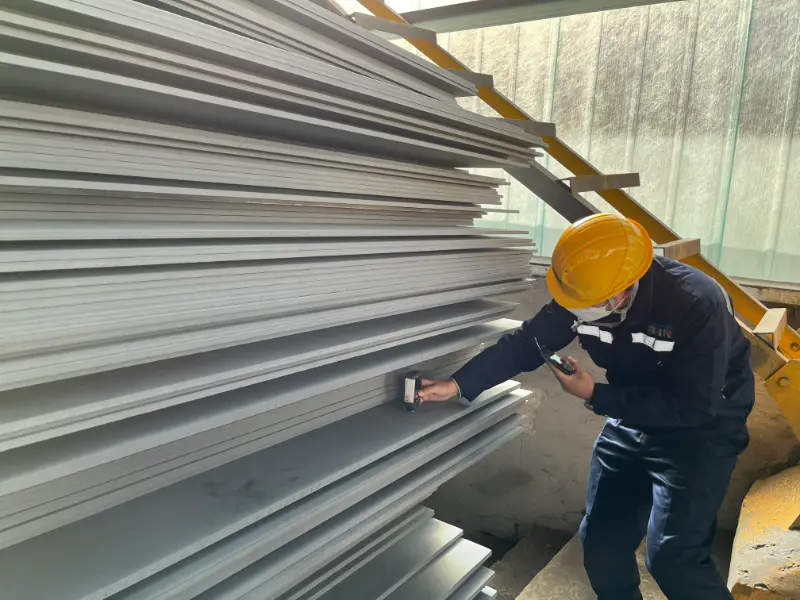
API 2H Grade 42 Offshore Platform Steel Plate
API Spec 2H Grade 42 Offshore Platform Steel Plate – Properties & Equivalents
Detailed material data for API Spec 2H Grade 42 steel plate for offshore structures, including chemical composition, mechanical and physical properties, international equivalents, and application guidance.
TMCP (Thermo-Mechanical Controlled Process), Normalizing, Quenching and Tempering (if specified)
- Phone : +8618037372205
- Email : [email protected]
- WhatsApp: Contact via Whtsapp
- WeChat: +8618037372205
API 2H Grade 42 Offshore Platform Steel Plate Introduction
API Spec 2H Grade 42 is a structural carbon-manganese steel plate produced by thermo-mechanical controlled process (TMCP) or normalizing, specifically designed for offshore platforms and marine structures. It offers a minimum yield strength of 290 MPa (42 ksi), good weldability, and excellent low-temperature toughness. This grade meets stringent requirements for through-thickness properties and resistance to brittle fracture in harsh marine environments, making it suitable for critical structural components such as jacket legs, deck beams, and node connections.
API 2H Grade 42 Offshore Platform Steel Plate Chemical Composition
Chemical requirements as per API Spec 2H, 9th Edition, Supplement 1, for Grade 42 plates. Values are maximum unless a range is indicated. Ceq = C + Mn/6 + (Cr+Mo+V)/5 + (Ni+Cu)/15, limited to 0.38% for thickness ≤ 50 mm (2 in) and 0.40% for thickness > 50–100 mm (2–4 in). Fine grain practice is mandatory with sufficient Al, Nb, V, or Ti additions.
| Element | Specified Value (wt%) | Remarks |
|---|---|---|
| Carbon (C) | ≤ 0.18 | Typical 0.14–0.18 |
| Manganese (Mn) | 0.60 – 1.35 | |
| Silicon (Si) | 0.15 – 0.50 | |
| Phosphorus (P) | ≤ 0.030 | |
| Sulfur (S) | ≤ 0.030 | For improved through-thickness properties, ≤0.010% may be specified |
| Niobium (Nb) | ≤ 0.05 | When added alone or in combination |
| Vanadium (V) | ≤ 0.10 | When added alone or in combination |
| Titanium (Ti) | ≤ 0.02 | For grain refinement |
| Aluminum (Al) total | ≥ 0.020 | If used as grain refiner |
| Copper (Cu) | ≤ 0.35 | |
| Nickel (Ni) | ≤ 0.40 | |
| Chromium (Cr) | ≤ 0.20 | |
| Molybdenum (Mo) | ≤ 0.08 | |
| Nitrogen (N) | ≤ 0.012 | If not sufficient Al or other fixers, lower N may be required |
| Ceq | ≤ 0.38 (t≤50mm), ≤0.40 (50<t≤100mm) | Carbon equivalent by formula |
API 2H Grade 42 Offshore Platform Steel Plate Thermal and Electrical Physical Properties
Physical properties for low-carbon structural steel similar to API 2H Gr.42. Values are typical at room temperature unless otherwise indicated. These can vary slightly with heat treatment and composition within the specification range.
| Property | Typical Value | Unit | Test Conditions |
|---|---|---|---|
| Density (ρ) | 7.85 | g/cm³ | 20 °C |
| Elastic Modulus (E) | 200 – 210 | GPa | 20 °C |
| Shear Modulus (G) | 80 | GPa | 20 °C, estimated from E and ν |
| Poisson's Ratio (ν) | 0.3 | — | 20 °C |
| Thermal Expansion Coefficient (α) | 11.7 × 10⁻⁶ | /K | 20 – 100 °C |
| Thermal Expansion Coefficient (α) | 12.5 × 10⁻⁶ | /K | 20 – 200 °C |
| Thermal Conductivity (λ) | 52 | W/(m·K) | 20 °C |
| Specific Heat Capacity (c) | 460 – 500 | J/(kg·K) | 20 °C |
| Electrical Resistivity (ρₑ) | 0.20 – 0.25 | μΩ·m | 20 °C |
API 2H Grade 42 Offshore Platform Steel Plate Mechanical Properties
Tensile and impact properties as required by API Spec 2H for Grade 42 plates. All tests are performed in the transverse direction unless longitudinal is specified. Charpy V-notch impact tests are mandatory at a temperature agreed upon, usually –40 °C (–40 °F) for offshore structures. Actual values depend on thickness and heat treatment.
| Property | Required Value | Unit | Test Conditions / Thickness |
|---|---|---|---|
| Yield Strength (ReH) | ≥ 290 | MPa (ksi) | t ≤ 100 mm (4 in); 42 ksi |
| Tensile Strength (Rm) | 435 – 580 | MPa (ksi) | 63 – 84 ksi |
| Elongation (A), 50 mm (2 in) gauge | ≥ 24 | % | t ≤ 50 mm (2 in), transverse |
| Elongation (A), 200 mm (8 in) gauge | ≥ 20 | % | t ≤ 50 mm, transverse |
| Elongation (A), 50 mm gauge | ≥ 24 | % | 50 < t ≤ 100 mm, transverse |
| Elongation (A), 200 mm gauge | ≥ 20 | % | 50 < t ≤ 100 mm, transverse |
| Impact Energy (KV), transverse | ≥ 27 (20 ft·lbf) | J (ft·lbf) | At –40 °C (–40 °F), standard full-size specimen; single value |
| Impact Energy (KV), longitudinal | ≥ 41 (30 ft·lbf) | J (ft·lbf) | At –40 °C (–40 °F), single value; often specified |
| Bend Test (Mandrel diameter) | 3t (180° bending) | — | No cracks or defects; t = specimen thickness |
API 2H Grade 42 Offshore Platform Steel Plate Identical or Directly Equivalent Material Standards & Substitute Grades
| Country / Region | Standard | Grade | Remarks |
|---|---|---|---|
| International | API Spec 2H | Grade 42 | Offshore platform steel, TMCP or normalized |
| USA | ASTM A572/A572M | Grade 42 | Similar yield strength (290 MPa), but without mandatory low-temperature impact testing; specify supplementary requirements for offshore use |
| Europe | EN 10025-3 | S275N/NL | S275 has lower strength (275 MPa); S355N/NL is stronger (355 MPa). Not a direct match but can replace Gr.42 with design review. |
| Japan | JIS G3106 | SM400B | Yield ≥ 245 MPa, lower strength; suitable for less critical parts |
API 2H Grade 42 Offshore Platform Steel Plate Application Introduction
API 2H Grade 42 is a dedicated offshore structural plate intended for welded construction of fixed and floating platforms. It is selected where a reliable minimum yield strength of 290 MPa combined with excellent low-temperature notch toughness is required. The steel is typically used in the North Sea and other cold climate offshore fields. Typical applications include:
Product Applications: Jacket legs and bracing, Deck plates and main girders, Piles and transition pieces, Subsea manifolds and structural nodes, Offshore wind turbine foundations (monopile, jacket)
Processed into products: Joints and node can sections, Stiffened plate panels, Tubular members with welded attachments, Tension leg platform (TLP) tendon components, Riser protection structures
Application industries: Offshore Oil & Gas, Marine renewable energy (offshore wind turbine substructures), Shipbuilding (special structures), Bridge construction (in cryogenic conditions)
API 2H Grade 42 Offshore Platform Steel Plate Similar / Closest Cross-Reference Materials
| Country / Region | Standard | Grade | Remarks |
|---|---|---|---|
| USA | API Spec 2H | Grade 50 | Higher strength (345 MPa yield); often used where weight savings are needed, with similar toughness requirements |
| Europe | EN 10025-4 | S355M/ML | Thermo-mechanically rolled, 355 MPa yield, good toughness; can be used for offshore if ordered with appropriate options |
| Europe | EN 10025-6 | S460Q/QL1 | Quenched and tempered, high strength, suitable for thick sections in offshore; more alloyed |
| China | GB/T 712 | DH36 | Similar yield (355 MPa), marine steel with mandatory impact tests at −20 °C (−36 °F); widely used in shipbuilding; some overlap in offshore applications |
| International | ISO 19902 / EN 10225 | S355G10+N or G10+M | Offshore structural steel for fixed structures, 355 MPa yield, designed for offshore environment; higher strength but comparable toughness |
Notes:
Special Requirements: Through-thickness (Z-direction) tensile testing per ASTM A770 or equivalent may be specified to guarantee resistance to lamellar tearing. Supplementary impact testing at –50 °C (–58 °F) is common for Arctic applications. Welding: Preheating is generally not required for thicknesses up to 50 mm when using low-hydrogen processes; however, heat input must be controlled to preserve HAZ toughness. Heat Treatment: Plates can be ordered in normalized (N) or TMCP condition; quenched and tempered (Q+T) is also possible for thicker sections to meet strength and impact requirements.
- Share



