
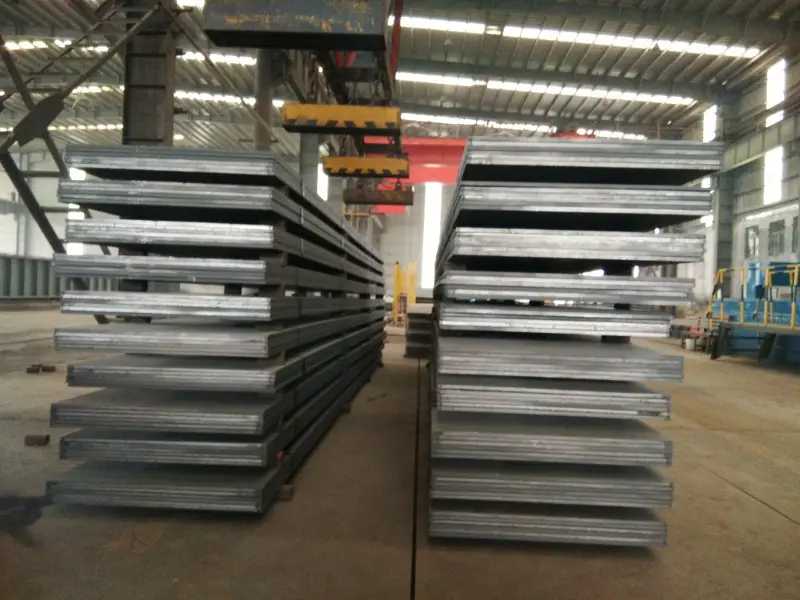
S235J2W Weather Resistant Steel Plate
EN 10155 S235J2W Weather Resistant Steel - Chemical & Mechanical Properties
Detailed material data for S235J2W weather resistant structural steel according to EN 10155, including chemistry, mechanical and physical properties, and international equivalents.
Hot rolling, cold forming, welding, bending, punching, drilling
- Phone : +8618037372205
- Email : [email protected]
- WhatsApp: Contact via Whtsapp
- WeChat: +8618037372205
S235J2W Weather Resistant Steel Plate Introduction
S235J2W is a hot-rolled structural steel with improved atmospheric corrosion resistance, designated under the former European standard EN 10155 (now superseded by EN 10025-5). It is characterized by a minimum yield strength of 235 MPa for thicknesses up to 16 mm and guarantees a Charpy impact energy of at least 27 J at -20 °C (J2 quality). The addition of alloying elements such as copper, chromium and nickel provides a protective patina that significantly reduces corrosion rates when exposed to outdoor conditions. This makes the steel well-suited for welded, bolted or riveted structures in bridges, building facades, industrial chimneys and shipping containers where painting may be omitted or delayed. Delivery condition is typically hot-rolled (AR) or normalized (N), with good weldability and cold-forming properties.
S235J2W Weather Resistant Steel Plate Chemical Composition
The chemical composition according to EN 10155 for product thickness ≤ 65 mm. Values represent the ladle analysis. Elements like copper, chromium and nickel are intentionally added to enhance atmospheric corrosion resistance (weathering property). Nitrogen is limited to ensure adequate formability and toughness.
- Carbon equivalent (CEV) may be specified by agreement.
- Phosphorus and sulfur are controlled to low levels to maintain weldability and ductility.
| Element | Content (%) | Remarks |
|---|---|---|
| Carbon (C) | ≤ 0.13 | |
| Silicon (Si) | ≤ 0.40 | |
| Manganese (Mn) | 0.20 – 0.60 | |
| Phosphorus (P) | ≤ 0.040 | For long products ≤ 0.035 |
| Sulfur (S) | ≤ 0.035 | For long products ≤ 0.030 |
| Chromium (Cr) | 0.40 – 0.80 | Key element for weather resistance |
| Nickel (Ni) | ≤ 0.65 | Contributes to toughness and corrosion resistance |
| Copper (Cu) | 0.25 – 0.55 | Essential for protective patina formation |
| Aluminium (Al) | ≥ 0.020 | If nitrogen-binding elements are required (e.g., when normalized) |
| Nitrogen (N) | ≤ 0.009 | When aluminium is added; without Al: ≤ 0.012 |
| Titanium (Ti), Vanadium (V), Niobium (Nb) | According to agreement | May be added for grain refinement; individual limits not specified |
S235J2W Weather Resistant Steel Plate Thermal and Electrical Physical Properties
The following physical properties are typical for S235J2W steel at room temperature unless otherwise indicated. These values are not part of the mandatory requirements of EN 10155 but are based on technical literature for low-carbon weather-resistant steels. They are useful for design calculations, thermal analysis, and electrical considerations.
- Density and elastic constants are almost identical to ordinary structural carbon steel.
- Thermal properties vary with temperature; the values given represent common reference data.
| Property | Typical Value | Unit | Test Condition / Remarks |
|---|---|---|---|
| Density (ρ) | 7850 | kg/m³ | At 20 °C |
| Modulus of Elasticity (E) | 200 – 210 | GPa | At 20 °C; slightly lower at elevated temperatures |
| Shear Modulus (G) | ≈ 80 | GPa | Calculated from E and ν |
| Poisson's Ratio (ν) | 0.3 | - | Elastic range |
| Thermal Expansion Coefficient (α) | 12.0 × 10⁻⁶ | K⁻¹ | Between 20 °C and 100 °C (linear expansion) |
| Thermal Expansion Coefficient (α) | 12.5 × 10⁻⁶ | K⁻¹ | Between 20 °C and 200 °C |
| Thermal Expansion Coefficient (α) | 13.0 × 10⁻⁶ | K⁻¹ | Between 20 °C and 300 °C |
| Thermal Conductivity (λ) | 45 – 55 | W/(m·K) | At 20 °C, typical range |
| Specific Heat Capacity (cp) | 460 – 480 | J/(kg·K) | At 20 – 100 °C |
| Electrical Resistivity (ρe) | 0.20 – 0.25 × 10⁻⁶ | Ω·m | At 20 °C |
S235J2W Weather Resistant Steel Plate Mechanical Properties
Mechanical properties in hot-rolled condition (or normalized) according to EN 10155. The yield strength decreases with increasing product thickness. For thicknesses above 100 mm, values may be agreed at the time of order. Charpy V-notch impact tests are performed at -20 °C (J2 requirement), three specimens average ≥ 27 J, with one individual ≥ 20 J. Elongation refers to a gauge length of 5.65√S₀ (A5).
- Values apply to flat and long products with thickness as indicated.
- Formability is ensured by minimum bend radii.
| Property | Value | Unit | Test Condition / Thickness (mm) |
|---|---|---|---|
| Yield Strength (ReH) | ≥ 235 | MPa | Thickness ≤ 16 |
| Yield Strength (ReH) | ≥ 225 | MPa | 16 < thickness ≤ 40 |
| Yield Strength (ReH) | ≥ 215 | MPa | 40 < thickness ≤ 63 |
| Yield Strength (ReH) | ≥ 215 | MPa | 63 < thickness ≤ 80 |
| Yield Strength (ReH) | ≥ 215 | MPa | 80 < thickness ≤ 100 |
| Yield Strength (ReH) | ≥ 195 | MPa | 100 < thickness ≤ 150 |
| Tensile Strength (Rm) | 360 – 510 | MPa | Thickness ≤ 100 |
| Tensile Strength (Rm) | 350 – 500 | MPa | 100 < thickness ≤ 150 |
| Elongation (A, Lo=5.65√S₀) | ≥ 26 | % | Thickness ≤ 40 |
| Elongation (A, Lo=5.65√S₀) | ≥ 24 | % | 40 < thickness ≤ 63 |
| Elongation (A, Lo=5.65√S₀) | ≥ 22 | % | 63 < thickness ≤ 100 |
| Elongation (A, Lo=5.65√S₀) | ≥ 20 | % | 100 < thickness ≤ 150 |
| Charpy Impact Energy (KV2) | ≥ 27 (avg) / ≥ 20 (single) | J | At -20 °C (longitudinal, test piece 10×10 mm) |
| Bend Test (Mandrel diameter) | No cracks | - | Bend angle 180°: mandrel diameter = 1.5 × thickness (t ≤ 16 mm); 2.0 × t (16 < t ≤ 100 mm) |
S235J2W Weather Resistant Steel Plate Fully Equivalent Material Standards and Substitutable Grades
| Country/Region | Standard | Grade | Remarks |
|---|---|---|---|
| European Union | EN 10025-5:2004 | S235J2W | Direct successor to EN 10155; chemical and mechanical requirements identical. |
| Germany | DIN EN 10155 | S235J2W | Identical adoption of EN 10155; now superseded by DIN EN 10025-5. |
| United Kingdom | BS EN 10155 | S235J2W | Identical British standard; now BS EN 10025-5. |
| France | NF EN 10155 | S235J2W | Identical French standard; now NF EN 10025-5. |
| Italy | UNI EN 10155 | S235J2W | Identical Italian standard; now UNI EN 10025-5. |
| Spain | UNE EN 10155 | S235J2W | Identical Spanish standard; now UNE EN 10025-5. |
| Sweden | SS-EN 10155 | S235J2W | Identical Swedish standard; now SS-EN 10025-5. |
| Poland | PN-EN 10155 | S235J2W | Identical Polish standard; now PN-EN 10025-5. |
| Netherlands | NEN-EN 10155 | S235J2W | Identical Dutch standard; now NEN-EN 10025-5. |
S235J2W Weather Resistant Steel Plate Application Introduction
S235J2W is intended for structural applications where the enhanced atmospheric corrosion resistance can be exploited to reduce maintenance costs. The steel forms a dense, adherent patina that impedes further corrosion, allowing unprotected use in many environments. It can be welded with all common methods, but low-hydrogen procedures and suitable weathering filler metals are recommended to maintain corrosion resistance at the weld. The material is easily cold-formable and machinable.
Typical service conditions include rural, urban, and light industrial atmospheres; direct contact with water or soil should be avoided or specially designed. Painting is not required but can be applied if desired. The J2 designation guarantees sufficient toughness at sub-zero temperatures down to -20 °C, making it suitable for outdoor structures in cold climates.
Product Applications: Steel bridges and footbridges (main girders, cross frames), High-rise building facades and cladding, Exposed architectural sculptures and art installations, Railway passenger coaches and freight wagons, Shipping and storage containers (ISO containers), Industrial chimneys and exhaust ducts, Transmission towers and utility poles, Offshore wind turbine towers (weathering steel in atmospheric zone), Noise barriers and motorway gantries, Grain silos and agricultural buildings
Processed into products: Flange and web plates in welded bridge girders, Cold-formed C and Z purlins for building envelopes, Dished ends and cylindrical shells for pressure vessels (atmospheric storage only), Welded tube sections for sign gantries and street light columns, Laser-cut architectural panels and screens, Bent plates for corner elements and casings, Weld-on brackets, stiffeners, and gusset plates, Bolted or riveted connections in truss structures, Machined bushings and bearing plates (with subsequent weathering steel filler welds)
Application industries: Civil engineering and infrastructure, Architectural and building construction, Railway and transportation, Energy and transmission, Shipbuilding (limited to non-marine exposure), Industrial machinery and equipment, Agricultural equipment
S235J2W Weather Resistant Steel Plate Similar/Comparable Weather Resistant Steel Grades
| Country/Region | Standard | Grade | Remarks |
|---|---|---|---|
| United States | ASTM A588 / A588M | Grade A | Similar weathering concept; min YS 345 MPa (50 ksi), Rm 483 MPa. Higher strength class, not a direct substitute for S235J2W. |
| United States | ASTM A242 / A242M | Type 1 | Similar weathering steel; minimum YS 345 MPa (50 ksi), Rm 480 MPa. Not directly interchangeable. |
| Japan | JIS G3114 | SMA400AW | Hot-rolled atmospheric corrosion resisting steel for welded structure; YS ≥ 235 MPa for ≤16 mm, impact at 0 °C. Chemical composition differs slightly (Cr 0.30–0.55, Cu 0.20–0.35). Comparable in strength and weathering but impact temperature is higher (JIS specifies 0 °C for AW). |
| Japan | JIS G3125 | SPA-H | High atmospheric corrosion resistance; YS ≥ 345 MPa. Higher strength; not a direct match. |
| China | GB/T 4171 | Q235NH | Weather resistant structural steel with YS ≥ 235 MPa, impact at 0 °C (quality C, D). Chemical composition similar but Cu: 0.25–0.55, Cr: 0.40–0.80, Ni ≤ 0.65. Not identical due to different impact temperature. |
| India | IS 11587 | Fe 410WA | Weather resistant structural steel; comparable strength (YS ≥ 230 MPa), but chemical composition somewhat different. |
Notes:
- EN 10155 was withdrawn and replaced by EN 10025-5:2004. S235J2W continues under the new standard with essentially unchanged requirements. For new designs, reference to EN 10025-5 is recommended.
- The atmospheric corrosion resistance index (I) according to ASTM G101 (Legault-Leckie formula) is typically ≥ 6.0 for S235J2W, indicating suitability for unpainted applications.
- Welding consumables should match the base metal's corrosion resistance, e.g., AWS A5.29 E81T1-W or equivalent EN ISO 17632-A T 46 Z W.
- Preheating may be required for thicker sections or when welding under adverse conditions; the carbon equivalent CEV is usually below 0.44%, granting good weldability.
- For detailed requirements of bend radii, impact test sub-size specimens, and through-thickness properties (Z-quality), consult the standard or supplementary agreements.
- Share



