
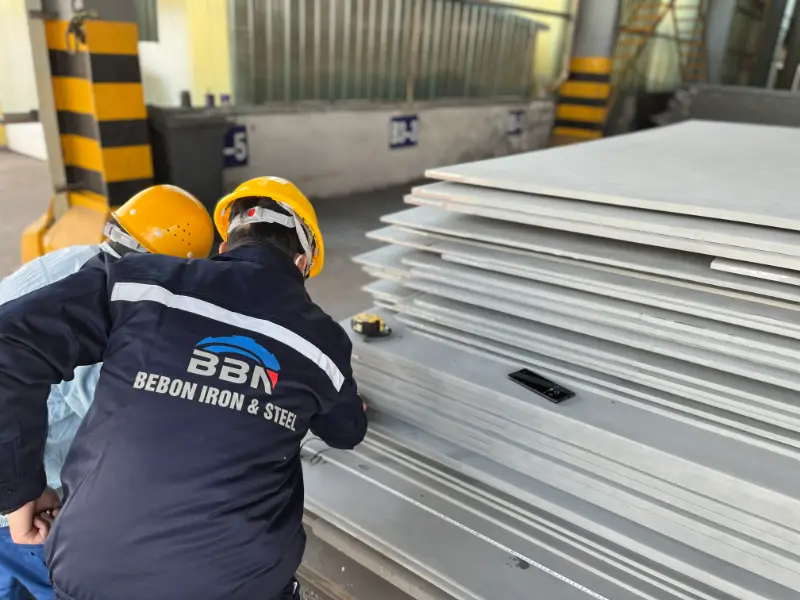
Q370R Pressure Vessel Steel Plate & Boiler Steel Grade
Q370R Pressure Vessel Steel Plate & Boiler Steel Grade - GB 713 Standard Analysis
Comprehensive technical data for Q370R steel plate including chemical composition, mechanical properties, physical performance, international equivalents, and application guidance according to GB/T 713 standard.
Cutting, forming, welding (SMAW, SAW, GMAW), post-weld heat treatment (PWHT), normalizing if required, cold and hot forming
- Phone : +8618037372205
- Email : [email protected]
- WhatsApp: Contact via Whtsapp
- WeChat: +8618037372205
Q370R Pressure Vessel Steel Plate & Boiler Steel Grade Introduction
Q370R is a normalized, low-alloy high-strength steel plate specifically designed for pressure vessels and boilers under the Chinese standard GB/T 713-2014 (Steel Plates for Boilers and Pressure Vessels).
- It offers a minimum yield strength of 370 MPa with excellent weldability and good low-temperature impact toughness.
- Controlled microalloying with Nb, V, Ti provides fine grain structure and high resistance to brittle fracture, making it suitable for critical welded structures in moderate and low-temperature environments.
- This grade is widely used in the fabrication of storage tanks, spherical vessels, heat exchangers, and industrial boilers, typically requiring post-weld heat treatment to relieve residual stresses.
Q370R Pressure Vessel Steel Plate & Boiler Steel Grade Chemical Composition
Chemical composition as per GB/T 713-2014 for thicknesses up to 100 mm. All values are maximum unless a range is specified. Aluminum is specified as total aluminum (Alt) to ensure fine grain practice. Carbon equivalent (CE) is typically controlled for weldability; common CE (IIW) requirement is ≤0.45% depending on thickness.
| Element | Standard Requirement (wt%) | Remarks |
|---|---|---|
| Carbon (C) | ≤0.18 | |
| Silicon (Si) | ≤0.55 | |
| Manganese (Mn) | 1.20 – 1.60 | |
| Phosphorus (P) | ≤0.020 | |
| Sulfur (S) | ≤0.010 | |
| Copper (Cu) | ≤0.30 | |
| Nickel (Ni) | ≤0.30 | |
| Chromium (Cr) | ≤0.30 | |
| Molybdenum (Mo) | ≤0.08 | |
| Niobium (Nb) | ≤0.050 | Microalloying for grain refinement |
| Vanadium (V) | ≤0.050 | Microalloying for strength |
| Titanium (Ti) | ≤0.050 | Used for deoxidation and grain refinement |
| Alt (Total Al) | ≥0.020 | Required for fine grain practice |
| Nitrogen (N) | ≤0.012 | Bound by Al, Ti to prevent aging |
| *CE (IIW) | ≤0.45 typically | Not mandatory but often specified for weldability |
Q370R Pressure Vessel Steel Plate & Boiler Steel Grade Physical and Thermophysical Properties
Physical properties are typical for low-alloy structural steel at ambient temperature, unless a range is given. These values are not part of the mandatory standard but are derived from general engineering data for similar low-alloy steels and can be used for design calculations. Density, elastic moduli, and thermal expansion are especially relevant for pressure vessel design under thermal loads.
| Property | Typical Value | Unit | Test Condition / Remarks |
|---|---|---|---|
| Density (ρ) | 7.85 | g/cm³ | At 20°C |
| Modulus of Elasticity (E) | 206 | GPa | Room temperature |
| Shear Modulus (G) | 79.3 | GPa | Typical, based on ν=0.3 |
| Poisson's Ratio (ν) | 0.3 | Elastic range | |
| Coefficient of Thermal Expansion (α) | 11.5 | 10−⁸ /K | 20–100°C |
| Coefficient of Thermal Expansion (α) | 12.5 | 10−⁸ /K | 20–200°C |
| Coefficient of Thermal Expansion (α) | 13.5 | 10−⁸ /K | 20–400°C |
| Thermal Conductivity (λ) | 45 | W/(m·K) | At 20°C; decreases to ~37 at 400°C |
| Specific Heat Capacity (c) | 460 | J/(kg·K) | At 20–100°C |
| Electrical Resistivity (ρₓ) | 0.20 – 0.25 | μΩ·m | At 20°C |
Q370R Pressure Vessel Steel Plate & Boiler Steel Grade Mechanical Properties
Mechanical properties according to GB/T 713-2014 for Q370R steel plate at room temperature. Impact tested on Charpy V-notch specimens at 0°C.
- Yield strength is specified as upper yield (ReH) for thickness ≤16 mm, or 0.2% proof strength (Rp0.2) for greater thicknesses.
- Minimum bend diameter for bend test: 2a for thickness ≤16 mm, 3a for thicker plates (a = nominal thickness).
| Property | Standard Requirement | Unit | Test Condition / Remarks |
|---|---|---|---|
| Yield Strength (ReH / Rp0.2) | ≥370 | MPa | Thickness 6 to <16 mm |
| Yield Strength (ReH / Rp0.2) | ≥360 | MPa | Thickness >16 to ≤36 mm |
| Yield Strength (ReH / Rp0.2) | ≥350 | MPa | Thickness >36 to ≤60 mm |
| Tensile Strength (Rm) | 530 – 630 | MPa | For all thicknesses 6 to 60 mm |
| Elongation after fracture (A) | ≥20 | % | Gauge length 5.65√So, thickness ≤16 mm |
| Elongation after fracture (A) | ≥19 | % | Gauge 5.65√So, thickness >16 to ≤36 mm |
| Elongation after fracture (A) | ≥18 | % | Gauge 5.65√So, thickness >36 to ≤60 mm |
| Impact Energy (KV2) | ≥34 | J | Charpy V-notch, test temperature 0°C, longitudinal direction |
| Bend Test (d=2a) | No cracks | 180° bending, d=2a, for thickness ≤16 mm | |
| Bend Test (d=3a) | No cracks | 180° bending, d=3a, for thickness >16 mm |
Q370R Pressure Vessel Steel Plate & Boiler Steel Grade Full Equivalents by Standard & Substitutable Grades
| Country / Region | Standard | Grade | Remarks / Comparability |
|---|---|---|---|
| China | GB/T 713 | Q370R | Original grade, normalized, 0°C impact |
| EU | EN 10028-3 | P355N | Closest match in normalized condition; minimum yield 355 MPa, may require verification of impact temperature and CEV. |
| USA | ASTM / ASME | A537 Class 1 | Normalized, similar tensile strength (485-620 MPa); impact test requirements differ (usually -30°C optional). Need project agreement. |
| Japan | JIS G3115 | SPV355 | For pressure vessels, yield ≥355 MPa; check availability in normalized state and impact temperature (usually 0°C). |
| International | ISO 4950-2 | P355N | Normalized, yield 355 MPa, tensile 470-630 MPa; matches mechanical range broadly. |
Q370R Pressure Vessel Steel Plate & Boiler Steel Grade Application Introduction
Q370R steel is engineered for medium- and low-temperature pressure equipment, combining strength, weldability, and notch toughness. It can be formed into various components through cold or hot working, and is readily joined by all common arc welding processes. Post-weld heat treatment is recommended to restore toughness and reduce residual stresses. Key industries:
Product Applications: Spherical storage tanks (LPG, ammonia), Fixed-roof and floating-roof tanks, Vertical and horizontal pressure vessels, separators, Industrial boiler drums and headers, Heat exchanger shells and channels, Penstocks and pressure pipes, Large-diameter heavy-wall reactors and columns
Processed into products: Shell courses for vessels and tanks, Hemispherical, elliptical, and torispherical heads (formed by pressing), Nozzles, manways, and reinforcement pads, Flanges (welding neck, slip-on) machined from plate, Tube sheets and bonnets, Structural supports and skirts, Internal trays and baffles for columns
Application industries: Oil & Gas, Petrochemical, Chemical Processing, Power Generation (including fossil fuel and nuclear heat exchangers), Boiler Manufacturing, Shipbuilding (pressure parts), Ammonia and Urea Plants
Q370R Pressure Vessel Steel Plate & Boiler Steel Grade Similar / Alternative Materials with Close Properties
| Country / Region | Standard | Grade | Remarks / Key Differences |
|---|---|---|---|
| China | GB/T 713 | Q345R (16MnR) | Lower strength (yield ≥345 MPa for thin plates), widely used standard grade; may be upgraded to Q370R for weight reduction. |
| China | GB/T 713 | Q420R | Higher strength version (yield ≥420 MPa); more alloying, may require careful welding and PWHT control. |
| China | GB 3531 | 16MnDR | Low-temperature pressure vessel steel, similar Mn content but with improved toughness at -40°C; often used interchangeably when low-temperature service is required. |
| EU | EN 10028-3 | P355NH | Similar to P355N but with guaranteed elevated temperature yield; useful as an alternative when hot operating conditions are specified. |
| USA | ASTM / ASME | A516 Grade 70 | Carbon-manganese steel for pressure vessels, normalized; lower strength (yield 260 MPa) but excellent toughness; thicker sections could be an option if strength is not critical. |
Notes:
Additional Technical Remarks:
- Carbon equivalent (CE) based on IIW formula: CE = C + Mn/6 + (Cr+Mo+V)/5 + (Ni+Cu)/15. Typical market requirement for Q370R is CE ≤0.45% for thickness ≤50 mm; for thicker plates, the limit may be relaxed to ≤0.48% or as agreed.
- Q370R plates shall be ultrasonic tested per the order requirements; often UT per NB/T 47013.3 or ASTM A435/A578 is required for pressure vessel applications.
- When service involves hydrogen environment or sour service (HIC), plates may be supplied with hydrogen-induced cracking (HIC) and sulfide stress corrosion cracking (SSCC) resistant properties; special composition with Ca treatment and low sulfur (<0.002%) may be specified.
- Simulated post-weld heat treatment (SPWHT) mechanical properties may be guaranteed if specified in the order.
- Share



