
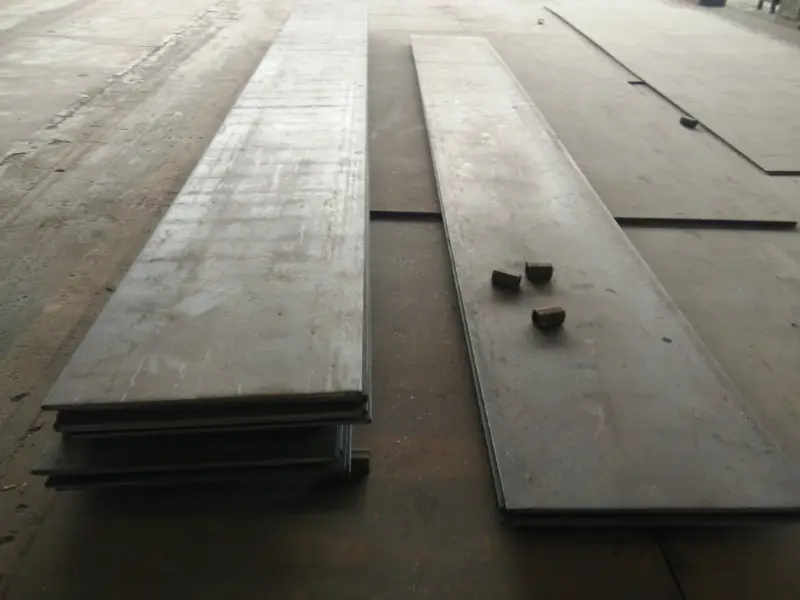
P460QH Pressure Vessel Steel Plate
P460QH Pressure Vessel Steel Plate: EN 10028-6 Quenched and Tempered Fine Grain Weldable Steel
Comprehensive technical data for P460QH steel to EN 10028-6, including chemical composition, mechanical properties, physical properties, international equivalents, and application guidelines.
Hot rolling followed by quenching and tempering; suitable for welding, cold forming, hot forming, and machining
- Phone : +8618037372205
- Email : [email protected]
- WhatsApp: Contact via Whtsapp
- WeChat: +8618037372205
P460QH Pressure Vessel Steel Plate Introduction
P460QH is a quenched and tempered weldable fine grain structural steel specifically designed for pressure vessels and boilers under the European standard EN 10028-6. With a minimum yield strength of 460 MPa at room temperature, it offers a balanced combination of high strength, excellent toughness at low temperatures, and good weldability. The 'Q' designates quenched and tempered delivery condition, while 'H' indicates the grade for elevated temperature properties.
- Fine grain practice ensures uniform mechanical properties and improved notch toughness.
- Low carbon equivalent (CEV ≤ 0.52) facilitates welding without excessive preheat.
- Controlled additions of microalloying elements (Nb, V, Ti) provide precipitation strengthening and grain refinement.
- Typical thicknesses range from 3 mm to 50 mm for the standard yield strength guarantee; thicker plates may require special agreement.
- The material is delivered in the quenched and tempered condition, offering a homogeneous tempered martensitic/bainitic microstructure.
It is intended for service at moderate temperatures and is widely used in the fabrication of storage spheres, chemical reactors, heat exchangers, and high-pressure piping systems.
P460QH Pressure Vessel Steel Plate Chemical Composition
The chemical composition of P460QH is carefully balanced to achieve the required strength, toughness, and weldability. The steel is microalloyed with niobium, vanadium, and titanium for grain refinement and precipitation strengthening. Maximum limits for phosphorus and sulfur ensure high cleanliness and good resistance to brittle fracture. The carbon equivalent (CEV) is restricted to guarantee excellent weldability without cold cracking.
- All values are maximum unless a range or minimum is indicated.
- Elements not listed may be present as residuals but are not intentionally added.
| Element | Standard Value (max %) | Remarks |
|---|---|---|
| Carbon (C) | ≤0.20 | Key for hardenability and strength |
| Silicon (Si) | ≤0.50 | Deoxidation aid |
| Manganese (Mn) | ≤1.70 | Contributes to strength and toughness |
| Phosphorus (P) | ≤0.025 | Residual element; low limit for toughness |
| Sulfur (S) | ≤0.015 | Residual element; low limit for cleanliness |
| Aluminium (Al total) | ≥0.015 | Grain refining element, minimum specified |
| Nitrogen (N) | ≤0.015 | Limited to prevent strain aging |
| Niobium (Nb) | ≤0.05 | Microalloy; grain refinement and precipitation strengthening |
| Vanadium (V) | ≤0.08 | Microalloy; precipitation strengthening |
| Titanium (Ti) | ≤0.03 | Microalloy; grain refinement and nitrogen fixation |
| Chromium (Cr) | ≤0.50 | Hardenability element |
| Nickel (Ni) | ≤1.0 | Improves toughness and hardenability |
| Molybdenum (Mo) | ≤0.50 | Hardenability element, carbide former |
| Copper (Cu) | ≤0.30 | Residual element; may cause hot shortness at high levels |
| Boron (B) | ≤0.005 | Strong hardenability agent, carefully controlled |
| Zirconium (Zr) | ≤0.05 | Optional for inclusion shape control |
| Nb+V+Ti | ≤0.12 | Combined microalloy maximum for weldability |
| Carbon Equivalent (CEV) | ≤0.52 | Based on CEV = C + Mn/6 + (Cr+Mo+V)/5 + (Ni+Cu)/15 |
P460QH Pressure Vessel Steel Plate Thermal and Electrical Physical Properties
Physical properties are provided as typical values for quenched and tempered low-alloy steels of this class. These are not mandatory in EN 10028-6 but are based on published technical literature and producer data sheets. Actual properties may vary slightly with exact chemical composition and heat treatment.
- Data is valid at room temperature unless a temperature range is specified.
- Thermal expansion coefficient is given up to 600°C.
- Thermal conductivity and specific heat capacity are indicative for thermal design.
- Electrical resistivity is for general reference.
| Property | Typical Value | Unit | Condition / Temperature |
|---|---|---|---|
| Density (ρ) | 7.85 | g/cm³ | At 20°C |
| Modulus of Elasticity (E) | 210 | GPa | At 20°C |
| Shear Modulus (G) | ~81 | GPa | At 20°C |
| Poisson's Ratio (ν) | 0.3 | — | Elastic range |
| Thermal Expansion Coefficient (α) | 12.5 | 10⁻⁶/K | 20°C – 100°C |
| Thermal Expansion Coefficient (α) | 13.0 | 10⁻⁶/K | 20°C – 200°C |
| Thermal Expansion Coefficient (α) | 13.5 | 10⁻⁶/K | 20°C – 300°C |
| Thermal Expansion Coefficient (α) | 14.0 | 10⁻⁶/K | 20°C – 400°C |
| Thermal Expansion Coefficient (α) | 14.5 | 10⁻⁶/K | 20°C – 500°C |
| Thermal Expansion Coefficient (α) | 14.8 | 10⁻⁶/K | 20°C – 600°C |
| Thermal Conductivity (λ) | 45 | W/(m·K) | At 20°C |
| Thermal Conductivity (λ) | 42 | W/(m·K) | At 100°C |
| Thermal Conductivity (λ) | 38 | W/(m·K) | At 200°C |
| Thermal Conductivity (λ) | 35 | W/(m·K) | At 300°C |
| Thermal Conductivity (λ) | 33 | W/(m·K) | At 400°C |
| Specific Heat Capacity (cp) | 460 | J/(kg·K) | At 20°C |
| Specific Heat Capacity (cp) | 490 | J/(kg·K) | At 100°C |
| Specific Heat Capacity (cp) | 530 | J/(kg·K) | At 200°C |
| Specific Heat Capacity (cp) | 560 | J/(kg·K) | At 300°C |
| Specific Heat Capacity (cp) | 590 | J/(kg·K) | At 400°C |
| Electrical Resistivity (ρe) | 0.25 | μΩ·m | At 20°C |
P460QH Pressure Vessel Steel Plate Mechanical Properties
Mechanical properties apply to quenched and tempered plates in the thickness range 3 mm ≤ t ≤ 50 mm. The values are verified in accordance with EN 10028-1 and EN 10028-6.
- Yield strength (ReH) and tensile strength (Rm) are guaranteed for the specified thickness range.
- Elongation (A) is measured on a proportional gauge length L0=5.65√S0 for thicknesses ≥3 mm; for thinner products other gauge lengths may be agreed.
- Charpy V-notch impact tests are performed at -20°C, with a minimum average absorbed energy of 27 J on transverse specimens.
- Bend test is a technological test with a bend diameter of 3×thickness (3a) for all thicknesses when required.
| Property | Required Value | Unit | Test Condition / Remarks |
|---|---|---|---|
| Yield Strength (ReH) | ≥460 | MPa | For thickness 3 ≤ t ≤ 50 mm |
| Tensile Strength (Rm) | 550 – 720 | MPa | For thickness 3 ≤ t ≤ 50 mm |
| Elongation (A) | ≥17 | % | Gauge length L0 = 5.65√S0, transverse |
| Bend Test (Bend Angle 180°) | d = 3a | — | Bend diameter = 3 × specimen thickness; no cracks |
| Charpy Impact Energy (KV2) at -20°C | ≥27 (average), ≥19 (single) | J | Transverse test, V-notch, 10×10 mm specimen |
P460QH Pressure Vessel Steel Plate Fully Equivalent Material Standards and Designations
The following table lists national standards that are identical or technically equivalent to EN 10028-6 P460QH. Since the EN standard is adopted by CEN member countries, the designation P460QH remains the same across Europe. There is no direct single-grade match in ASTM, JIS, or GB standards.
| Country / Region | Standard | Designation | Remarks |
|---|---|---|---|
| European Union | EN 10028-6:2017 | P460QH | Original standard; mandatory in EU |
| Germany | DIN EN 10028-6 | P460QH | Adopted EN standard as DIN EN |
| France | NF EN 10028-6 | P460QH | Adopted EN standard as NF EN |
| United Kingdom | BS EN 10028-6 | P460QH | Adopted EN standard as BS EN |
| Italy | UNI EN 10028-6 | P460QH | Adopted EN standard as UNI EN |
| Spain | UNE EN 10028-6 | P460QH | Adopted EN standard as UNE EN |
| Sweden | SS-EN 10028-6 | P460QH | Adopted EN standard as SS-EN |
P460QH Pressure Vessel Steel Plate Application Introduction
P460QH steel is engineered for demanding welded pressure equipment operating at moderate temperatures. Its high yield strength allows reduced wall thickness, saving weight and welding cost. The fine grain structure guarantees safe fracture toughness even at sub-zero ambient conditions, making it suitable for storage of liquefied gases and outdoor installations. The material is typically used in the as-delivered quenched and tempered condition; post-weld heat treatment may be applied according to pressure vessel codes. Key industries include oil & gas, chemical processing, power generation, and shipbuilding.
Product Applications: Spherical pressure vessels (LPG, ammonia, propylene storage spheres), Horizontal and vertical cylindrical vessels (separators, knock-out drums, reactors), High-pressure steam boilers and drums, Shell-and-tube heat exchangers, Autoclaves and leaching vessels, Penstocks and surge tanks for hydropower, Offshore platform topside pressure modules, Storage tanks for liquefied gases (limited by MDMT)
Processed into products: Shell courses and welded head plates for pressure vessels, Tube sheets and flanges for heat exchangers, Forged nozzles and manways (when produced from plate-like products), Stiffening rings and support skirts, Welded beams and columns for heavy structural parts in pressure plants, Piping spools and manifolds (when fabricated from plate and formed into pipe), Transition pieces and cone sections in vessels
Application industries: Oil & Gas (upstream and downstream), Petrochemical and chemical processing, Power generation (conventional and nuclear), Industrial boiler manufacturing, Offshore and marine engineering, Hydrocarbon storage and transportation, Cryogenic and low-temperature services (down to -20°C, with some margins)
P460QH Pressure Vessel Steel Plate Similar or Closest Alternative Grades
The grades below are not fully equivalent but are often used in similar applications or have comparable strength levels. They may differ in chemical composition, delivery condition, testing requirements, or thickness range. Direct substitution requires detailed engineering assessment.
| Country / Region | Standard | Designation | Remarks |
|---|---|---|---|
| International | ISO 4997:2015 | CR 420 (formerly FE 460) | Not identical; specifies cold-rolled products with lower strength; not directly interchangeable |
| USA | ASTM A517/A517M | Grade B (or H) | Quenched and tempered high-strength steel; min yield 690 MPa, much higher strength, different chemistry (Ni-Cr-Mo with B) |
| USA | ASTM A537/A537M | Class 2 | Quenched and tempered C-Mn-Si steel; min yield 415 MPa, lower strength but similar toughness philosophy |
| China | GB/T 19189-2011 | 07MnMoVR | Quenched and tempered pressure vessel steel; min yield 490 MPa, close strength level, Chinese standard, check CE requirements |
| Japan | JIS G3115 | SPV490Q | Pressure vessel steel in quenched and tempered condition; min yield 490 MPa, widely used in Japan; suitable alternative with caution |
| Korea | KS D 3544 | SPV490Q | Same as JIS G3115 SPV490Q |
| Russia | GOST R 52927-2015 | 10KhSND (10ХСНД) | Low-alloy structural steel; not directly equivalent, lower yield, different alloy concept |
Notes:
Additional remarks:
- Plates are usually supplied with inspection documents according to EN 10204 type 3.1 or 3.2.
- Welding consumables should match the strength and toughness; preheat and interpass temperature control is essential for thick sections.
- For thicknesses above 50 mm, mechanical properties must be agreed at the time of enquiry and order.
- Post-weld heat treatment (PWHT) temperatures, if required, are typically in the range 540–580°C; prolonged holding may reduce strength.
- The steel may be ordered with additional requirements such as through-thickness properties (Z-quality), simulated PWHT test, or elevated temperature proof strength testing according to EN 10028-6.
- This P460QH grade is not intended for continuous service above 400°C; for higher temperatures, consider Cr-Mo alloy steels (e.g., 13CrMo4-5, 10CrMo9-10).
- Share



