
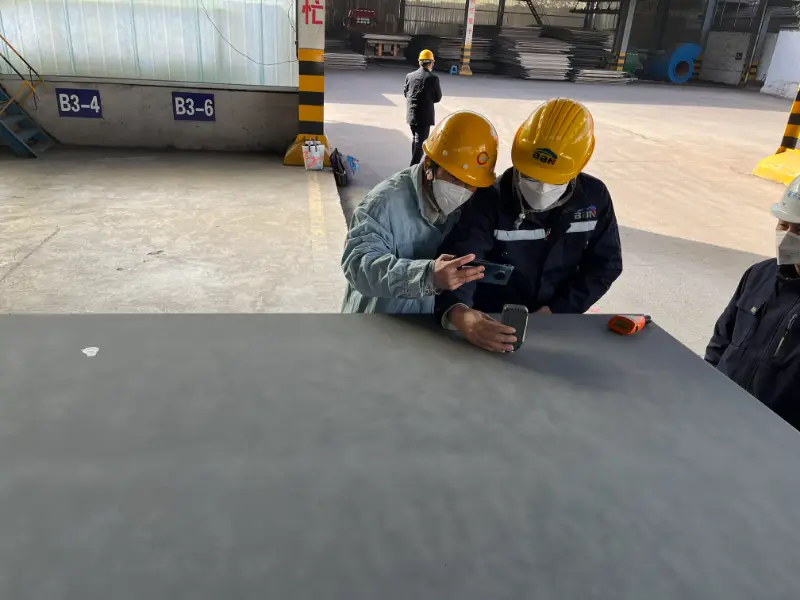
JIS G3114 SMA400BP Weather Resistant Steel Plate
JIS G3114 SMA400BP Weather Resistant Steel Plate - Outstanding Corrosion-Resistant Structural Steel
Comprehensive technical data for JIS G3114 SMA400BP weather resistant steel plate, including chemical composition, mechanical properties, thermal and electrical physical performance, international equivalents, and application guidelines for bridges, buildings, and welded structures.
Hot rolling, normalizing, welding, cutting, drilling, cold forming
- Phone : +8618037372205
- Email : [email protected]
- WhatsApp: Contact via Whtsapp
- WeChat: +8618037372205
JIS G3114 SMA400BP Weather Resistant Steel Plate Introduction
JIS G3114 SMA400BP is a hot-rolled weather resistant steel plate designed for welded structural applications, manufactured in accordance with Japanese Industrial Standard JIS G3114. The designation SMA400 signifies a minimum tensile strength of 400 N/mm², while the letter B indicates a guaranteed impact property at 0°C. The suffix P denotes that the steel is intended for painted use, although it inherently forms a protective rust-like layer due to the addition of copper, chromium, and nickel. This steel category offers improved atmospheric corrosion resistance compared to ordinary carbon steels, making it highly suitable for bridges, building frames, and outdoor structures exposed to moderate weathering conditions. It combines good weldability, moderate strength, and extended maintenance-free service life when properly painted or left uncoated.
JIS G3114 SMA400BP Weather Resistant Steel Plate Chemical Composition
The typical chemical composition of SMA400BP according to JIS G3114. The addition of Cu, Cr, and Ni provides enhanced atmospheric corrosion resistance by forming a dense, adherent oxide layer. Values are maximum unless a range is specified.
| Element | Specified Value (mass %) | Remarks |
|---|---|---|
| Carbon (C) | ≤ 0.18 | Typical for weldable structural steel; keeps carbon content low to ensure good weldability. |
| Silicon (Si) | ≤ 0.75 | Deoxidizer; contributes to strength. |
| Manganese (Mn) | ≤ 1.40 | Enhances strength and hardenability; maintained at a moderate level for toughness. |
| Phosphorus (P) | ≤ 0.035 | Control of impurities for improved welding and cold forming characteristics. |
| Sulfur (S) | ≤ 0.035 | Low sulfur improves hot workability and reduces the risk of hot cracking during welding. |
| Copper (Cu) | 0.30 – 0.60 | Key alloying element for atmospheric corrosion resistance; promotes formation of protective rust. |
| Chromium (Cr) | 0.45 – 0.75 | Synergistically improves corrosion resistance with Cu and contributes to hardenability. |
| Nickel (Ni) | 0.05 – 0.30 | Enhances toughness and further improves atmospheric corrosion resistance, especially in marine environments. |
JIS G3114 SMA400BP Weather Resistant Steel Plate Thermal and Electrical Physical Properties
Representative physical properties for SMA400BP at room temperature unless stated otherwise. These values are similar to those of mild steel and are suitable for design calculations involving thermal expansion, heat transfer, and electrical resistivity.
| Property | Typical Value | Unit | Test Condition / Remarks |
|---|---|---|---|
| Density (ρ) | 7.85 | g/cm³ | At 20 °C |
| Modulus of Elasticity (E) | 205 | GPa | At 20 °C, tension test |
| Shear Modulus (G) | 80 | GPa | Calculated from E and Poisson ratio |
| Poisson's Ratio (ν) | 0.3 | – | In elastic range |
| Thermal Expansion Coefficient (α) | 11.7 × 10⁻⁶ | /°C | Between 20 °C and 100 °C |
| Thermal Expansion Coefficient (α) | 12.2 × 10⁻⁶ | /°C | Between 20 °C and 200 °C |
| Thermal Conductivity (λ) | 45 | W/(m·K) | At 20 °C |
| Specific Heat Capacity | 460 – 470 | J/(kg·K) | At 20 °C, typical range |
| Electrical Resistivity (ρ_e) | 0.15 – 0.25 | Ω·mm²/m | At 20 °C |
JIS G3114 SMA400BP Weather Resistant Steel Plate Mechanical Properties
Mechanical property requirements for SMA400BP plates according to thickness ranges. Tensile tests are performed on longitudinal (L) test pieces except where noted. Impact test temperature is 0 °C, Charpy V-notch, average of three specimens.
| Property | Specified Value | Unit | Test Condition / Remarks |
|---|---|---|---|
| Yield Strength (ReH) | ≥ 245 | N/mm² | Plate thickness t ≤ 16 mm |
| Yield Strength (ReH) | ≥ 235 | N/mm² | 16 mm < t ≤ 40 mm |
| Yield Strength (ReH) | ≥ 215 | N/mm² | 40 mm < t ≤ 75 mm |
| Tensile Strength (Rm) | 400 – 540 | N/mm² | For all thicknesses |
| Elongation (A) | ≥ 22 | % | Thickness t ≤ 5 mm, JIS No. 5 test piece, gauge length 50 mm, longitudinal |
| Elongation (A) | ≥ 17 | % | 5 mm < t ≤ 16 mm, JIS No. 1A test piece, gauge length 200 mm, longitudinal |
| Elongation (A) | ≥ 21 | % | 16 mm < t ≤ 50 mm, JIS No. 1A test piece, transverse to rolling direction |
| Elongation (A) | ≥ 24 | % | 40 mm < t ≤ 100 mm, JIS No. 1A test piece, transverse to rolling direction |
| Bend Test (Bend Diameter) | 1.0 × t | – | Thickness t ≤ 16 mm, 180° bend, no cracks on outside of bent portion |
| Bend Test (Bend Diameter) | 1.5 × t | – | 16 mm < t ≤ 100 mm, 180° bend, no cracks |
| Charpy Impact Energy (KV, 0 °C) | ≥ 27 (average of 3) | J | Longitudinal V-notch, test temperature 0 °C, all thicknesses; individual minimum ≥ 19 J |
JIS G3114 SMA400BP Weather Resistant Steel Plate Identical Material Standards and Replaceable Grade Designations
| Country/Region | Standard | Grade | Remarks |
|---|---|---|---|
| Japan | JIS G3114 | SMA400BP | Original grade, painted application; chemical and mechanical properties identical to base B grade. |
| Japan | JIS G3114 | SMA400BW | Unpainted (bare) application; identical mechanical and chemical specifications except intended for no additional surface coating. |
JIS G3114 SMA400BP Weather Resistant Steel Plate Application Introduction
SMA400BP weather resistant steel is extensively used in structures where long-term durability without frequent maintenance is required. The combination of moderate strength, good weldability, and enhanced atmospheric corrosion resistance makes it ideal for heavy structural components. Typical processing includes cutting, drilling, bending, and welding using common carbon steel consumables. When used in its painted (P) variety, the protective coating further prolongs service life in aggressive environments.
Product Applications: Steel bridge girders, decks, and truss members, Structural frames for high-rise and industrial buildings, Rail passenger car and freight wagon bodies, Shipping containers and dry bulk storage compartments, Chimney liners and flue gas ducts, Transmission tower angles and plates, Outdoor crane structures and port facilities
Processed into products: Bridge main and cross girders, stiffeners, and bracing plates, Connecting brackets and splice plates in building frames, Railway wagon side panels, underframes, and hopper chutes, Container corner castings, door frames, and roof bows, Tower leg sections and gusset plates, Severe-service plate girders and box columns in power plants
Application industries: Civil engineering and infrastructure, Bridge construction, Architectural and building construction, Railway vehicle manufacturing, Container and shipping industries, Power transmission and telecommunication towers, Industrial plant and chimneys
JIS G3114 SMA400BP Weather Resistant Steel Plate Closely Comparable / Alternative Material Recommendations
| Country/Region | Standard | Grade | Remarks |
|---|---|---|---|
| China | GB/T 4171 | Q295NH | Similar atmospheric corrosion resistance; minimum yield strength 295 MPa, tensile 430–560 MPa, 0 °C impact. Offers higher strength but may require design adjustment. |
| European Union | EN 10025-5 | S235J0W | Similar 0 °C impact class; minimum yield 235 MPa (t≤16), tensile 360–510 MPa. Slightly lower strength, suitable for less demanding applications. |
| United States | ASTM A588 / A588M | Grade A | High-strength low-alloy weathering steel; yield 345 MPa, tensile ≥ 485 MPa. Significantly stronger; suitable where weight reduction is desired but joining and forming may differ. |
| India | IS 2062 | E410 Grade B (Fe 410WB) | Yield ≥ 250 MPa, tensile ≥ 410 MPa, impact at 0 °C, with Cu-Cr addition. Very close strength range and usage scenario. |
Notes:
- Weldability: Generally good; preheat and low-hydrogen practices are recommended for thick sections (>40 mm) or under low ambient temperature conditions.
- Weathering characteristic: When used unpainted (as SMA400BW), a protective patina develops after alternate wet and dry cycles. In continuously wet or highly corrosive environments, painting may be required.
- Cold forming: Suitable with a minimum bend radius of 2.0t for thicknesses up to 16 mm, provided edges are ground smooth. For thicker plates, increased radii and an evaluation of strain ageing are advised.
- Galvanizing compatibility: SMA400BP can be hot-dip galvanized after proper surface preparation; however, the weathering alloy elements may slightly affect coating thickness and adherence.
- Share



