
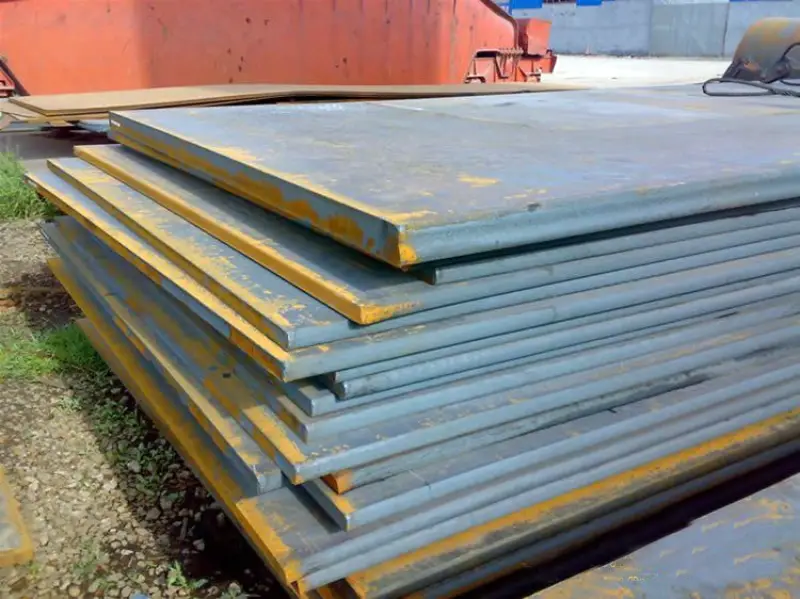
EN 10028-3 P355N Steel Plate
EN 10028-3 P355N Steel Plate: Premium Normalized Weldable Fine Grain Steel for Pressure Vessels and Boilers
Explore the comprehensive technical data of P355N steel plate conforming to EN 10028-3, including chemical composition, mechanical properties, physical performance, equivalent grades, and application guidance for pressure vessels and boilers.
Hot rolling, normalizing, cold forming, cutting, welding, machining, bending, rolling, drilling, and surface treatment
- Phone : +8618037372205
- Email : [email protected]
- WhatsApp: Contact via Whtsapp
- WeChat: +8618037372205
EN 10028-3 P355N Steel Plate Introduction
P355N is a normalized, weldable fine grain structural steel grade defined in EN 10028-3, specifically designed for pressure vessels, boilers, and related applications where high-temperature performance and safety are critical. This steel offers minimum yield strength of up to 355 MPa for thinner sections and good tensile strength in the range of 490–630 MPa. It is characterized by excellent toughness at subzero temperatures, with guaranteed impact energy values at -20°C, and reliable weldability due to its low carbon equivalent. P355N is widely used in the fabrication of storage tanks, reactors, heat exchangers, and process columns. The normalization heat treatment refines the grain structure, ensuring uniformity of mechanical properties across the thickness and improving resistance to brittle fracture. With controlled sulfur and phosphorus levels and aluminum-killed fine grain practice, the steel exhibits good formability and can be safely employed under demanding operational conditions. European standard EN 10028-3 specifies both the technical delivery conditions and testing requirements, making P355N a trusted material in the chemical, petrochemical, and energy sectors.
EN 10028-3 P355N Steel Plate Chemical Composition
The chemical composition of P355N is strictly controlled to ensure good weldability, fine grain structure, and high-temperature strength. The steel is aluminum-killed and contains micro-alloying elements such as niobium, titanium, and vanadium for grain refinement and precipitation strengthening. Maximum sulfur and phosphorus are restricted to enhance cleanliness and toughness. The carbon equivalent (CEV) is limited to maintain weldability without preheating under normal conditions. All values comply with EN 10028-3:2017.
| Element | Standard Requirement (wt%) | Remarks |
|---|---|---|
| Carbon (C) | ≤ 0.18 | Ladle analysis |
| Silicon (Si) | ≤ 0.50 | |
| Manganese (Mn) | 1.10 – 1.70 | |
| Phosphorus (P) | ≤ 0.025 | Maximum for fine grain practice |
| Sulfur (S) | ≤ 0.015 | Low sulfur for improved toughness |
| Aluminum (Al) total | ≥ 0.020 | Aluminum killed, ensures fine grain |
| Nitrogen (N) | ≤ 0.012 | |
| Chromium (Cr) | ≤ 0.30 | Residual element |
| Copper (Cu) | ≤ 0.30 | May increase with reservation for weather resistance |
| Molybdenum (Mo) | ≤ 0.08 | Trace |
| Niobium (Nb) | ≤ 0.05 | Grain refiner |
| Nickel (Ni) | ≤ 0.50 | Generally low unless specified |
| Titanium (Ti) | ≤ 0.03 | Optional micro-alloy |
| Vanadium (V) | ≤ 0.10 | Precipitation strengthening |
| Nb+Ti+V | ≤ 0.12 | Sum of micro-alloying elements |
| CEV (Carbon Equivalent) | Typically 0.43 max (product analysis) | CEV = C + Mn/6 + (Cr+Mo+V)/5 + (Ni+Cu)/15, as per EN 10028-3 |
EN 10028-3 P355N Steel Plate Thermal and Electrical Physical Properties
The physical properties of P355N are representative of low-alloy carbon-manganese steels. These values are essential for design calculations involving thermal expansion, heat transfer, and electrical conductivity. They are applicable for the specified temperature ranges and may vary slightly depending on the exact heat treatment and product form. Density is taken as standard for ferritic steels. Elastic moduli and Poisson's ratio are for static conditions.
| Property | Standard Requirement / Typical Value | Unit | Test Condition |
|---|---|---|---|
| Density (ρ) | 7.85 | g/cm³ | Room temperature |
| Young's Modulus (E) | 210 | GPa | Room temperature |
| Shear Modulus (G) | 81 | GPa | Room temperature (calculated from E and ν) |
| Poisson's Ratio (ν) | 0.3 | – | Room temperature |
| Thermal expansion coefficient (α) | 11.1 × 10⁻⁶ | 1/K | 20 – 100°C |
| Thermal expansion coefficient (α) | 12.1 × 10⁻⁶ | 1/K | 20 – 200°C |
| Thermal expansion coefficient (α) | 12.9 × 10⁻⁶ | 1/K | 20 – 300°C |
| Thermal expansion coefficient (α) | 13.5 × 10⁻⁶ | 1/K | 20 – 400°C |
| Thermal expansion coefficient (α) | 13.9 × 10⁻⁶ | 1/K | 20 – 500°C |
| Thermal conductivity (λ) | 51 | W/(m·K) | 20°C |
| Thermal conductivity (λ) | 51 | W/(m·K) | 100°C |
| Thermal conductivity (λ) | 49 | W/(m·K) | 200°C |
| Thermal conductivity (λ) | 46 | W/(m·K) | 300°C |
| Thermal conductivity (λ) | 42 | W/(m·K) | 400°C |
| Thermal conductivity (λ) | 38 | W/(m·K) | 500°C |
| Specific Heat Capacity (cp) | 460 | J/(kg·K) | 20°C |
| Specific Heat Capacity (cp) | 490 | J/(kg·K) | 100°C |
| Specific Heat Capacity (cp) | 520 | J/(kg·K) | 200°C |
| Specific Heat Capacity (cp) | 550 | J/(kg·K) | 300°C |
| Specific Heat Capacity (cp) | 590 | J/(kg·K) | 400°C |
| Specific Heat Capacity (cp) | 650 | J/(kg·K) | 500°C |
| Electrical Resistivity (ρ_e) | 0.23 | Ω·mm²/m | 20°C |
EN 10028-3 P355N Steel Plate Mechanical Properties
The mechanical properties of P355N are tested at room temperature unless otherwise indicated. The steel exhibits a minimum yield strength of 355 MPa for gauges up to 16 mm, decreasing gradually for thicker plates. The guaranteed impact energy is measured on Charpy V-notch specimens in the transverse direction at -20°C. Elongation requirements ensure adequate formability. Bending properties are verified with a mandrel diameter based on the plate thickness. All values conform to EN 10028-3:2017 for product thickness ranges.
| Property | Standard Requirement | Unit | Test Condition / Plate Thickness |
|---|---|---|---|
| Minimum Yield Strength (ReH) | ≥ 355 | MPa | t ≤ 16 mm, normalized |
| Minimum Yield Strength (ReH) | ≥ 345 | MPa | 16 mm < t ≤ 40 mm |
| Minimum Yield Strength (ReH) | ≥ 335 | MPa | 40 mm < t ≤ 60 mm |
| Minimum Yield Strength (ReH) | ≥ 315 | MPa | 60 mm < t ≤ 100 mm |
| Minimum Yield Strength (ReH) | ≥ 295 | MPa | 100 mm < t ≤ 150 mm |
| Minimum Yield Strength (ReH) | ≥ 280 | MPa | 150 mm < t ≤ 250 mm |
| Tensile Strength (Rm) | 490 – 630 | MPa | t ≤ 100 mm, normalized |
| Tensile Strength (Rm) | 470 – 610 | MPa | 100 mm < t ≤ 250 mm |
| Elongation after fracture (A) | ≥ 22 | % | Longitudinal, t ≤ 100 mm, gauge 5.65√So |
| Elongation after fracture (A) | ≥ 21 | % | Longitudinal, 100 mm < t ≤ 250 mm |
| Charpy V-notch impact energy (KV₂) | ≥ 40 | J | Transverse, -20°C, t ≤ 60 mm |
| Charpy V-notch impact energy (KV₂) | ≥ 34 | J | Transverse, -20°C, 60 mm < t ≤ 100 mm |
| Charpy V-notch impact energy (KV₂) | ≥ 31 | J | Transverse, -20°C, 100 mm < t ≤ 150 mm |
| Charpy V-notch impact energy (KV₂) | ≥ 27 | J | Transverse, -20°C, 150 mm < t ≤ 250 mm |
| Bend test (180°) | D = 3t (for t ≤ 10 mm) | – | Mandrel diameter D, thickness t; For t>10 mm, D = 4t, no cracks |
EN 10028-3 P355N Steel Plate Identical Materials: International Standards and Replaceable Grades
| Country/Region | Standard | Grade | Remarks |
|---|---|---|---|
| European Union | EN 10028-3:2017 | P355N | Original standard |
| Germany | DIN EN 10028-3:2017 | P355N | Adopted EN standard |
| United Kingdom | BS EN 10028-3:2017 | P355N | Adopted EN standard |
| France | NF EN 10028-3:2017 | P355N | Adopted EN standard |
| Italy | UNI EN 10028-3:2017 | P355N | Adopted EN standard |
| Spain | UNE EN 10028-3:2017 | P355N | Adopted EN standard |
| International | ISO 9328-2:2018 | P355N | Directly equivalent to EN 10028-3 |
EN 10028-3 P355N Steel Plate Application Introduction
P355N delivers an optimal balance of strength, toughness, and weldability, making it the first choice for medium-temperature pressure equipment. The normalized delivery condition guarantees uniform properties and reduces fabrication risks. The steel can be formed by cold or hot working and is suitable for welding by all common methods (SMAW, SAW, GMAW, FCAW) with low-hydrogen practices. Post-weld heat treatment (PWHT) may be applied according to codes such as EN 13445 or ASME VIII-1. With CEV typically below 0.43, the steel is crack-resistant and seldom requires high preheat. It is extensively used in the oil & gas, chemical, petrochemical, and power industries, where safety and longevity are crucial. Typical products include cylindrical shells, formed heads, flanges, tubesheets, and reinforcement pads. When exposed to temperatures up to 400°C, the design stress values remain acceptable, and the steel shows good oxidation resistance. For services with hydrogen or sour gas, additional tests (HIC, SSC) can be carried out on customer request.
Product Applications: Pressure Vessel Shells and Dished Ends, Boiler Drums and Steam Headers, Storage Tanks and Spheres (LPG, LNG, Ammonia), Heat Exchangers and Condensers, Reactors and Column Bodies, Autoclaves and Crystallizers, Piping Components (large-bore elbows, reducers), Manhole Covers and Flanges
Processed into products: Rolled and Welded Cylindrical Sections, Formed Elliptical, Hemispherical, and Torispherical Heads, Flat Plates used as Tube Sheets, Nozzle Reinforcing Pads and Forgings, Stiffening Rings and Support Skirts, Baffles and Internal Parts, Flange Blanks for Welding Neck Flanges, Expansion Bellows (for limited movement applications)
Application industries: Chemical and Petrochemical Processing, Oil & Gas (Upstream, Midstream, Downstream), Power Generation (fossil, nuclear, renewable), Boiler and Pressure Vessel Manufacturing, Industrial Gas Storage and Transportation, Offshore Platforms and FPSO Vessels, Pharmaceutical and Food Processing Equipment, Desalination Plants
EN 10028-3 P355N Steel Plate Similar and Comparable Substitute Materials
| Country/Region | Standard | Grade | Remarks |
|---|---|---|---|
| USA | ASTM A516/A516M | Grade 70 (normalized) | Similar strength and tough, but fine grain practice not identical; often used as alternative with engineering assessment. |
| China | GB/T 713 | Q345R | Similar yield strength class, normalized; widely used for pressure vessels in China, but chemical composition and impact toughness values may differ slightly. |
| Japan | JIS G3115 | SPV355 | Comparable properties for pressure vessels; normalization required, but carbon equivalent limits differ. |
| Russia | GOST 5520 | 09G2S (09Г2С) | Long used for boilers and vessels, similar mechanical properties but different chemical composition and design allowables. |
Notes:
- The datasheet reflects EN 10028-3:2017 requirements; for specific thicknesses and temperatures, always refer to the latest material test certificates.
- This steel may be ordered with additional requirements such as normalized + tempered condition, simulated post-weld heat treatment (PWHT) testing, or elevated temperature proof stress testing.
- For sour service (H₂S containing environments), supplementary testing for hydrogen induced cracking (HIC) and sulfide stress cracking (SSC) as per NACE MR0175/ISO 15156 can be agreed upon.
- When used at temperatures above 400°C, creep properties and oxidation resistance may become limiting factors; engineering assessment is recommended.
- Welding consumables should match the strength and toughness of P355N; typical filler metals include E7018-type electrodes and ER70S-6 wires with appropriate flux.
- Always observe the required preheating and interpass temperatures based on the plate thickness and combined CEV value.
- Share



