
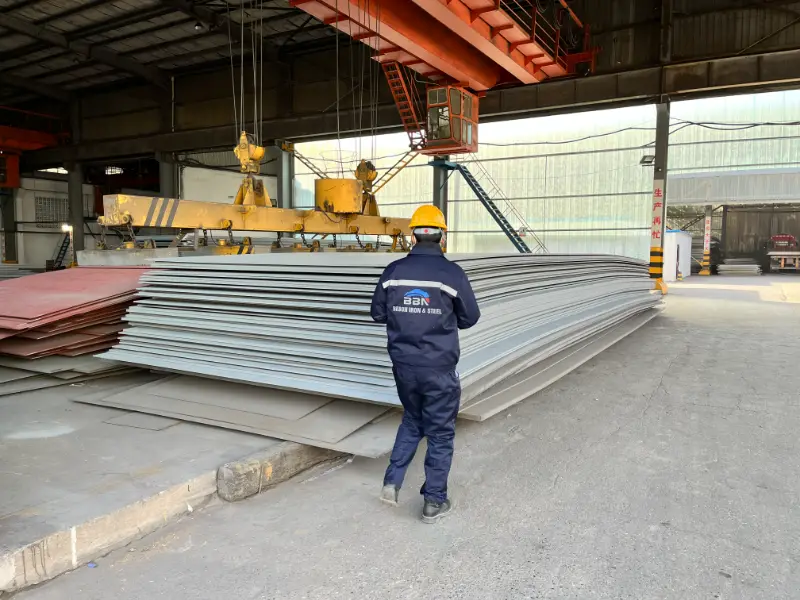
ASTM A537 Class 1 (A537CL1) Pressure Vessel Steel Plate
ASTM A537 Class 1 (A537CL1) Pressure Vessel Steel Plate - Composition, Properties & Applications
Complete technical data for ASTM A537 Class 1 (A537CL1) pressure vessel and boiler steel plate: chemical composition, mechanical and thermal properties, international equivalents, application guidance, and delivery condition.
Welding, hot forming, cold forming, machining, cutting, bending
- Phone : +8618037372205
- Email : [email protected]
- WhatsApp: Contact via Whtsapp
- WeChat: +8618037372205
ASTM A537 Class 1 Pressure Vessel Steel Plate Introduction
ASTM A537 Class 1 (A537CL1) is a quenched and tempered (Q&T) carbon-silicon steel plate primarily used for welded pressure vessels and boilers in moderate and lower temperature service. It offers an excellent combination of strength and toughness, with a minimum yield strength of 345 MPa (50 ksi) and tensile strength in the range of 485–620 MPa (70–90 ksi) for most thicknesses. The steel is produced to fine grain practice and exhibits good weldability and formability. Class 1 is the baseline grade of the A537 specification, which also includes Class 2 (for lower temperature notch toughness) and Class 3 (higher strength). Typical applications include storage tanks, heat exchangers, reactor vessels, and industrial boilers. The steel is delivered in the quenched and tempered condition, ensuring uniform mechanical properties through the thickness. Optional Charpy V-notch impact testing can be specified to verify toughness at sub-zero temperatures.
ASTM A537 Class 1 Pressure Vessel Steel Plate Chemical Composition
The following chemical composition applies to ASTM A537 Class 1 plates. Manganese content is adjusted according to plate thickness to ensure adequate strength and hardenability. All other elements are controlled as residuals and comply with ASTM A20/A20M general requirements.
| Element | Standard Value (max unless range) | Remarks |
|---|---|---|
| Carbon (C) | ≤0.24 | Heat analysis |
| Manganese (Mn) | 0.70–1.35 (thickness ≤ 40 mm) / 1.00–1.60 (thickness > 40 mm) | Range depends on plate thickness |
| Phosphorus (P) | ≤0.035 | |
| Sulfur (S) | ≤0.035 | |
| Silicon (Si) | 0.15–0.50 | For killed steel, fine grain practice |
| Copper (Cu) | ≤0.35 | Residual; not intentionally added |
| Nickel (Ni) | ≤0.25 | Residual |
| Chromium (Cr) | ≤0.25 | Residual |
| Molybdenum (Mo) | ≤0.08 | Residual |
| Vanadium (V) | ≤0.02 | Residual |
| Niobium (Nb) | ≤0.02 | Residual |
| Titanium (Ti) | ≤0.03 | Residual |
| Aluminum (Al) | ≥0.020 total aluminum or equivalent fine grain practice | For grain refinement |
ASTM A537 Class 1 Pressure Vessel Steel Plate Thermal and Electrical Physical Properties
The following physical properties are typical for ASTM A537 Class 1 steel in the quenched and tempered condition. Actual values may vary slightly depending on exact composition and heat treatment. These reference data are suitable for engineering calculations.
| Property | Typical Value | Unit | Test Condition |
|---|---|---|---|
| Density (ρ) | 7.85 | g/cm³ | Room temperature |
| Elastic Modulus (E) | 200 | GPa | Ambient temperature |
| Shear Modulus (G) | 77 | GPa | Calculated from E and ν |
| Poisson's Ratio (ν) | 0.30 | — | Ambient temperature |
| Thermal Expansion Coefficient (α) | 11.7 | µm/m·°C | 0–100 °C |
| Thermal Conductivity (λ) | 52 | W/m·K | At 100 °C |
| Specific Heat Capacity (c) | 470 | J/kg·K | At 20 °C |
| Electrical Resistivity (ρ_e) | 0.17 | µΩ·m | At 20 °C |
ASTM A537 Class 1 Pressure Vessel Steel Plate Mechanical Properties
Tensile and yield strength values vary with plate thickness as indicated. Elongation requirements differ for 8-inch (200 mm) and 2-inch (50 mm) gauge lengths. Bend test is mandatory for plates up to 40 mm thick. Charpy V-notch impact testing is optional and performed only when specified by the purchaser.
| Property | Standard Requirement | Unit | Test Condition / Thickness |
|---|---|---|---|
| Tensile Strength (Rm) | 485–620 (70–90) | MPa (ksi) | ≤65 mm (2.5 in.) |
| Tensile Strength (Rm) | 450–585 (65–85) | MPa (ksi) | >65 to ≤150 mm (2.5–6 in.) |
| Yield Strength (ReH) | ≥345 (50) | MPa (ksi) | ≤65 mm (2.5 in.) |
| Yield Strength (ReH) | ≥310 (45) | MPa (ksi) | >65 to ≤150 mm (2.5–6 in.) |
| Elongation (A) in 8 in. (200 mm) | ≥20 | % | ≤65 mm (2.5 in.) |
| Elongation (A) in 8 in. (200 mm) | ≥18 | % | >65 to ≤150 mm (2.5–6 in.) |
| Elongation (A) in 2 in. (50 mm) | ≥23 | % | ≤65 mm (2.5 in.) |
| Elongation (A) in 2 in. (50 mm) | ≥22 | % | >65 to ≤150 mm (2.5–6 in.) |
| Bend Test (180°) | No cracks on outside of bent portion | — | Thickness ≤40 mm; pin diameter = 2× plate thickness |
| Charpy V-notch Impact (KV) (optional) | Typical ≥27 J at -12 °C (10 °F) | J (ft·lb) | Transverse specimen; value by agreement |
ASTM A537 Class 1 Pressure Vessel Steel Plate Direct Equivalent Standards and Replaceable Grades
| Country/Region | Standard | Grade | Remarks |
|---|---|---|---|
| USA | ASME SA537 Class 1 | SA537CL1 | Identical to ASTM A537 Class 1; for ASME pressure vessels |
| Europe | EN 10028-2:2017 | P355GH | Similar strength level; fine grain pressure vessel steel, may require impact testing |
| Japan | JIS G3115 | SPV355 | Comparable yield and tensile ranges; for pressure vessels |
| China | GB/T 713-2014 | Q345R | Equivalent yield strength; widely used in Chinese pressure vessel industry |
| International | ISO 9328-2:2018 | P355GH | Harmonized with EN P355GH; suitable alternative |
ASTM A537 Class 1 Pressure Vessel Steel Plate Application Introduction
ASTM A537 Class 1 is a versatile pressure vessel steel suited for applications requiring moderate strength and good fabrication properties. It is commonly used in the chemical, petrochemical, and power industries. The steel can be formed, welded, and machined using conventional methods. Pre-heating and post-weld heat treatment may be required to avoid hydrogen cracking, especially in thick sections.
Product Applications: Pressure vessels (ASME code vessels, storage bullets), Industrial boilers (shells, drums), Heat exchangers (shell and tube, plate heat exchangers), Storage tanks (spheres, cylindrical tanks), Process piping (high-pressure line pipe, fittings), Hydropower equipment (penstocks, spiral cases)
Processed into products: Vessel shells (rolled and welded cylinders), Heads (dished, ellipsoidal, hemispherical), Nozzles and manways, Flanges (welding neck, slip-on), Baffles and support plates, Tube sheets, Stiffening rings, Base plates and saddles
Application industries: Oil & Gas (refining, LNG storage, gas processing), Chemical Processing (reactors, columns, heat exchangers), Power Generation (boiler drums, high-pressure vessels, steam headers), Water Treatment (pressure filters, storage tanks), Shipbuilding (cargo tanks, LPG carriers), Mining and Minerals (autoclaves, digesters)
ASTM A537 Class 1 Pressure Vessel Steel Plate Similar or Closely Related Steels
| Country/Region | Standard | Grade | Remarks |
|---|---|---|---|
| USA | ASTM A516/A516M | Grade 70 | Normalized carbon steel for pressure vessels; lower yield (260 MPa) and lower tensile strength (485–620 MPa) |
| USA | ASTM A537/A537M | Class 2 | Superior notch toughness for lower temperatures; similar strength |
| USA | ASTM A537/A537M | Class 3 | Higher tensile and yield strength (≥415 MPa yield) for thicker sections |
| Europe | EN 10028-3 | P355N | Normalized fine grain steel; similar strength but different delivery condition |
| Japan | JIS G3115 | SPV450 | Higher strength alternative; 450 MPa tensile class |
Notes:
- Welding: Common processes include SMAW, SAW, GMAW, and FCAW. Preheating to 150–200 °C is recommended for thicknesses over 25 mm. Post-weld heat treatment (stress relieving) at 600–650 °C is often applied to reduce residual stresses.
- Impact testing: While not mandatory, Charpy V-notch impact testing can be specified (e.g., 27 J at -20 °C) to comply with specific pressure vessel design codes.
- Nondestructive examination: Ultrasonic testing (UT) or radiographic testing (RT) may be required per ASTM A20/A20M supplementary requirements.
- Surface condition: Plates are typically supplied with a hot-rolled, oiled, or blast-cleaned surface. Mill scale removal and priming are available upon request.
- Certification: Material is certified to ASTM A537/A537M and can be dual-certified to ASME SA537 when requested.
- Thickness tolerance: Conforms to ASTM A20/A20M general requirements for thickness and flatness.
- Share



