
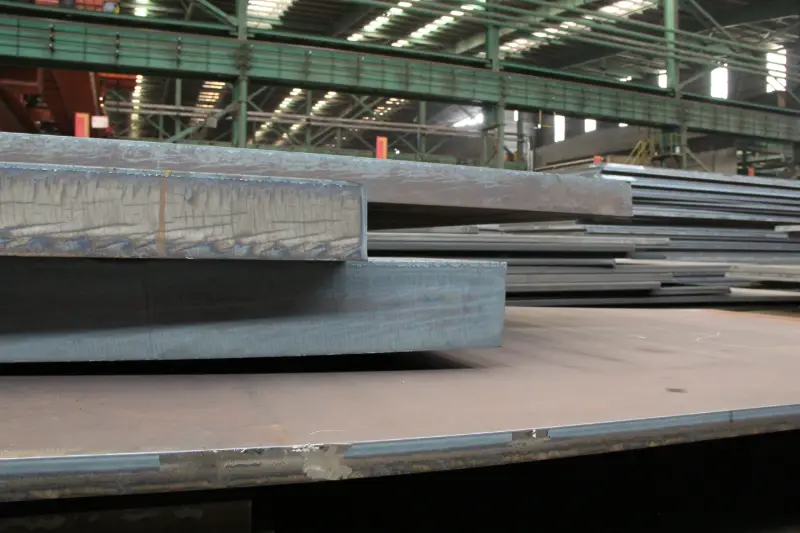
ASTM A612M Steel Plate
ASTM A612M Steel Plate: High-Strength Carbon Steel for Boilers & Pressure Vessels
Comprehensive data on ASTM A612M pressure vessel steel plate: chemical composition, mechanical and physical properties, international equivalents, and application guidance.
Hot rolling, normalizing, stress relieving, cutting, forming, welding
- Phone : +8618037372205
- Email : [email protected]
- WhatsApp: Contact via Whtsapp
- WeChat: +8618037372205
ASTM A612M Steel Plate Introduction
ASTM A612M is a specification for high-strength carbon-manganese-silicon steel plates intended for welded pressure vessels in moderate and lower temperature service. This steel offers excellent strength and weldability, making it suitable for boilers, storage tanks, and process equipment. Key features include:
- Elevated yield and tensile strengths compared to standard carbon steel grades
- Good notch toughness at low temperatures (when impact tested per supplementary requirements)
- Available in multiple strength levels (Grade A, B, C, D)
- Typically supplied in normalized or stress-relieved condition
The plates are produced by open-hearth, basic-oxygen, or electric-furnace processes and may undergo heat treatment as agreed between purchaser and manufacturer. They are widely used in the power generation, petrochemical, and general engineering industries.
ASTM A612M Steel Plate Chemical Composition
The following table lists the chemical requirements for ASTM A612 Grade B as per ASTM A612/A612M. Values are maximum unless a range is given. The steel is fully killed and made to fine grain practice, ensuring uniform properties and good weldability. Nb, V, Ti may be present as grain refiners.
| Element | Standard Value (%) | Remarks |
|---|---|---|
| C | ≤0.25 | For plate thickness ≤25 mm (1 in.) |
| Mn | 1.00 - 1.50 | For plates ≤25 mm; slightly lower for thicker plates |
| P | ≤0.035 | |
| S | ≤0.040 | |
| Si | 0.15 - 0.50 | Killed steel, fine grain practice |
| Cu | ≥0.20 (if specified) | Optional; may be required for improved atmospheric corrosion resistance |
| Ni | ≤0.25 | Residual element limit |
| Cr | ≤0.25 | Residual element limit |
| Mo | ≤0.08 | Residual element limit |
| V | ≥0.01 (if used for grain refining) | Microalloying permitted |
| Nb | ≥0.005 (if used for grain refining) | Microalloying permitted |
ASTM A612M Steel Plate Thermal and Electrical Physical Properties
The following physical properties are typical for carbon-manganese steel and are provided for engineering reference. They are not mandatory per ASTM A612 but are useful for design calculations. Values may vary slightly with heat treatment and exact composition.
| Property | Typical Value | Unit | Temperature / Condition |
|---|---|---|---|
| Density (ρ) | 7800 | kg/m³ | At 20°C |
| Modulus of Elasticity (E) | 205 | GPa | At 20°C |
| Shear Modulus (G) | 80 | GPa | At 20°C |
| Poisson's Ratio (ν) | 0.29 | – | At 20°C |
| Thermal Expansion Coefficient (α) | 12.0 | 10⁻⁶/K | 20 - 200°C |
| Thermal Expansion Coefficient (α) | 12.8 | 10⁻⁶/K | 20 - 400°C |
| Thermal Conductivity (λ) | 51 | W/(m·K) | At 20°C |
| Thermal Conductivity (λ) | 42 | W/(m·K) | At 300°C |
| Specific Heat Capacity | 470 | J/(kg·K) | At 20°C |
| Electrical Resistivity (ρₑ) | 0.22 | µΩ·m | At 20°C |
ASTM A612M Steel Plate Mechanical Properties
Mechanical properties of ASTM A612 Grade B in normalized condition for plate thickness ≤50 mm. Data compiled from standard requirements and typical mill test reports. Impact tests are often required as supplementary (e.g., at -20°C or -40°C).
| Property | Standard Requirement | Unit | Test Condition |
|---|---|---|---|
| Tensile Strength (Rm) | 560 - 695 | MPa | Ambient, transverse specimen |
| Yield Strength (ReH) | ≥345 | MPa | 0.2% offset, ambient |
| Elongation (A) | ≥21 (in 200 mm) | % | Gauge length 200 mm (8 in.) |
| Elongation (A) | ≥27 (in 50 mm) | % | Gauge length 50 mm (2 in.) for narrower specimens |
| Bend Test | No cracks | – | 180° bend, diameter = 3t (t = plate thickness) |
| Impact Energy (KV) - typical | ≥27 J (optional) | J | At -20°C, Charpy V-notch, as per S5.1 |
ASTM A612M Steel Plate Direct Equivalent Standards and Replaceable Grades
| Country/Region | Standard | Grade | Remarks |
|---|---|---|---|
| Europe | EN 10028-3 | P355NH | Normalized, similar chemical and mechanical properties |
| International | ISO 9328-2 | P355NH | Harmonized grade equivalent to EN P355NH |
| Japan | JIS G3115 | SPV355 | Carbon steel for pressure vessels; compare thickness limits |
| China | GB/T 713 | Q345R | Comparable yield strength, but may require careful evaluation of toughness |
ASTM A612M Steel Plate Application Introduction
ASTM A612 Grade B plates are designed for welded pressure vessels operating at moderate to lower temperatures. The high strength-to-weight ratio enables lighter construction, while good notch toughness (when specified) ensures safety against brittle fracture. Common applications include:
- Steam boilers and economizers
- Compressed air receivers
- Cryogenic storage tanks (with appropriate impact testing)
- Petrochemical reactors and columns
- Heat exchangers and condensers
Fabrication involves welding (with preheat and post-weld heat treatment as required), rolling, pressing, and machining. The material can be formed into heads, shells, and other pressure-retaining components.
Product Applications: Welded pressure vessels and boilers, Storage tanks for liquefied gases, Heat exchanger shells and channels, Industrial autoclaves and sterilizers, Pulverized coal injection vessels
Processed into products: Shell courses and heads (dished ends, hemispherical), Nozzle reinforcements and flanges, Tube sheets for heat exchangers, Support skirts and saddles, Baffles and partition plates
Application industries: Power generation (boilers, heat recovery steam generators), Oil and gas (pressure vessels, separators, storage tanks), Chemical and petrochemical (reactors, columns, autoclaves), Fabricated metal products (tanks, silos, process equipment)
ASTM A612M Steel Plate Similar or Alternative Material Recommendations
| Country/Region | Standard | Grade | Remarks |
|---|---|---|---|
| USA | ASTM A516/A516M | Grade 70 | Lower strength (Rm 485–620 MPa), excellent low-temperature toughness |
| USA | ASTM A537/A537M | Class 1 | Quenched and tempered carbon-manganese-silicon steel, higher strength |
| Europe | EN 10028-3 | P275NH | Lower strength level, good weldability, suitable for less demanding applications |
| Europe | EN 10028-3 | P460NH | Higher strength (Rm 570–720 MPa), for pressure vessels with elevated requirements |
Notes:
Supplementary requirements of ASTM A612/A612M must be specified at the time of order if additional testing is needed, such as:
- Charpy V-notch impact tests at specific temperatures (S5)
- Ultrasonic examination for internal soundness (S8)
- Restricted chemistry for improved weldability or HIC resistance
The material is generally weldable with low-hydrogen processes. Preheating may be necessary for thicker sections. Consult the standard for limits on plate dimensions and tolerances. For service below -20°C, tougher grades (e.g., ASTM A516 Gr.70) or nickel-alloyed steels are often preferred.
- Share



