
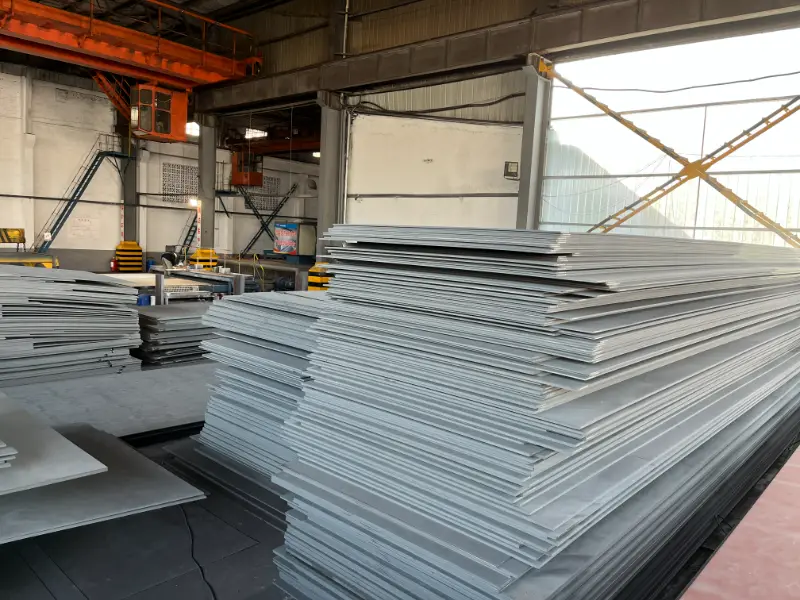
ASTM A387 Grade 12 Class 1 (A387GR12CL1)
ASTM A387 Grade 12 Class 1 (A387GR12CL1) - Cr-Mo Alloy Steel Plate for Pressure Vessels & Boilers
Full property profile of ASTM A387 Grade 12 Class 1 (1Cr-0.5Mo) pressure vessel plate including chemical composition, mechanical & physical data, equivalent grades and application guidance.
Hot rolling, followed by normalizing and tempering
- Phone : +8618037372205
- Email : [email protected]
- WhatsApp: Contact via Whtsapp
- WeChat: +8618037372205
ASTM A387 Grade 12 Class 1 Introduction
ASTM A387 Grade 12 Class 1 is a chromium-molybdenum (1Cr-0.5Mo) alloy steel plate intended for elevated-temperature service in welded boilers and pressure vessels. It is supplied in the normalized and tempered condition, providing a fine-grained microstructure with good resistance to hydrogen attack, oxidation and creep.
- Minimum yield strength of 230 MPa (33 ksi) at room temperature
- Anti-corrosion and heat-resistant properties up to ~500 °C
- Excellent weldability with proper pre- and post-weld heat treatment
- Widely used in petrochemical, power generation and chemical processing industries
ASTM A387 Grade 12 Class 1 Chemical Composition
The chemical requirements for ASTM A387 Grade 12 Class 1 are taken from the product standard. The steel is essentially a 1Cr-0.5Mo composition with tight control of residuals for high-temperature integrity. Phosphorus and sulfur are kept low to ensure good toughness and weldability.
| Element | Content (%) | Remarks |
|---|---|---|
| Carbon (C) | 0.05 – 0.17 | Heat analysis |
| Manganese (Mn) | 0.40 – 0.65 | |
| Phosphorus (P) | ≤ 0.025 | |
| Sulfur (S) | ≤ 0.025 | |
| Silicon (Si) | 0.15 – 0.40 | |
| Chromium (Cr) | 0.80 – 1.15 | Key alloying element for strength and creep resistance |
| Molybdenum (Mo) | 0.45 – 0.60 | Enhances high-temperature strength and hardenability |
ASTM A387 Grade 12 Class 1 Thermal & Electrical Physical Properties
These physical properties represent typical values for 1Cr-0.5Mo alloy steel at room temperature, unless stated otherwise. They are not part of the ASTM A387 specification but are widely accepted for design calculations.
| Property | Typical Value | Unit | Condition / Temperature |
|---|---|---|---|
| Density (ρ) | 7.85 | g/cm³ | 20 °C |
| Modulus of Elasticity (E) | 200 – 210 | GPa | RT |
| Shear Modulus (G) | 80 | GPa | RT |
| Poisson's Ratio (ν) | 0.30 | — | RT |
| Coefficient of Thermal Expansion (α) | 11.2 × 10⁻⁶ | K⁻¹ | 20–100 °C |
| Thermal Conductivity (λ) | 44 | W/(m·K) | 100 °C |
| Specific Heat Capacity | 460 | J/(kg·K) | 20 °C |
| Electrical Resistivity (ρe) | ~0.25 × 10⁻⁶ | Ω·m | 20 °C |
ASTM A387 Grade 12 Class 1 Mechanical Properties
The following tensile properties are specified by ASTM A387 for plates in the normalized and tempered condition. Values apply for thicknesses ≤ 50 mm (2 in.). For thicker material, the requirements may be adjusted; consult the standard. No mandatory impact test is required unless separately agreed.
| Property | Specified Value | Unit | Test Condition |
|---|---|---|---|
| Yield Strength (ReH) | ≥ 230 | MPa | Room temperature, 0.2% offset |
| Tensile Strength (Rm) | 380 – 550 | MPa | |
| Elongation (A), 2 in. (50 mm) gauge | ≥ 22 | % | Longitudinal, thickness ≤ 50 mm |
| Elongation (A), 8 in. (200 mm) gauge | ≥ 18 | % | Longitudinal, thickness ≤ 50 mm |
ASTM A387 Grade 12 Class 1 Completely Equivalent Material Standards & Substitute Grades
| Country / Region | Standard | Designation / Grade | Remarks |
|---|---|---|---|
| USA | ASME SA-387 | Grade 12 Class 1 | Identical to ASTM A387 – ASME boiler code edition |
| Europe | EN 10028-2 | 13CrMo4-5 (1.7335) | Direct equivalent in high-temperature pressure vessel steel |
| Japan | JIS G4109 | SCMV 2 | Cr-Mo steel for boilers and pressure vessels |
| China | GB/T 713 | 15CrMoR | Same nominal composition; minor differences in tolerance |
| Germany (historical) | DIN 17155 | 13CrMo44 | Superseded; 13CrMo4-5 is the replacement |
| ISO | ISO 9328-2 | 13CrMo4-5 | International equivalent |
ASTM A387 Grade 12 Class 1 Application Introduction
ASTM A387 Grade 12 Class 1 is a versatile Cr-Mo alloy steel plate employed where moderate high-temperature strength, resistance to hydrogen attack and steam oxidation are required. It is widely fabricated into pressure-containing equipment.
Product Applications: Process pressure vessels (separators, reactors, columns), Steam boilers and superheaters, Shell-and-tube heat exchangers, Hot-wall hydrogen service equipment, Coke drums and hydrocracking reactors, High-temperature piping and headers
Processed into products: Shell plates and courses, Dished heads (ellipsoidal, hemispherical), Tube sheets and baffles, Integrally clad or weld-overlay plates, Manway covers and flanges, Bends and elbows (fabricated from plate), Transition pieces and support rings
Application industries: Petrochemical & Refining, Power Generation (fossil, nuclear, concentrated solar), Oil & Gas (onshore & offshore), Chemical & Fertilizer Plants, Industrial Boiler Manufacturing
ASTM A387 Grade 12 Class 1 Similar / Alternative Alloy Steel Grades for Elevated Temperature Service
| Country / Region | Standard | Designation | Remarks |
|---|---|---|---|
| USA | ASTM A387 | Grade 12 Class 2 | Higher strength class (min YS 275 MPa) – same chemistry, different heat treatment |
| USA | ASTM A387 | Grade 11 Class 1 | 1.25Cr-0.5Mo steel – slightly higher Cr, similar high-temperature applications |
| USA | ASTM A387 | Grade 22 Class 1 | 2.25Cr-1Mo steel – higher Cr content for better hydrogen and oxidation resistance |
| Europe | EN 10028-2 | 16Mo3 | Lower alloy content (0.3% Mo) – used for moderate temperatures |
| Japan | JIS G4109 | SCMV 3 | Higher Mo variant for increased creep strength |
Notes:
Fabrication considerations: This grade requires preheating (typically 150–300 °C) before welding and post-weld heat treatment (PWHT) at 620–680 °C to relieve stresses and reduce hardness. It exhibits good formability and machinability in the normalized and tempered condition. Corrosion allowance should be considered in hydrogen service; the steel is susceptible to temper embrittlement if cooled slowly through 400–600 °C, so rapid cooling after tempering is often practiced. Service temperature is generally limited to approximately 540 °C (1000 °F) depending on design codes.
- Share



