
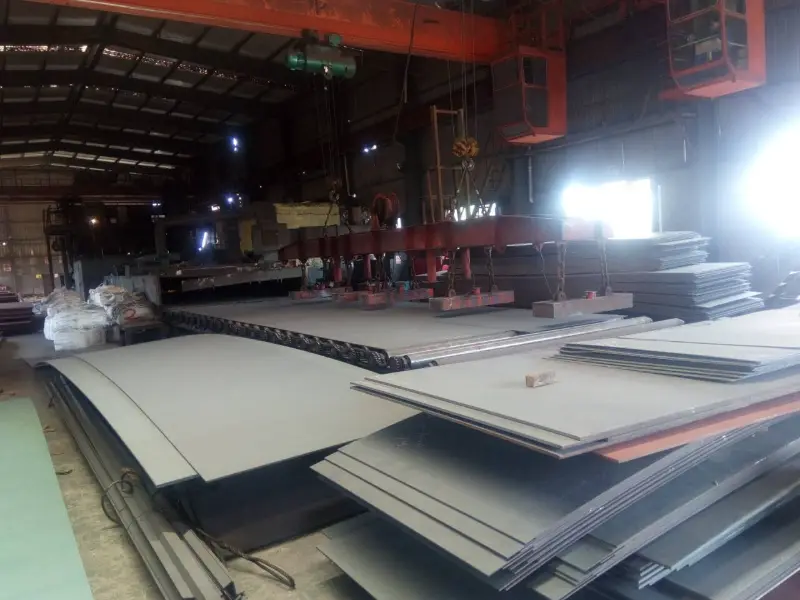
ASTM A387 Grade 12 Class 2 (A387GR12CL2) Pressure Vessel And Boiler Steel Plate
ASTM A387 Grade 12 Class 2 (A387GR12CL2) Pressure Vessel And Boiler Steel Plate -
Complete technical data for ASTM A387 Grade 12 Class 2 steel plate: chemical composition, mechanical and thermal properties, international equivalents, and application guidance for pressure vessels and boilers.
Hot rolling, normalizing, tempering, quenching, welding, cutting, forming
- Phone : +8618037372205
- Email : [email protected]
- WhatsApp: Contact via Whtsapp
- WeChat: +8618037372205
ASTM A387 Grade 12 Class 2 Pressure Vessel And Boiler Steel Plate Introduction
ASTM A387 Grade 12 Class 2 (A387GR12CL2) is a chromium-molybdenum alloy steel plate intended for welded pressure vessels and boilers at elevated temperatures. It belongs to the 1% Cr – 0.5% Mo family and offers excellent resistance to hydrogen attack and good high-temperature strength. This grade is typically supplied in the normalized and tempered condition and is widely used in petrochemical, power generation, and process industries. Class 2 indicates a higher minimum tensile strength level compared to Class 1, making it suitable for demanding structural integrity requirements.
ASTM A387 Grade 12 Class 2 Pressure Vessel And Boiler Steel Plate Chemical Composition
Chemical composition according to ASTM A387/A387M, heat analysis. The alloying elements chromium and molybdenum provide improved high-temperature strength and resistance to hydrogen attack.
| Element | Standard Value (%) | Remarks |
|---|---|---|
| Carbon (C) | 0.05 – 0.17 | Heat analysis |
| Manganese (Mn) | 0.40 – 0.65 | Heat analysis |
| Phosphorus (P) | ≤ 0.025 | |
| Sulfur (S) | ≤ 0.025 | |
| Silicon (Si) | 0.40 – 0.65 | Heat analysis |
| Chromium (Cr) | 0.80 – 1.15 | Key alloying element |
| Molybdenum (Mo) | 0.45 – 0.60 | Key alloying element |
ASTM A387 Grade 12 Class 2 Pressure Vessel And Boiler Steel Plate Thermal and Electrical Physical Properties
Typical physical properties for 1Cr-0.5Mo steel at room temperature and elevated temperatures. These values are for reference and can vary slightly with actual composition and heat treatment.
- Density, elastic modulus, and Poisson's ratio are provided at 20°C.
- Thermal expansion, thermal conductivity, and specific heat are given over a temperature range.
| Property | Typical Value | Unit | Temperature / Condition |
|---|---|---|---|
| Density (ρ) | 7.85 | g/cm³ | 20°C |
| Elastic Modulus (E) | 200 – 210 | GPa | 20°C |
| Shear Modulus (G) | 80 | GPa | 20°C (calculated) |
| Poisson's Ratio (ν) | 0.30 | — | 20°C |
| Thermal Expansion (α) | 11.2 / 11.9 / 12.5 / 12.9 / 13.3 | 10⁻⁶/K | 20–100°C / 20–200°C / 20–300°C / 20–400°C / 20–500°C |
| Thermal Conductivity (λ) | 42 / 41 / 39 / 37 / 35 | W/(m·K) | 100°C / 200°C / 300°C / 400°C / 500°C |
| Specific Heat Capacity | 460 | J/(kg·K) | 20–100°C average |
| Electrical Resistivity (ρe) | 0.25 | μΩ·m | 20°C |
ASTM A387 Grade 12 Class 2 Pressure Vessel And Boiler Steel Plate Mechanical Properties
Tensile properties for ASTM A387 Grade 12 Class 2 plates in normalized and tempered condition, based on standard requirements. Tests are performed at room temperature.
- Values apply to plate thickness ≤ 50 mm (2 in.). For greater thickness, requirements may be modified as per the standard.
- Elongation is measured in a 50 mm (2 in.) gauge length.
| Property | Standard Value | Unit | Test Condition |
|---|---|---|---|
| Tensile Strength (Rm) | 450 – 585 | MPa | Room temperature |
| Yield Strength (ReH) | ≥ 275 | MPa | 0.2% offset |
| Elongation (A) | ≥ 22 | % | 50 mm gauge length (plate thickness ≤ 50 mm) |
ASTM A387 Grade 12 Class 2 Pressure Vessel And Boiler Steel Plate Exact Equivalent Material Standards and Substitutable Grades
| Country / Region | Standard | Grade | Remarks |
|---|---|---|---|
| USA | ASME SA-387/SA-387M | Grade 12 Class 2 | Identical to ASTM A387 Gr.12 Cl.2 for ASME pressure vessel construction |
| Europe | EN 10028-2 | 13CrMo4-5 | Comparable 1Cr-0.5Mo grade; minor difference in Mn and Si ranges |
| Japan | JIS G4109 | SCMV 3-2 | Boiler and pressure vessel Cr-Mo steel plate |
| International | ISO 9328-2 | 13CrMo4-5 | Same designation as EN, widely recognized |
ASTM A387 Grade 12 Class 2 Pressure Vessel And Boiler Steel Plate Application Introduction
ASTM A387 Grade 12 Class 2 is specifically designed for welded pressure vessels and boilers operating at elevated temperatures. Its chromium-molybdenum composition provides excellent resistance to hydrogen attack and maintains strength up to approximately 500°C. Typical delivery condition is normalized and tempered, providing a good balance of strength and toughness.
- Excellent weldability following standard Cr-Mo welding procedures, usually requiring preheating and post-weld heat treatment.
- Suitable for hydrogen service applications due to its resistance to high-temperature hydrogen attack (HTHA).
Product Applications: Pressure vessels and storage tanks, Industrial boilers and steam generators, Heat exchangers and condensers, Reactors and columns (hydrotreaters, catalytic crackers), High-temperature piping components
Processed into products: Shells, heads, and transition pieces for pressure vessels, Tube sheets and baffles for heat exchangers, Boiler drums and water walls, Flanges and pipe fittings for high-temperature service, Structural parts in hot-wall reactors
Application industries: Petrochemical and refinery, Power generation (boilers, steam drums), Oil and gas processing, Chemical process equipment, Fertilizer and syngas plants
ASTM A387 Grade 12 Class 2 Pressure Vessel And Boiler Steel Plate Similar / Alternative Materials Recommendation
| Country / Region | Standard | Grade | Remarks |
|---|---|---|---|
| USA | ASTM A387 | Grade 11 Class 2 | 1.25Cr-0.5Mo steel, similar high-temperature properties, higher Cr content |
| USA | ASTM A387 | Grade 22 Class 2 | 2.25Cr-1Mo steel, higher strength at elevated temperatures, better hydrogen resistance |
| China | GB/T 713 | 15CrMoR | 1Cr-0.5Mo pressure vessel steel, widely used in China |
| Europe | EN 10028-2 | 16Mo3 | 0.3% Mo steel, lower Cr content, used for less demanding elevated temperature service |
Notes:
Additional Information:
- The material is normally supplied with a test certificate according to EN 10204 or ASTM A20.
- Impact testing is not mandatory unless specified by supplementary requirements (e.g., SA-387 with Charpy V-notch testing).
- For thicknesses above 50 mm, mechanical property requirements should be agreed between purchaser and supplier.
- Post-weld heat treatment (PWHT) is typically required to restore mechanical properties and reduce residual stresses.
- Share



