
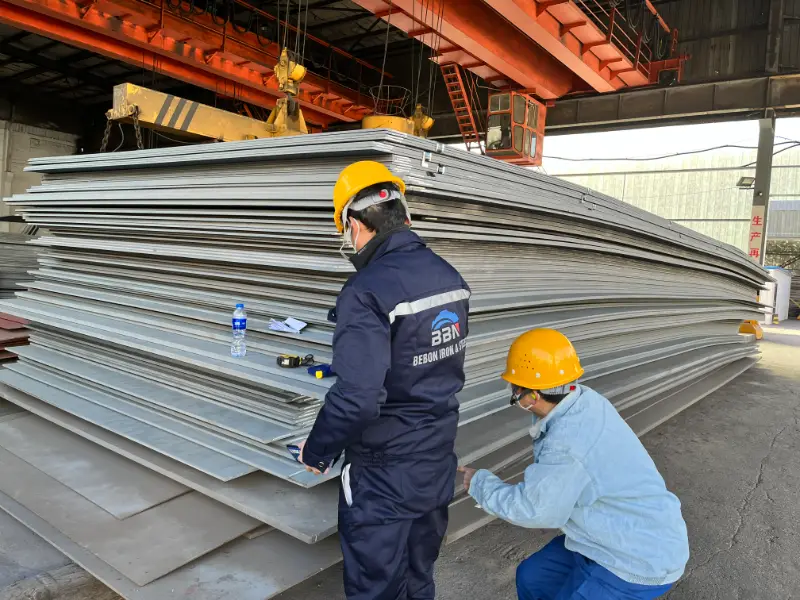
Q310GNH Weather Resistant Steel Plate
Q310GNH Weather Resistant Steel Plate: Composition, Properties & Equivalents (GB/T 4171)
Complete property data for Q310GNH steel under GB/T 4171 standard, including chemistry, mechanics, physics, international equivalents, and application examples.
Hot rolling, cold forming, machining, welding (with matching consumables), painting (optional)
- Phone : +8618037372205
- Email : [email protected]
- WhatsApp: Contact via Whtsapp
- WeChat: +8618037372205
Q310GNH Weather Resistant Steel Plate Introduction
Q310GNH is a high-strength low-alloy structural steel with enhanced atmospheric corrosion resistance, classified as a high weather-resistant steel under GB/T 4171-2008. It contains alloying elements such as copper, chromium, nickel, and phosphorus, which promote the formation of a dense, protective oxide layer (patina) during outdoor exposure, significantly slowing further corrosion. The minimum yield strength is 310 MPa, making it suitable for welded, bolted, and riveted constructions subjected to moderate load.
- Excellent weathering in unpainted condition after proper exposure
- Good cold formability and weldability with proper procedures
- Widely used in building facades, bridges, railway vehicles, and landscape architecture
Q310GNH Weather Resistant Steel Plate Chemical Composition as per GB/T 4171-2008 for Q310GNH
The chemical composition is designed to achieve weathering characteristics through controlled additions of Cu, Cr, Ni, and P. Maximum limits for carbon ensure good weldability, while sulfur and phosphorus are kept low for toughness. Aluminium is added as a deoxidizer. All data are in weight percent based on heat analysis.
| Element | Value (wt.%) | Remarks |
|---|---|---|
| C | ≤0.12 | Improves strength; kept low for weldability |
| Si | 0.20 – 0.75 | Deoxidizer, strength enhancer |
| Mn | ≤1.00 | Contributes to strength and hardenability |
| P | ≤0.020 | Maintaining low level to avoid embrittlement |
| S | ≤0.020 | Low sulfur for improved formability and toughness |
| Cu | 0.25 – 0.50 | Key element for corrosion resistance |
| Cr | 0.30 – 1.25 | Promotes protective patina formation |
| Ni | ≤0.65 | Enhances corrosion resistance and toughness |
| Alt (acid soluble Al) | ≥0.020 | Deoxidation and grain refinement |
Q310GNH Weather Resistant Steel Plate Thermal & Electrical Physical Properties
The following physical properties are typical for tempered Q310GNH type weathering steel at room temperature. These values are not given in GB/T 4171 but are widely accepted reference data for similar low-alloy steels. They are relevant for structural design, thermal expansion calculations, and electrical applications.
| Physical Property | Typical Value | Unit | Test Condition / Remarks |
|---|---|---|---|
| Density (ρ) | 7.85 | g/cm³ | At 20°C |
| Elastic Modulus (E) | 206 | GPa | At room temperature, longitudinal |
| Shear Modulus (G) | 79.3 | GPa | Calculated from E and ν |
| Poisson's Ratio (ν) | 0.30 | – | Typical for steel |
| Thermal Expansion Coefficient (α) | 12.0 | ×10⁻⁶ /K | Average for 20–100°C |
| Thermal Conductivity (λ) | 45 | W/(m·K) | At 20°C |
| Specific Heat Capacity | 460 | J/(kg·K) | At 20°C |
| Electrical Resistivity (ρe) | 0.25 | ×10⁻⁶ Ω·m | At 20°C |
Q310GNH Weather Resistant Steel Plate Mechanical Properties as per GB/T 4171-2008 for Q310GNH
The mechanical properties are guaranteed in the delivery condition (hot-rolled or normalized). Yield strength, tensile strength, and elongation values vary with product thickness. Impact requirements are specified at -20°C in longitudinal direction. Bend test ensures adequate ductility for cold forming.
| Property | Typical / Required Value | Unit | Test Condition / Remarks |
|---|---|---|---|
| Yield Strength (ReH) | ≥310 | MPa | Thickness ≤ 16 mm |
| Yield Strength (ReH) | ≥295 | MPa | Thickness > 16 – 40 mm |
| Yield Strength (ReH) | ≥285 | MPa | Thickness > 40 – 60 mm |
| Tensile Strength (Rm) | ≥460 | MPa | Thickness ≤ 16 mm |
| Tensile Strength (Rm) | ≥450 | MPa | Thickness > 16 – 40 mm |
| Tensile Strength (Rm) | ≥430 | MPa | Thickness > 40 – 60 mm |
| Elongation (A) | ≥20 | % | Thickness ≤ 16 mm, gauge length 5.65√So |
| Elongation (A) | ≥19 | % | Thickness > 16 – 40 mm |
| Elongation (A) | ≥19 | % | Thickness > 40 – 60 mm |
| Impact Energy (KV2) | ≥27 | J | -20°C, longitudinal Charpy V-notch, standard specimen |
| Bend Test (180°) | d = a | – | Thickness ≤ 6 mm, d = bending diameter, a = specimen thickness |
| Bend Test (180°) | d = 2a | – | Thickness > 6 – 16 mm |
| Bend Test (180°) | d = 3a | – | Thickness > 16 mm |
Q310GNH Weather Resistant Steel Plate Direct International Equivalents of Q310GNH
| Country/Region | Standard | Grade | Remarks |
|---|---|---|---|
| Europe | EN 10025-5:2004 | S355J0WP (1.8945) / S355J2WP (1.8946) | Higher minimum yield (355 MPa) but similar weathering concept; chemistry differ slightly |
| Japan | JIS G3125:2004 | SPA-H (SPA-HP325) | Corrosion-resistant hot-rolled steel; comparable in atmospheric corrosion resistance, strength values may vary |
| United States | ASTM A588/A588M | Grade A (Type 1) / Grade C | High-strength low-alloy structural steel with 50 ksi yield; weathering performance similar, chemistry may differ |
| China (identical) | GB/T 4171-2008 | Q310GNH | Original grade; fully compliant with the standard |
Q310GNH Weather Resistant Steel Plate Application Introduction
Q310GNH is designed for structural applications where long-term atmospheric corrosion resistance is required without paint or with limited coatings. Its typical uses range from architectural cladding to heavy welded frameworks. Welding requires matching weathering filler metals (e.g., AWS ER80S-G or covered electrodes for weathering steel) to maintain equal corrosion resistance at the weld. Cold forming is possible, but bend radii should follow standards. Shipping is normally in as-rolled condition; surfaces develop the protective oxide layer naturally.
Product Applications: Weather-resistant building facades and roof panels, Highway and pedestrian bridges, Railway freight car bodies and chassis, ISO shipping containers, Outdoor sculptures and street furniture
Processed into products: Welded I-beams and box columns, Cold-formed Z- and C-purlins, Laser-cut ornamental panels and screens, Bolted truss connections, Riveted or welded diaphragms, Perforated acoustic panels
Application industries: Architecture and construction (exposed steel structures, cladding), Bridge engineering (box girders, trusses), Railway vehicle manufacturing (freight cars, passenger coach frames), Port and marine infrastructure (containers, cranes), Landscape architecture (sculptures, urban furniture)
Q310GNH Weather Resistant Steel Plate Similar Weather-Resistant Steels with Close Mechanical/Chemical Characteristics
| Country/Region | Standard | Grade | Analysis / Remarks |
|---|---|---|---|
| China | GB/T 4171-2008 | Q235GNH / Q355GNH | Q235 has lower strength (235 MPa), Q355 higher; same weathering family, chemistry adjusted accordingly |
| Europe | EN 10025-5 | S235J2W / S355J2W | Standard carbon structural steels with improved atmospheric corrosion resistance (Corten type); comparable concept |
| United States | ASTM A242 | Type 1 / Type 2 | High-strength low-alloy structural steel for thickness up to 1.5 in; slightly lower alloy content but good weathering |
| Japan | JIS G3114 | SMA490AW / SMA490CW | Atmospheric corrosion resisting steels for welded structures; strength similar to Q310GNH after thickness correction |
Notes:
Welding recommendations: Preheat is typically not required for thicknesses below 30 mm. Use consumables that match the chemistry of the base metal (e.g., AWS A5.28 ER80S-Ni1 or similar). Surface treatment: If exposed to aggressive environments (e.g., marine chloride splash), a supplementary coating or wash primer is advisable. Inspection: Mechanical testing is performed per GB/T 2975; samples may be taken from strip/plate in as-delivered condition. Availability: Commonly supplied in widths 1000–2500 mm and thicknesses 1.5–60 mm, but availability may vary by mill.
- Share



