
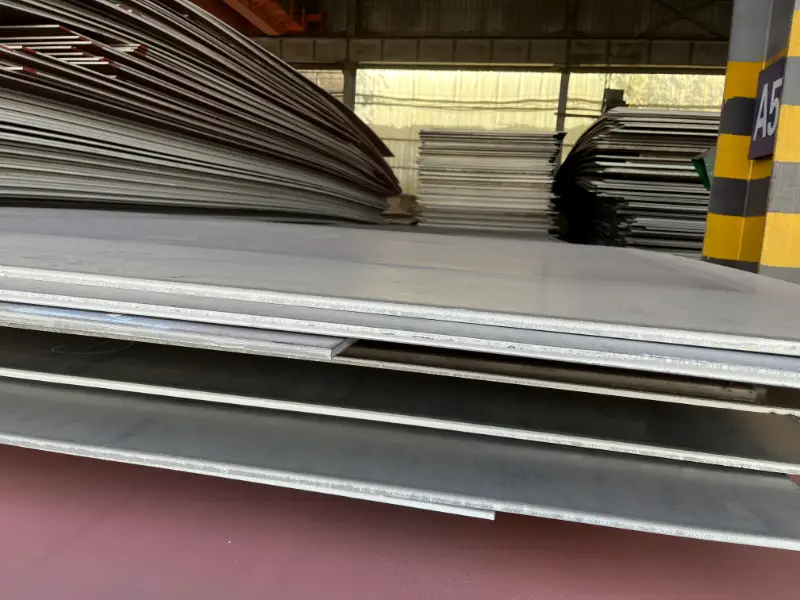
China GB/T 4171 Q295NH Weather Resistant Steel Plate
China GB/T 4171 Q295NH Weather Resistant Steel Plate - Composition, Properties & Equivalents
Complete data sheet for Q295NH weather resistant structural steel conforming to China GB/T 4171 standard. Find chemical composition, mechanical and physical properties, equivalent international grades, and application guidelines.
Hot rolling, cold forming, welding, bending, edge milling, thermal cutting
- Phone : +8618037372205
- Email : [email protected]
- WhatsApp: Contact via Whtsapp
- WeChat: +8618037372205
China GB/T 4171 Q295NH Weather Resistant Steel Plate Introduction
Q295NH is a high-strength low-alloy weather resistant structural steel defined in China GB/T 4171 standard. It is designed to form a stable, protective oxide layer when exposed to the atmosphere, which significantly reduces corrosion rates compared to ordinary carbon steels. This grade provides a minimum yield strength of 295 MPa and exhibits good weldability, formability, and impact toughness, especially at low temperatures. The alloying elements such as copper, chromium, and nickel contribute to its superior atmospheric corrosion resistance. Q295NH is widely used in outdoor structures that require both strength and durability without frequent painting, such as bridges, rail vehicles, containers, and architectural facades.
China GB/T 4171 Q295NH Weather Resistant Steel Plate Chemical Composition
The chemical composition of Q295NH is defined in GB/T 4171-2008. The alloying elements Cu, Cr, and Ni are added to improve atmospheric corrosion resistance. Micro-alloying elements V, Nb, and Ti may be present singly or in combination to refine grain structure and enhance strength. All values are max unless a range is stated.
| Chemical Element | Standard Value (wt%) | Remarks |
|---|---|---|
| Carbon (C) | ≤ 0.15 | Typical max content |
| Silicon (Si) | ≤ 0.50 | Typical max content |
| Manganese (Mn) | 0.50 – 1.00 | Increases strength and hardenability |
| Phosphorus (P) | ≤ 0.030 | Limited for brittleness avoidance |
| Sulfur (S) | ≤ 0.030 | Limited for toughness |
| Copper (Cu) | 0.25 – 0.55 | Primary corrosion resistance element |
| Chromium (Cr) | 0.40 – 0.80 | Enhances oxidation resistance |
| Nickel (Ni) | ≤ 0.65 | Adds toughness and corrosion resistance |
| Vanadium (V) | 0.02 – 0.10 | Optional micro-alloying element |
| Niobium (Nb) | 0.015 – 0.060 | Optional micro-alloying element |
| Titanium (Ti) | 0.02 – 0.10 | Optional micro-alloying element |
| Aluminum (Al) | ≥ 0.020 (total Al) | Grain refining, deoxidation |
| Nitrogen (N) | ≤ 0.012 | Typical max for fine grain steels |
China GB/T 4171 Q295NH Weather Resistant Steel Plate Thermal and Electrical Physical Properties
The physical property values provided are typical for low-alloy weather resistant steel. Actual values may vary slightly depending on the exact composition and processing conditions. These data are suitable for engineering design calculations.
| Property | Standard Requirement Value | Unit | Test Condition / Remarks |
|---|---|---|---|
| Density (ρ) | 7.85 | g/cm³ | At 20°C |
| Elastic modulus (E) | 200 | GPa | At 20°C, typical for steel |
| Shear modulus (G) | 77 | GPa | At 20°C, approximate |
| Poisson's ratio (ν) | 0.30 | — | Typical for structural steel |
| Thermal expansion coefficient (α) | 12.0×10⁻⁶ | K⁻¹ | 20 – 100°C |
| Thermal conductivity (λ) | 50 | W/(m·K) | At 20°C, typical |
| Specific heat capacity (c) | 470 | J/(kg·K) | At 20°C, typical |
| Electrical resistivity (ρₑ) | 0.16×10⁻⁶ | Ω·m | At 20°C, typical for low-alloy steel |
China GB/T 4171 Q295NH Weather Resistant Steel Plate Mechanical Properties
Mechanical properties are based on GB/T 4171-2008 and vary with product thickness. The table shows minimum yield strength (ReH), tensile strength (Rm) range, elongation (A) after fracture, and impact energy (KV2) at -20°C. Bending test requirements are also specified. All values apply to longitudinal test pieces.
| Property | Standard Requirement Value | Unit | Test Condition / Remarks |
|---|---|---|---|
| Yield Strength (ReH) | ≥ 295 | MPa | Thickness ≤ 16 mm |
| Yield Strength (ReH) | ≥ 285 | MPa | 16 < thickness ≤ 40 mm |
| Yield Strength (ReH) | ≥ 275 | MPa | 40 < thickness ≤ 60 mm |
| Yield Strength (ReH) | ≥ 255 | MPa | 60 < thickness ≤ 100 mm |
| Tensile Strength (Rm) | 430 – 560 | MPa | All thicknesses |
| Elongation after fracture (A) | ≥ 24 | % | Thickness ≤ 16 mm, gauge L₀ = 5.65√S₀ |
| Elongation after fracture (A) | ≥ 24 | % | 16 < thickness ≤ 40 mm |
| Elongation after fracture (A) | ≥ 23 | % | 40 < thickness ≤ 60 mm |
| Elongation after fracture (A) | ≥ 22 | % | 60 < thickness ≤ 100 mm |
| Impact energy (KV₂) | ≥ 34 | J | Longitudinal, test temperature -20°C |
| Bend test (d = bend mandrel diameter, a = specimen thickness) | d = 2a | — | Thickness ≤ 16 mm |
| Bend test | d = 3a | — | 16 < thickness ≤ 100 mm |
China GB/T 4171 Q295NH Weather Resistant Steel Plate Fully Equivalent Material Standards and Replaceable Grades
| Country / Region | Standard | Grade | Remarks |
|---|---|---|---|
| China | GB/T 4171 | Q295NH | Original grade |
| Europe | EN 10025-5 | S235J2W | Closest weathering steel by chemical approach, but lower strength (235 MPa yield) |
| USA | ASTM A588 / A588M | Grade A | Comparable weathering steel, min yield 50 ksi (345 MPa); strength slightly higher |
| Japan | JIS G3114 | SMA400AW | Weather resistant hot-rolled steel, min yield 245 MPa; often used as an alternative |
| International | ISO 4952 | Fe355W-1A | Atmospheric corrosion-resistant structural steel, min yield 355 MPa; higher strength |
China GB/T 4171 Q295NH Weather Resistant Steel Plate Application Introduction
Q295NH weather resistant steel is specifically suited for structures exposed to the atmosphere where painting or other protective coatings are not desired or are difficult to maintain. Its self-protecting patina provides long-term corrosion resistance in most non-marine atmospheric environments. The steel is readily weldable with conventional methods and can be formed into various shapes.
Product Applications: Weather-resistant steel plates for bridge girders, Pre-formed sections for architectural facades, Railway wagon side panels and underframes, Corrugated panels for modular containers, Tubular sections for transmission towers, Welded H-beams and I-beams for industrial buildings
Processed into products: Bridge main beams, crossbeams, and stiffeners, Container corner posts, rails, and roof bows, Railway car body bolsters and center sills, Architectural louvers and sunshade panels, Tower leg members, diagonal bracing, and gusset plates, Chimney shells and support rings, Welded structural nodes and base plates
Application industries: Bridge engineering, Railway vehicle manufacturing (freight wagons, passenger cars), Container fabrication (shipping and storage containers), Architectural cladding and structural frames, Transmission towers and wind turbine towers, Industrial chimneys and flue stacks, Mining and earth-moving equipment structures
China GB/T 4171 Q295NH Weather Resistant Steel Plate Near/Similar Substitute Material Recommendations
| Country / Region | Standard | Grade | Remarks |
|---|---|---|---|
| China | GB/T 4171 | Q235NH | Lower strength weather resistant structural steel (min yield 235 MPa); good weldability |
| China | GB/T 4171 | Q355NH | Higher strength weather resistant structural steel (min yield 355 MPa); for heavier sections |
| China | GB/T 4171 | Q295GNH | Similar strength but with higher atmospheric corrosion resistance (GN class); more demanding environments |
| Europe | EN 10025-5 | S355J2WP | Typical high-strength weathering steel, min yield 355 MPa; good for painted or unpainted structures |
| USA | ASTM A242 | Type 1 | High-strength low-alloy weathering steel, min yield 50 ksi (345 MPa); used in structural applications |
Notes:
Welding considerations: Low hydrogen welding processes are recommended. Preheat may be required for thick sections. The weathering steel patina formation requires alternate wet/dry cycles; for aesthetic uniformity, the surface should be blast cleaned before exposure. Availability: Typical supply in hot-rolled condition, cut to length or as coil. Edge preparation and surface inspection according to GB/T 4171. Testing: Impact test at -20°C is mandatory for NH grades; additional ultrasonic testing may be agreed upon.
- Share



