
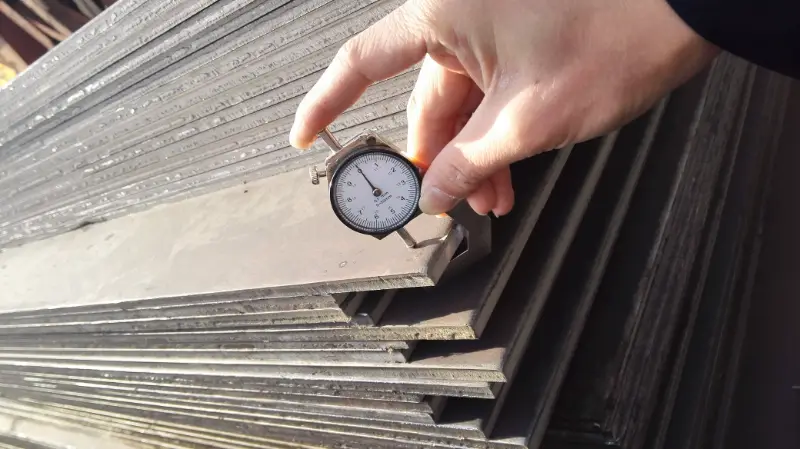
Q355NH Weather Resistant Steel Plate
Q355NH Weather Resistant Steel Plate: GB/T 4171 Analysis & Equivalents
Comprehensive technical data for Q355NH weather resistant structural steel plate per GB/T 4171, including chemical composition, mechanical properties, thermal and electrical physical properties, and full international cross-reference equivalents.
Hot rolling, controlled rolling, normalizing, welding, cutting, bending, drilling
- Phone : +8618037372205
- Email : [email protected]
- WhatsApp: Contact via Whtsapp
- WeChat: +8618037372205
Q355NH Weather Resistant Steel Plate Introduction
Q355NH is a weather resistant structural steel grade specified in the Chinese standard GB/T 4171. It is designed for atmospheric corrosion resistance by adding alloying elements such as Cu, Cr, and Ni, which form a dense, adherent rust layer that slows further corrosion.
- Minimum yield strength of 355 MPa for thickness up to 16 mm, with good tensile strength ranging from 490 to 630 MPa.
- Excellent weldability and toughness, available in various impact quality levels (B, C, D, E) for different service temperatures.
- Widely used in bridges, buildings, containers, and railway vehicles, often in unpainted conditions, reducing maintenance costs.
- Supplied in hot-rolled or normalized condition; the steel can be cut, bent, and welded with conventional methods.
The combination of strength and corrosion resistance makes it an economical choice for long-life structures exposed to the atmosphere.
Q355NH Weather Resistant Steel Plate Chemical Composition
The chemical composition of Q355NH according to GB/T 4171 ensures enhanced atmospheric corrosion resistance through controlled additions of Cu, Cr, and Ni. Optional microalloying elements (Nb, V, Ti) may be added for grain refinement and strength improvement. The limits are as follows:
| Element | Standard Value (wt%) | Remarks |
|---|---|---|
| C | ≤0.16 | Maximum carbon content for weldability |
| Si | ≤0.50 | Silicon range |
| Mn | 0.50 – 1.50 | Manganese provides strength and deoxidation |
| P | ≤0.025 | Phosphorus for enhanced corrosion resistance (controlled max) |
| S | ≤0.025 | Sulfur for machinability, kept low |
| Cu | 0.25 – 0.55 | Key element for weather resistance |
| Cr | 0.40 – 0.80 | Chromium improves rust layer adherence |
| Ni | ≤0.65 | Nickel enhances toughness and corrosion resistance |
| Nb | 0.015 – 0.060 (if added) | Optional grain refining element |
| V | 0.02 – 0.12 (if added) | Optional microalloy for strength |
| Ti | 0.02 – 0.10 (if added) | Optional grain refining element |
| Alt | ≥0.020 (if added) | Total aluminum for deoxidation when used |
| N | ≤0.012 (if required) | Nitrogen may be specified; normally controlled |
Q355NH Weather Resistant Steel Plate Thermal and Electrical Physical Properties
The following physical properties are typical for Q355NH type weather resistant structural steel at room temperature and are not part of normative requirements but serve as general guidance for design.
| Property | Typical Value | Unit | Test Condition / Remarks |
|---|---|---|---|
| Density (ρ) | 7.85 | g/cm³ | At 20 °C |
| Modulus of elasticity (E) | 210 | GPa | At 20 °C, longitudinal |
| Shear modulus (G) | 80 | GPa | At 20 °C, calculated from E and ν |
| Poisson's ratio (ν) | 0.3 | – | At room temperature |
| Thermal expansion coefficient (α) | 11.8 | ×10⁻⁶/K | Between 20 °C and 100 °C |
| Thermal conductivity (λ) | 50 | W/(m·K) | At 100 °C |
| Specific heat capacity (c) | 470 | J/(kg·K) | At 20 °C |
| Electrical resistivity (ρ_e) | ~0.18 | µΩ·m | At 20 °C |
Q355NH Weather Resistant Steel Plate Mechanical Properties
The mechanical properties of Q355NH per GB/T 4171 are thickness dependent. Tensile testing is performed on transverse specimens. Impact test values correspond to the quality grade. Below are the standard requirements for hot-rolled plates; impact requirements are typically verified at 0°C (Grade C) unless otherwise ordered. Bending is performed at 180° with specified mandrel diameters.
| Property | Standard Requirement | Unit | Test Condition |
|---|---|---|---|
| Yield Strength (ReL) | ≥355 | MPa | Thickness ≤ 16 mm |
| Yield Strength (ReL) | ≥345 | MPa | Thickness > 16 mm to ≤ 40 mm |
| Yield Strength (ReL) | ≥335 | MPa | Thickness > 40 mm to ≤ 63 mm |
| Yield Strength (ReL) | ≥325 | MPa | Thickness > 63 mm to ≤ 80 mm |
| Yield Strength (ReL) | ≥315 | MPa | Thickness > 80 mm to ≤ 100 mm |
| Tensile Strength (Rm) | 490 – 630 | MPa | Thickness ≤ 100 mm |
| Elongation after fracture (A) | ≥22 | % | Thickness ≤ 16 mm, gauge length 5.65√So |
| Elongation after fracture (A) | ≥22 | % | Thickness > 16 mm to ≤ 40 mm |
| Elongation after fracture (A) | ≥21 | % | Thickness > 40 mm to ≤ 63 mm |
| Elongation after fracture (A) | ≥20 | % | Thickness > 63 mm to ≤ 80 mm |
| Elongation after fracture (A) | ≥20 | % | Thickness > 80 mm to ≤ 100 mm |
| Bend test (180°) | d = 2a | – | Thickness ≤ 16 mm; no cracks on outer surface |
| Bend test (180°) | d = 3a | – | Thickness > 16 mm to ≤ 100 mm |
| Impact energy (KV2, long.) | ≥47 | J | At 0 °C, Charpy V-notch, typical Grade C requirement; other grades: B (+20°C ≥47J), D (-20°C ≥47J), E (-40°C ≥60J) available |
Q355NH Weather Resistant Steel Plate Full Equivalent Grade Standards and Substitutable Grades
| Country/Region | Standard | Grade | Remarks |
|---|---|---|---|
| China | GB/T 4171 | Q355NH | Original grade; base material of analysis |
| Europe | EN 10025-5 | S355J2W (1.8965) | Comparable weathering steel with minimum yield 355 MPa and impact at -20 °C; similar corrosion resistance. |
| USA | ASTM A588/A588M | Grade A | High-strength low-alloy weathering steel equivalent to Q355NH in strength and application. |
| Japan | JIS G3125 | SPA-H | Weather resistant steel for structural use; yield ≥355 MPa, tensile ≥490 MPa; widely used in Asia. |
| International | ISO 4952 | Fe355W | International weathering steel grade with similar mechanical properties and corrosion resistance. |
Q355NH Weather Resistant Steel Plate Application Introduction
Q355NH is ideal for structural applications where atmospheric corrosion resistance is crucial. Its ability to develop a protective rust layer allows it to be used in the bare (unpainted) condition, which reduces maintenance. Typical application includes:
Product Applications: Weather-resistant structural plates and sections, Welded H-beams, box girders for bridges, Container panels (corrugated and flat), Railway wagon bodies and frames, Industrial chimneys and exhaust stacks, Sculptures and landscape structures
Processed into products: Bridge main girders, cross beams, and splice plates, Container corner castings, side panels, and roof sheets, Railway underframes and body side sheets, Welded structural connections and bracket plates, Tubular towers and masts
Application industries: Bridge construction and civil engineering, Architecture and building facades, Railway vehicles and rolling stock, Container manufacturing (shipping and storage), Power generation (cooling towers, flue gas ducts), Port machinery and offshore structures
Q355NH Weather Resistant Steel Plate Similar or Alternative Weathering Steel Grades
| Country/Region | Standard | Grade | Remarks |
|---|---|---|---|
| China | GB/T 4171 | Q345NH | Slightly lower yield strength (345 MPa); similar corrosion resistance, suitable when lower strength permitted. |
| China | GB/T 4171 | Q355GNH | High-phosphorus weathering steel with increased atmospheric corrosion resistance; yield 355 MPa. |
| China | GB/T 4171 | Q420NH | Higher strength grade (420 MPa yield) for weight reduction; similar weathering properties. |
| Europe | EN 10025-5 | S355J0WP | Weathering steel with phosphorus addition for enhanced rust layer; yield 355 MPa, impact 0 °C min 27J. |
| USA | ASTM A588/A588M | Grade B | Close alternative to Grade A with minor chemistry variation; tensile strength similar, may be substituted in many designs. |
Notes:
Special considerations: Q355NH weathering steel forms a dense patina when exposed to alternating wet/dry cycles. In design, a corrosion allowance (typically 1–2 mm) is added to the thickness for exposed conditions. Painting may be applied in severe marine or humid environments. Welding should use matching consumables (e.g., AWS E7018-W or equivalents) to preserve corrosion resistance. For thickness above 100 mm, properties may deviate; consult the mill for tailored data. Delivery conditions and impact test requirements must be clearly specified in the order.
- Share



