
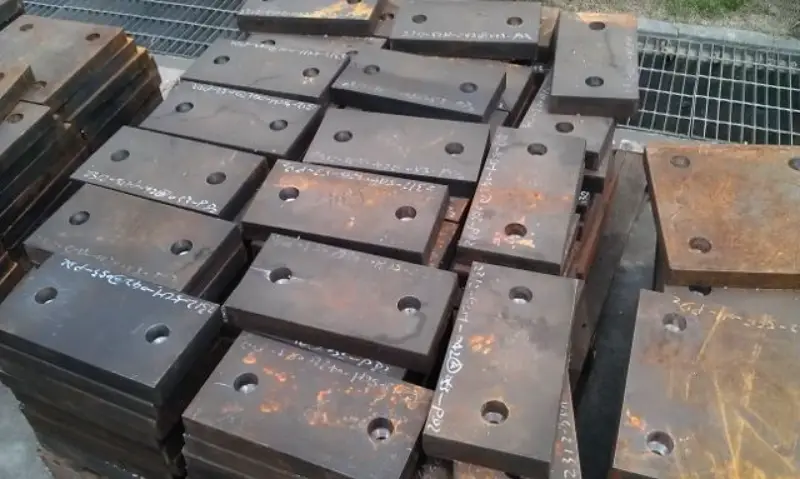
EN 10225 S420G2+QT Offshore Steel
EN 10225 S420G2+QT Offshore Steel: High-Strength Structural Plate for Harsh Marine Environments
Comprehensive material data and properties for EN 10225 Grade S420G2+QT offshore structural steel, including chemical composition, mechanical properties, and physical performance. Ideal for engineers specifying materials for fixed offshore structures.
Hot rolling, Quenching and Tempering, Welding, Cold forming, Cutting, Machining
- Phone : +8618037372205
- Email : [email protected]
- WhatsApp: Contact via Whtsapp
- WeChat: +8618037372205
EN 10225 S420G2+QT Offshore Steel Introduction
EN 10225 Grade S420G2+QT is a weldable structural steel specifically developed for fixed offshore structures. This grade is supplied in the quenched and tempered (+QT) condition, ensuring a minimum yield strength of 420 MPa for enhanced structural integrity.
Key characteristics include:
- High Strength: Excellent yield and tensile strength, reducing structural weight while maintaining load-bearing capacity.
- Superior Toughness: Guaranteed impact properties at low temperatures (down to -40°C), essential for resisting brittle fracture in cold marine environments.
- Through-Thickness Properties: Improved through-thickness ductility to resist lamellar tearing, crucial for welded joints under high restraint.
- Excellent Weldability: Low carbon equivalent (CEV) design for efficient and safe fabrication without excessive preheating.
Designed for the most demanding offshore applications, such as jacket legs, topside modules, and node cans, this steel provides a reliable and cost-effective solution for long-term service life.
EN 10225 S420G2+QT Offshore Steel Chemical Composition
The chemical composition of S420G2+QT is precisely controlled to achieve high strength, excellent toughness, and superior weldability. Maximum limits are specified for elements like Carbon, Sulphur, and Phosphorus to ensure ductility and cleanliness, while micro-alloying elements like Niobium, Vanadium, and Titanium contribute to grain refinement and precipitation strengthening.
| Chemical Element | Typical Value (max %) | Remarks |
|---|---|---|
| Carbon (C) | 0.12 | For thicknesses ≤ 40mm |
| Carbon (C) | 0.14 | For thicknesses > 40mm |
| Silicon (Si) | 0.15 - 0.55 | |
| Manganese (Mn) | 1.00 - 1.60 | |
| Phosphorus (P) | 0.020 | Max value |
| Sulphur (S) | 0.007 | Max value for through-thickness properties |
| Chromium (Cr) | 0.25 | Max value |
| Nickel (Ni) | 0.70 | Max value |
| Molybdenum (Mo) | 0.25 | Max value |
| Copper (Cu) | 0.30 | Max value |
| Aluminium (Al) total | 0.020 - 0.060 | Grain refining |
| Niobium (Nb) | 0.04 | Max value |
| Vanadium (V) | 0.08 | Max value |
| Titanium (Ti) | 0.025 | Max value |
| Nitrogen (N) | 0.010 | Max value |
| Carbon Equivalent Value (CEV) | 0.43 - 0.45 | Depending on thickness |
EN 10225 S420G2+QT Offshore Steel Thermal and Electrical Physical Properties
Physical properties of S420G2+QT are fundamental for engineering design, including structural analysis under thermal loads and weight estimation. These properties are typical for high-strength low-alloy steel at room temperature.
| Property | Typical Value | Unit | Testing Condition |
|---|---|---|---|
| Density (ρ) | 7850 | kg/m³ | At 20°C |
| Modulus of Elasticity (E) | 210 | GPa | At 20°C |
| Shear Modulus (G) | 81 | GPa | At 20°C |
| Poisson's Ratio (ν) | 0.3 | - | At 20°C |
| Linear Thermal Expansion Coefficient (α) | 11.7 x 10⁻⁶ | /K | Between 20°C and 100°C |
| Linear Thermal Expansion Coefficient (α) | 12.5 x 10⁻⁶ | /K | Between 20°C and 200°C |
| Linear Thermal Expansion Coefficient (α) | 13.2 x 10⁻⁶ | /K | Between 20°C and 300°C |
| Thermal Conductivity (λ) | 42 | W/(m·K) | At 20°C |
| Thermal Conductivity (λ) | 40 | W/(m·K) | At 200°C |
| Specific Heat Capacity | 460 | J/(kg·K) | At 20°C |
| Specific Heat Capacity | 500 | J/(kg·K) | At 200°C |
| Electrical Resistivity (ρ_e) | 0.20 - 0.25 | Ω·mm²/m | At 20°C |
EN 10225 S420G2+QT Offshore Steel Mechanical Properties
The quenching and tempering process ensures S420G2+QT achieves high strength combined with exceptional toughness at sub-zero temperatures. Values are specified for transverse test pieces, which is critical for plate products. Impact testing verifies resistance to brittle fracture at the design reference temperature.
| Property | Specified Value | Unit | Testing Condition |
|---|---|---|---|
| Minimum Yield Strength (ReH) | 420 | MPa | Thickness ≤ 40mm, Transverse |
| Minimum Yield Strength (ReH) | 400 | MPa | Thickness > 40mm to 63mm, Transverse |
| Minimum Yield Strength (ReH) | 390 | MPa | Thickness > 63mm to 80mm, Transverse |
| Minimum Yield Strength (ReH) | 380 | MPa | Thickness > 80mm to 100mm, Transverse |
| Tensile Strength (Rm) | 500 - 660 | MPa | Thickness ≤ 40mm, Transverse |
| Tensile Strength (Rm) | 480 - 640 | MPa | Thickness > 40mm to 80mm, Transverse |
| Tensile Strength (Rm) | 470 - 630 | MPa | Thickness > 80mm to 100mm, Transverse |
| Minimum Elongation after fracture (A) | 19 | % | Gauge length 5.65√S0, Transverse |
| Minimum Impact Energy (KV) | 50 | J | Test at -40°C, Transverse, Full Size (10x10mm) |
| Minimum Impact Energy (KV) | 33 | J | Test at -40°C, Transverse, Sub-Size (7.5x10mm) |
| Minimum Through-Thickness Reduction of Area (Z) | 35 | % | Average of 3 tests, Class Z35 |
EN 10225 S420G2+QT Offshore Steel Exact Equivalent Material Standards and Replaceable Grade Recommendations
| Country/Region | Standard | Grade | Remarks |
|---|---|---|---|
| United Kingdom | BS 7191 | 420EM | Identical origin standard, with the same chemical and mechanical requirements. |
| Norway | NORSOK M-120 | Y42 | Norwegian offshore standard, designation Y42 corresponds to a 420 MPa yield strength G2 quality steel. |
| France | NF A36-212 | E420FP | French standard for offshore structural steels, technically equivalent. |
| Germany | DIN EN 10225 | S420G2+QT | As an EN standard adopted by DIN, the designation is directly identical. |
| USA | API RP 2W | Grade 50 | API specification for steel plates for offshore structures. Similar in strength but S420G2+QT has more stringent toughness and Z-quality requirements typical for North Sea applications. |
EN 10225 S420G2+QT Offshore Steel Application Introduction
S420G2+QT steel is the backbone of modern offshore engineering. Its combination of high strength, excellent low-temperature toughness, and guaranteed through-thickness properties makes it the primary choice for safety-critical and highly stressed components in harsh environments. Proper welding procedures and strict adherence to fabrication guidelines are essential to maintain its designed properties.
Product Applications: Fixed Offshore Platforms (Jackets) and Compliant Towers, Topsides and Module Support Frames (MSFs), Floating Production, Storage and Offloading (FPSO) Vessel Hulls, Offshore Substations and Converter Platforms for Wind Farms
Processed into products: Tubular joints and node cans, Jacket legs, bracings, and piles, Deck plating and girder webs, Crane pedestals and flare boom supports, Transition pieces for monopile foundations, Ice-resistant structural belts for arctic applications
Application industries: Offshore Oil & Gas Exploration and Production, Offshore Wind Energy (foundations, transition pieces), Shipbuilding (specialized vessels, heavy-lift cranes), Civil Engineering (bridges, high-rise buildings in seismic areas)
EN 10225 S420G2+QT Offshore Steel Similar and Alternative Material Recommendations
| Country/Region | Standard | Grade | Remarks |
|---|---|---|---|
| European Union | EN 10025-6 | S460QL, S460QL1 | A structural steel with higher 460 MPa yield strength. Suitable for weight reduction but has different weldability and design rules. Not specific to offshore applications and lacks mandatory through-thickness properties unless Z-grade is specified separately. |
| European Union | EN 10025-4 | S420ML | Thermomechanical rolled steel with 420 MPa yield strength. A lighter-weight, cost-effective alternative for less critical applications where the superior toughness of QT steel is not mandatory. |
| European Union | EN 10225 | S420G1+M | A thermomechanical rolled (+M) variant within the same offshore standard. Similar strength but with generally lower toughness compared to G2+QT, making it suitable for secondary structural members in warmer waters. |
| USA | ASTM A572/A572M | Grade 60 [415] | A common high-strength low-alloy structural steel. Yield strength is approximately 415 MPa. It is a non-offshore grade, lacking the guaranteed low-temperature toughness and Z-quality essential for critical welded joints. |
Notes:
Welding and Fabrication: The low carbon equivalent (CEV) of S420G2+QT allows for excellent weldability. However, a welding procedure specification (WPS) must be qualified according to a recognized standard like EN ISO 15614-1. Heat input, preheat/interpass temperature, and the selection of low-hydrogen consumables are critical to avoid hydrogen-induced cold cracking and to maintain toughness in the heat-affected zone (HAZ).
Certification: This steel is typically delivered with an EN 10204 Type 3.2 inspection certificate, signed by both the manufacturer and an independent third-party inspection authority, verifying compliance with the specified requirements for chemical composition, mechanical properties, and non-destructive testing.
- Share



