
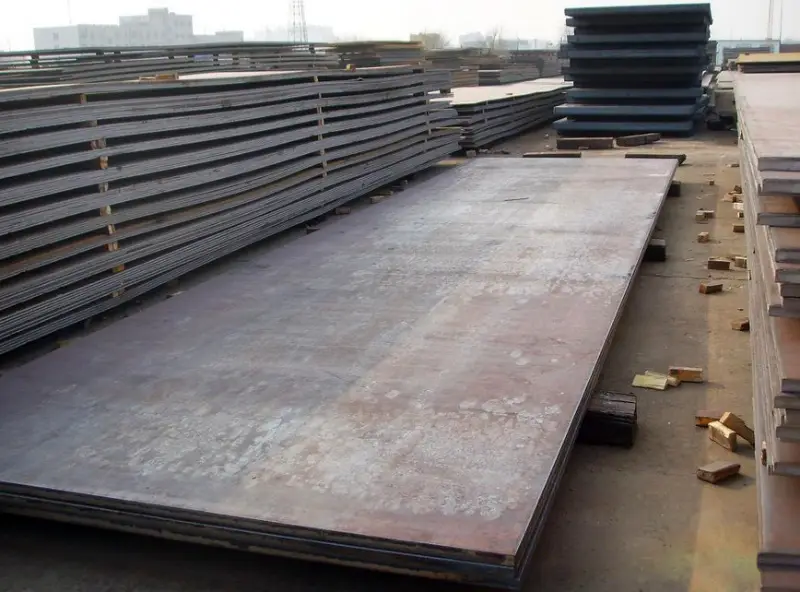
EN10225 S460G1+M Offshore Steel Plate
EN10225 S460G1+M Offshore Steel Plate - High Strength Structural Steel with Z25 Through-Thickness Properties
Comprehensive material data for EN10225 Grade S460G1+M offshore platform steel plate, including chemical composition, mechanical properties, physical properties, and international equivalents.
Thermomechanical rolling (+M); suitable for welding, cutting, and cold forming with restrictions due to high strength.
- Phone : +8618037372205
- Email : [email protected]
- WhatsApp: Contact via Whtsapp
- WeChat: +8618037372205
EN10225 S460G1+M Offshore Steel Plate Introduction
S460G1+M is a thermomechanically rolled weldable structural steel conforming to EN 10225, developed specifically for fixed offshore structures operating in harsh marine environments. The grade designation indicates a minimum yield strength of 460 MPa (S460), improved through-thickness properties with a guaranteed reduction of area of at least 25% (G1 corresponds to Z25 quality), and delivery in the thermomechanically rolled condition (+M). The steel provides an excellent combination of high strength, low-temperature toughness (typically tested at -40°C), and superior resistance to lamellar tearing, making it suitable for critical structural components such as heavy plates, node joints, and braces in offshore platforms and wind turbine foundations. Its controlled chemical composition and fine grain structure ensure reliable weldability and fatigue performance under dynamic loads.
EN10225 S460G1+M Offshore Steel Plate Chemical Composition
The chemical composition of S460G1+M is tightly controlled to achieve the required mechanical properties and weldability. Maximum limits are specified for carbon, phosphorus, and sulfur to ensure good toughness and avoid embrittlement. Microalloying elements such as niobium, vanadium, and titanium are used for grain refinement and precipitation strengthening. The carbon equivalent value (CEV) is limited to guarantee satisfactory weldability without preheating under controlled conditions. The aluminium total content is maintained to ensure fine grain structure through aluminium nitride formation.
| Chemical Element | Standard Value (max % unless range) | Remarks |
|---|---|---|
| C | ≤0.14 | Carbon |
| Si | ≤0.55 | Silicon |
| Mn | ≤1.70 | Manganese |
| P | ≤0.020 | Phosphorus |
| S | ≤0.010 | Sulphur |
| N | ≤0.015 | Nitrogen |
| Al total | ≥0.015 (min) | Aluminium, for grain refinement |
| Nb | ≤0.06 | Niobium |
| V | ≤0.10 | Vanadium |
| Ti | ≤0.05 | Titanium |
| Cr | ≤0.30 | Chromium |
| Ni | ≤0.75 | Nickel |
| Mo | ≤0.30 | Molybdenum |
| Cu | ≤0.50 | Copper |
| CEV | ≤0.45 | Carbon Equivalent Value, CEV = C+Mn/6+(Cr+Mo+V)/5+(Ni+Cu)/15 |
EN10225 S460G1+M Offshore Steel Plate Thermal and Electrical Physical Properties
The physical properties below are typical for generic carbon-manganese structural steels with a density near 7850 kg/m³ and are not explicitly mandated by EN 10225. They serve as engineering references for design calculations involving thermal expansion, heat transfer, and electrical resistance. Actual values may vary slightly with exact composition and processing. For precise design, consult the steel manufacturer's specific data sheet.
| Property | Typical Value | Unit | Test Condition / Remarks |
|---|---|---|---|
| Density (ρ) | 7850 | kg/m³ | At 20°C |
| Young's Modulus (E) | 210 | GPa | At room temperature |
| Shear Modulus (G) | 81 | GPa | At room temperature |
| Poisson's Ratio (ν) | 0.3 | — | Elastic range |
| Thermal Expansion Coefficient (α) | 12.0 | 10⁻⁶/K | Between 20°C and 100°C |
| Thermal Conductivity (λ) | 50 | W/(m·K) | At 20°C |
| Specific Heat Capacity (cp) | 460 | J/(kg·K) | At 20°C |
| Electrical Resistivity (ρe) | 0.20 – 0.25 | 10⁻⁶ Ω·m | At 20°C |
EN10225 S460G1+M Offshore Steel Plate Mechanical Properties
The mechanical properties of S460G1+M are specified for different thickness ranges. The yield strength decreases with increasing plate thickness. Tensile strength remains within a fixed range, and elongation requirements guarantee sufficient ductility. Impact tests at -40°C demonstrate high toughness for cryogenic service conditions. The bending test confirms the steel's ability to undergo plastic deformation without cracking. All values are according to EN 10225:2009 and verified by the manufacturer's inspection documents.
| Property | Standard Requirement Value | Unit | Test Condition |
|---|---|---|---|
| Yield Strength ReH | 460 | MPa | Thickness ≤ 16 mm |
| Yield Strength ReH | 440 | MPa | 16 < thickness ≤ 25 mm |
| Yield Strength ReH | 430 | MPa | 25 < thickness ≤ 40 mm |
| Yield Strength ReH | 410 | MPa | 40 < thickness ≤ 63 mm |
| Yield Strength ReH | 390 | MPa | 63 < thickness ≤ 80 mm |
| Yield Strength ReH | 380 | MPa | 80 < thickness ≤ 100 mm |
| Tensile Strength Rm | 550 – 720 | MPa | All thicknesses up to 100 mm |
| Elongation A (L0=5.65√So) | 17 | % | Thickness ≤ 100 mm, transverse |
| Impact Energy KV | ≥ 50 (longitudinal) / ≥ 30 (transverse) (average of 3 specimens, min individual 70% of average) | J | At -40°C, Charpy V-notch |
| Bend Test (mandrel diameter) | 3t | — | Thickness ≤ 16 mm, transverse |
| Bend Test (mandrel diameter) | 4t | — | 16 < thickness ≤ 63 mm, transverse |
| Bend Test (mandrel diameter) | 5t | — | 63 < thickness ≤ 100 mm, transverse |
EN10225 S460G1+M Offshore Steel Plate Fully Equivalent Material Standards and Substitutable Grades
| Country / Region | Standard | Grade / Designation | Remarks |
|---|---|---|---|
| Europe | EN 10225 | S460G1+M | Base specification; includes through-thickness Z25 and +M delivery condition. |
| International (USA/API) | API 2W | Grade 60 with supplementary requirement S5 (Z25) and CVN at -40°C | Not a direct match; requires ordering with additional specifications to approximate EN 10225 S460G1+M properties. Verify chemical limits and testing. |
| Norway | NORSOK M-120 (Ed. 7) | Y46 with through-thickness properties Z25 | Norwegian offshore standard; Y46 has similar strength but different chemical composition constraints. Must be carefully compared. |
EN10225 S460G1+M Offshore Steel Plate Application Introduction
S460G1+M is purpose-designed for heavy structural components in offshore and marine engineering where a combination of high strength, low-temperature toughness, and through-thickness ductility is mandatory. Its use is critical in regions susceptible to lamellar tearing under high restraint welding conditions. Typical applications include the fabrication of primary load-bearing members and node connections in jacket structures and the transition pieces of offshore wind turbines.
Product Applications: Fixed offshore platforms (jackets, topsides), Offshore wind turbine foundations (monopile transition pieces, jacket nodes), Subsea structural frames and manifolds, Heavy-lift crane pedestals, Mooring structural components
Processed into products: Heavy plates for main structural beams and columns, Node blocks and welded tubular joints, Reinforcement plates and stiffeners, Brackets and gusset plates in high-stress zones, Flanges for bolted connections, Structural elements in leg chords of jack-up rigs
Application industries: Offshore oil and gas extraction, Offshore wind energy generation, Marine civil engineering (harbours, sea walls), Shipbuilding (specialised heavy structural parts), Bridge construction in aggressive environments
EN10225 S460G1+M Offshore Steel Plate Similar or Alternative Material Recommendations
| Country / Region | Standard | Grade / Designation | Remarks |
|---|---|---|---|
| Europe | EN 10025-4 | S460M | Thermomechanically rolled fine-grain structural steel without guaranteed through-thickness properties. Not suitable for Z-quality applications. |
| Europe | EN 10025-4 | S460ML | Low-temperature variant (-50°C impact test), but lacks through-thickness property guarantee. |
| Europe | EN 10025-6 | S460Q | Quenched and tempered steel with different delivery condition; lower toughness may require careful welding control. |
| Europe | EN 10225 | S460G2+M | Same standard with higher through-thickness reduction (Z35) for more demanding lamellar tearing resistance. |
| USA | ASTM A572/A572M | Grade 65 [450] | High-strength low-alloy structural steel; not offshore-certified and no through-thickness test unless specially ordered. Use with caution in marine environments. |
| USA | ASTM A913/A913M | Grade 65 | High-strength low-alloy structural steel with improved toughness; no default Z-quality, not offshore-specific. |
Notes:
Additional requirements typically apply: through-thickness tensile testing according to EN 10164 (Z25), ultrasonic testing per EN 10160 or equivalent, and Charpy V-notch impact test at -40°C as part of the certification. Welding procedures must be qualified in accordance with EN 10225 or project specifications to avoid cold cracking and ensure toughness in the heat-affected zone. The steel may be supplied with an inspection certificate 3.1 or 3.2 per EN 10204. For thickness > 100 mm, mechanical properties and chemical limits may deviate; consult the mill for tailored data.
- Share



